A river inside a protein: how an enzyme routes information to its workplace
An enzyme is like a crowded train station, where thousands of passenger atoms jostle, bump into each other and pass along invisible messages. Somewhere deep inside the building sits the ticket window, the catalytic site, where the main chemical reaction happens. For that window to work, it needs news of what is going on out on the far platforms. How does that news reach it through the crowd?
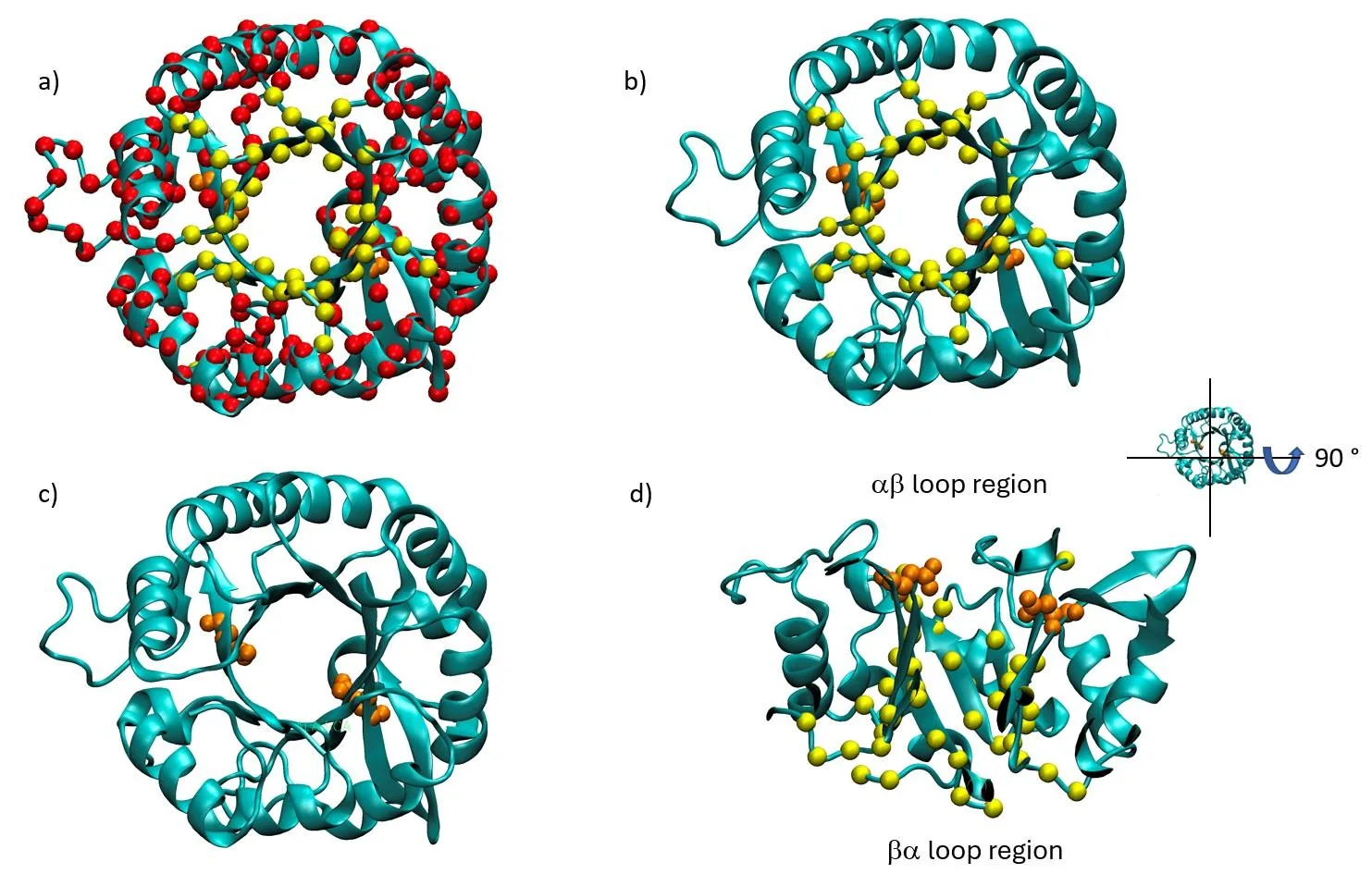
A team of researchers traced this route in seven different enzymes. They reduced each protein to a network of springs connecting its alpha-carbon atoms, then measured how vibrations in one region propagate to its neighbors. It turned out that disorder, or entropy, flows from the outskirts of the molecule toward its core. The amino acids at the edges happily share their bustle, while those sitting next to the workplace give almost nothing away. It is as if passengers on the distant platforms were loudly discussing the news, while right at the ticket window everything fell silent so the clerk could concentrate.
The most surprising discovery: the same route shows up even if you never watch the motion at all. All you have to do is draw a map of contacts between amino acids, who touches whom in space, and work out which nodes of that network are the most "informative." Nodes on the periphery turn out to be the best sources, nodes near the center the worst. Two completely different approaches, dynamic and topological, produced the same picture. So the direction of the information flow is written into the protein's very shape, the way a river's course is written into the lay of the land.
In the past, understanding how an enzyme passes a signal from one place to another meant running long computer simulations of every atom's motion. Now you can simply build a contact graph and compute the information centrality of its nodes. That takes seconds instead of hours. This kind of fast screening will be useful in drug development, for compounds that act not on the active site but on distant regulatory regions of a protein.
Let's return to our train station. It turned out that the crowd of passengers is arranged so that news from the far platforms always reaches the ticket window, even if nobody carries it there on purpose. The maze of walls and passageways itself steers the human hum toward the right point. An enzyme does the same thing, and its architecture is a ready-made blueprint for communication.
TIM-Barrel is one of the most common protein folds in nature: it appears in at least 15 different enzyme families, from bacteria to humans.