46 ways to calculate risk express
Geneticists read DNA like a long list of letters. From it, they compute a "polygenic risk score" — a number that shows how much higher or lower a person's chance of getting a disease, like diabetes, is compared to average. There are dozens of such risk calculation methods now, and each does it differently: one looks at a thousand letters, another at a million, a third requires a powerful computer, and a fourth crashes halfway through the data.
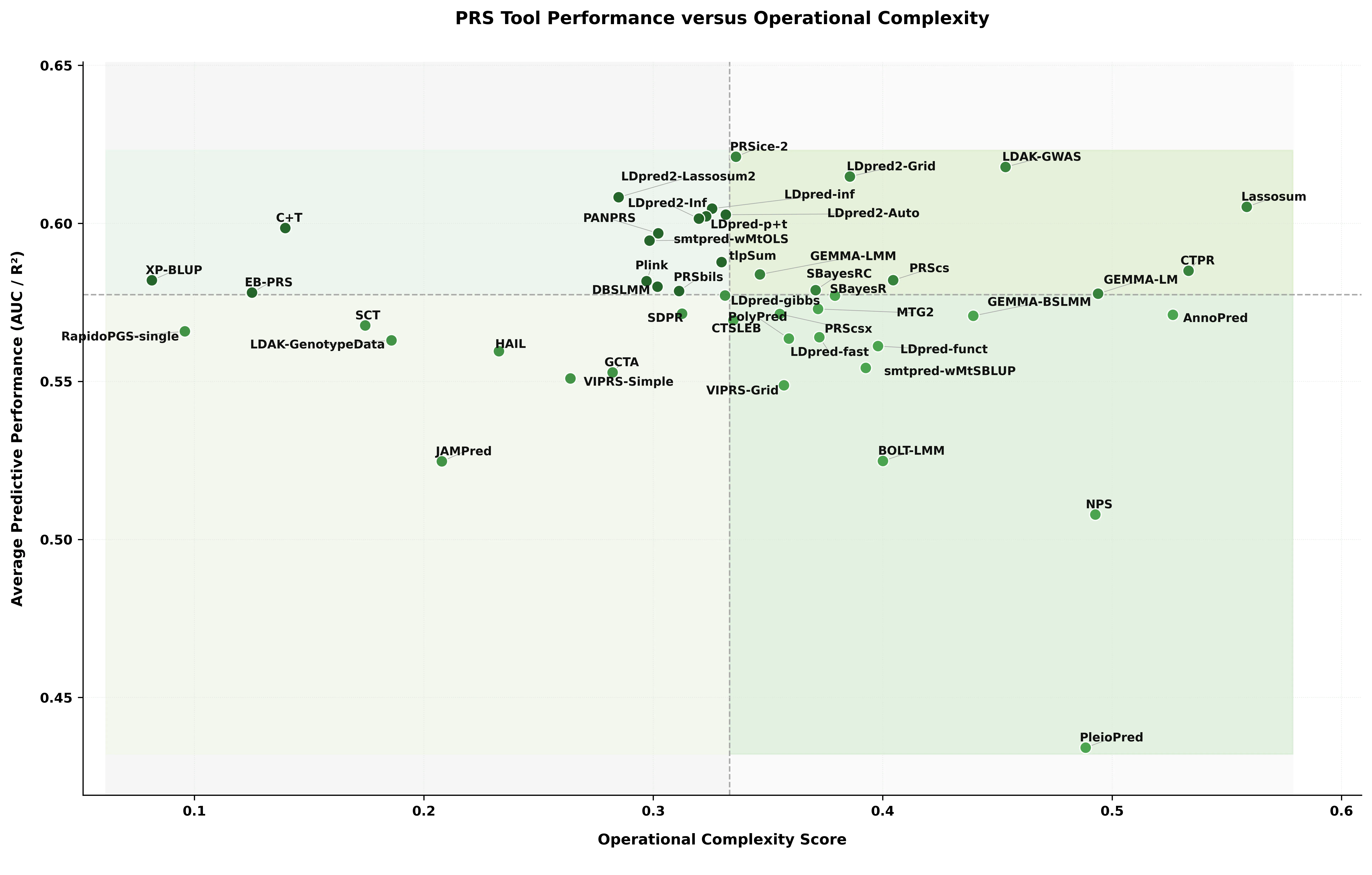
The authors gathered 46 such tools and gave them a fair exam. They took data from the UK Biobank, which stores DNA samples and medical records of hundreds of thousands of people. Each tool had to predict seven diseases and one common trait (like height). They tested in three scenarios: with no additional data, with only DNA, and with age, sex, and other information included. It turned out there is no universal winner: one tool is good for diabetes, another for asthma, and a third is the fastest but slightly less accurate.
The practical takeaway is simple: choosing a tool is not just about math. You need to consider how much data you have, how powerful your computer is, and whether the program can avoid crashing mid-calculation. The authors made their framework open so that any researcher can repeat the comparison on their own data and avoid the same pitfalls.
One of the tools in the test could use 100 times more memory than another, while achieving nearly the same prediction accuracy.