Scientist

Chien-Shiung Wu

1912–1997 · Nuclear physics, experimental physics, elementary particle physics
Chinese-American experimental physicist who conducted the famous experiment that disproved the law of parity conservation in weak interactions. This discovery changed the understanding of fundamental symmetry in nature.

Biography

Born in 1912 in Shanghai, China. She studied at National Central University, then in the USA, where she received her PhD from the University of California, Berkeley in 1940. She worked at Columbia University, later at Princeton and Columbia. In 1956, at the suggestion of Tsung-Dao Lee and Yang, she conducted an experiment with beta decay of cobalt-60, which showed parity violation. Although the Nobel Prize was awarded only to Lee and Yang, Wu received numerous awards, including the Comstock Prize and the National Medal of Science.

Key discoveries

💡 Chien-Shiung Wu was called the 'First Lady of Physics' and the 'Queen of Atomic Decay'. Her experiment was so elegant that one colleague said: 'She turned a question about the Universe into a tiny piece of cobalt and cooled it almost to absolute zero to get the answer.' Throughout her life, she fought against gender prejudice in science.
"She considered the moment when a hypothesis is confirmed by experiment as exciting, but found it even more amazing when an experiment disproves what everyone believed."
Concepts
neutrinoquantum measurementStandard Model
Laws
CPT theorem
Scientists
John Stewart BellEmilio Gino SegrèPaul DiracPeter HiggsSerge HarocheDavid BohmCharles BennettJohn von Neumann

Related articles

Dusty Seasons over La Palma: Thirty Years of Observations
Every clear night, a telescope on the island of La Palma looked at the sky and recorded how much the air dimmed starlight. This was routine work for astronomers measuring stellar positions. But in these records, like in an old diary, traces of a different story remained: the arrivals of dust from the Sahara.
Maximum Quantum Entanglement: Hidden Symmetry and the Mirror Universe
In the silent heart of creation, where particles converge and part, an act of pure harmony is born. Two Higgs bosons meet and for a fleeting moment form a single whole — and if one demands that their quantum entanglement always reaches its limit, like a tuning fork setting a perfect pitch, then the equations suddenly light up with a new symmetry.
HEP Phenomenology2025-06-131 minarXiv:2506.11806express
Particle Masses: A Simple Rule from the Depths of Physics
In the boiling broth of the newborn Universe, all particles lost their distinctions, like vegetables at hellish temperatures. Recovering that simple recipe is the goal of modern physics. The SO(10) theory — an extension of the Standard Model — offers such a recipe. It unifies all forces and links the masses of any particles with a single formula.
A Dark Dimension in the Tritium Spectrum: How KATRIN Searches for a Fifth Dimension
An electron flies out of a tritium nucleus with an energy of 18.57 keV, leaving behind an invisible partner: a neutrino. If that neutrino has access to a fifth dimension, its mass splits into a whole tower of states, and each one takes its own bite out of the spectrum.
Exoplanets2025-11-011 minarXiv:2511.00525express
How to Find Life: Look for Molecular Diversity
The chemical composition of a sample is like a soundscape. A living forest sounds polyphonic: chirping, rustles, the hum of insects. A barren desert is just the whistle of the wind.
Quantum Physics2025-11-271 minarXiv:2511.22450express
Exoplanets2025-11-281 minarXiv:2511.23163express
Dust Storms on a Rogue Planet
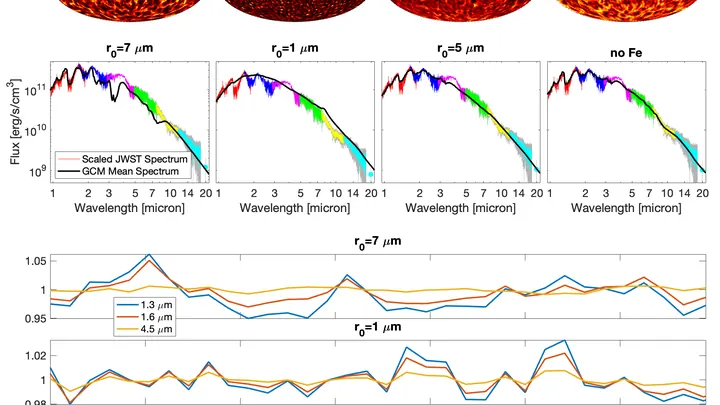
Far beyond the Solar System, a world called VHS 1256B wanders — a giant planet without a star. For a long time, astronomers couldn’t figure out why its brightness jumped by nearly 40% in just a few days. The answer came with the James Webb telescope: it turns out, colossal storms of silicate dust engulf the entire planet.
HEP Theory2025-11-282 minarXiv:2511.23447express
Klein Bottle Topology and the Origin of Baryon Asymmetry
In the familiar world, we have three spatial dimensions. However, theoretical physics allows for additional, hidden directions — compactified, that is, curled up to microscopic sizes.
Exoplanets2025-12-261 minarXiv:2512.22375express
The Moon Assembled from a Swarm of Earth's Fragments
When countless asteroids pummeled the young Earth, they tore chunks from its mantle. These fragments spiraled in a cosmic disk around the planet and, like a snowball in a blizzard, fused into the Moon.
Nuclear Experiment2026-01-011 minarXiv:2601.00248express
Weighing a Ghost: The Hunt for the Neutrino's Mass
Inside a giant spectrometer in Karlsruhe, shaped like a huge metal barrel, scientists are catching particles that are nearly impossible to catch. Neutrinos are the ghosts of the microcosm: every second, trillions of these particles fly through your body, and you don't even notice. But they do have mass, and scientists want to measure it.
Chemical Physics2026-01-031 minarXiv:2601.01135express
Ion Transistor in a Nanopore
In a narrow slit between two plates, ions don't behave like free particles but like a crowd in a packed bus: pressed tightly together, they form dense clusters. This very property, the ability of ions to bunch up in extremely confined spaces, underpins a new mechanism for controlling ion transport. Researchers studied ion behavior in two-dimensional nanochannels just a few atoms wide.
High Energy2026-01-042 minarXiv:2601.01533express
Neutrinos: Born in Black Hole Coronas
At the center of many galaxies lurks a black hole — an object predicted by solutions to the equations of Karl Schwarzschild. Around it stretches a scorching corona — a region of tenuous plasma heated to billions of degrees.
HEP Lattice2026-01-062 minarXiv:2601.02676express
How to Pin Down the Uncatchable
Neutrinos are the most elusive of all known particles. Every second, trillions of neutrinos from the Sun fly through your body, but you never notice: they barely interact with matter. To catch even one, physicists build giant detectors — pools of water or liquid argon deep underground.
Galaxies2026-01-062 minarXiv:2601.02724express
The Milky Way's Dust Settles into Two Layers
Dust in space is not just grime: it's the raw material for future stars and planets. But how it is distributed in our galaxy has long been a puzzle: dust is hard to measure directly, and it blocks the light of distant stars. Now astronomers have peered through this veil using data on five million stars: their brightness, color, and precise positions in the sky.
Neutrons from Water: What the Detectors Saw
Heavy water (the kind where ordinary hydrogen is replaced by its beefier cousin, deuterium) was subjected to an electric current. Palladium settled on the cathode, and in this modest electrochemical bath, detectors repeatedly caught something unexpected: traces of slow neutrons.
Cosmology2026-01-071 minarXiv:2601.04312express
Neutrino Decay Reconciles Two Worlds
In the thirties, Pauli realized: without tiny ghost-like particles, the energy of stars doesn't add up. Thus neutrinos were born — intangible wanderers that permeate everything.
Quiet Silicon for Ghost Hunting
Deep inside an underground laboratory, a room-sized detector waits for an event that might happen once in a hundred million billion years. That event is neutrinoless double beta decay — a process that would break one of physics' fundamental laws. To catch it, you need perfect silence: not a single stray radioactive atom in the detector's materials.
Galaxies2026-01-091 minarXiv:2601.06270express
Dust Grains in Space: Why They Hum Differently Than Expected
Cosmic dust isn't dirt: it's tiny grains, like soot from a campfire, scattered between the stars. Some of them spin at breakneck speeds, millions of times per second, emitting faint radio waves. Astronomers call this anomalous microwave emission: it interferes with studies of the early universe, but it's also a mystery in its own right.
High Energy2026-01-101 minarXiv:2601.06409express
Ice detectors listen to the radio voices of cosmic particles
Neutrinos are ghost particles: predicted by the Standard Model, they barely interact with matter. Catching them is like trying to hear a whisper in the roar of a waterfall.
Instrumentation2026-01-121 minarXiv:2601.08883express
The Colors of Life on Distant Planets
To spot life on other planets, you don't necessarily need to search for oxygen in the air. Living beings paint the surfaces of their worlds: Earth's plants in green, bacteria in purple. The future HWO space telescope will capture these "paints of life" on exoplanets.
HEP Phenomenology2026-01-131 minarXiv:2601.08451express
The Particle's Invisible Signature
The trace of a short-lived particle is like a signature left in the detector. The particle is born and decays in an instant, but from its trace you can reconstruct its character — whether it's compact like a stone or fluffy like a snowball. That's exactly what this work is about: the authors propose a new way to read such signatures. They noticed that each particle has an angle that links its mass and lifetime.
Materials2026-01-141 minarXiv:2601.09370express
A Crystal That Smells Solvent
In the air of factory floors and laboratories, invisible solvent molecules drift. One of them, acetonitrile, has a faint smell, but at high concentrations it can harm health. Typical sensors for it are bulky and expensive, but here we have a thin crystalline film that responds on its own to the presence of vapor.
High Energy2026-01-161 minarXiv:2601.11203express
Red Dots: The Universe's Neutrino Cannons
Astronomers nicknamed them 'little red dots' — distant galaxies where a giant black hole hides at the center, wrapped in a thick layer of hydrogen. This packaging isn't just camouflage; it's a natural cannon. The black hole sucks in matter, but some of it is spat back out in narrow jets.
Instrumentation2026-01-171 minarXiv:2601.12094express
Neutrino Smoke: How to Catch a Supernova Before the Flash
When a massive star runs out of fuel, it collapses and explodes as a supernova. An instant before the catastrophe, neutrinos — ghostly particles — burst from the core. They rush through the star and interstellar space like the smell of smoke, heralding a fire that will only ignite minutes or even days later.
Galaxies2026-01-191 minarXiv:2601.12728express
Cosmic Bullets in Cloud W44
In the dense, star-forming gas cloud W44, the ALMA telescope has spotted eight tiny clumps racing at enormous speeds. In position–velocity maps, each one looks like the letter V, just like the previously discovered 'Bullet'. This resemblance hints at a common origin.
A Detector That Can Hear a Single Electron
Light hits a silicon wafer, and a single electron is born inside it. An ordinary instrument wouldn't notice — the signal is too faint. The new detector not only hears it but also determines its energy with an accuracy of 589 millielectronvolts. That's like distinguishing the footsteps of an ant at arm's length. Inside the detector, a particle knocks an electron out of a silicon atom. This takes 0.
Mesoscale2026-01-231 minarXiv:2601.16861express
Magnetic chains of ancient bacteria
In the mud at the bottom of a pond live bacteria that carry tiny magnetic compass needles inside them. These needles are chains of magnetite crystals that help the bacteria swim along Earth's magnetic field, like a compass needle, in search of better conditions.
Galaxies2026-01-281 minarXiv:2601.20545express
Cosmic Static: Dust or Molecules?
The night sky glows not only with stars. Between them lies a faint microwave radiance that astronomers have noticed for three decades but couldn't explain. One idea: the culprits are polycyclic aromatic hydrocarbons — molecules like tiny soot flakes that spin in space and, like miniature antennas, emit radio waves.
HEP Experiment2026-01-291 minarXiv:2601.22267express
Invisible Guests from the Accelerator
In an underground hall at Fermilab, a huge tank holds liquid argon — a transparent fluid at minus 186 degrees. When an invisible neutrino flies into the tank, it occasionally strikes an argon nucleus, and a short track of charged particles flashes.
Galaxies2026-02-012 minarXiv:2602.01333express
Dust Grains Put the Brakes on an Invisible Wind
In the cold clouds of gas and dust where stars will one day ignite, some atoms have lost electrons and become charged. Charged particles feel the magnetic field, while neutral ones do not, so the charged ones slip through the neutral ones like water through a sieve. Astronomers have measured this drift speed: about a hundred meters per second.
Exoplanets2026-02-021 minarXiv:2602.01887express
Meteors with an Unusual Composition: Asteroids without Chondrules
Sometimes a fiery streak crosses the night sky. It's a piece of rock from space burning up in the air, and the color of the flash can tell you what elements it contained. Astronomers pointed sensitive cameras at such flashes and, among 180 images, found two rocks that stand out from the majority of shooting stars.
Exoplanets2026-02-021 minarXiv:2602.02267express
Life Not Needed: A Lifeless Earth Appears Inhabited
Scientists built a model of Earth with all living organisms removed — from bacteria to trees. Over billions of years, this 'empty house' didn't turn into an icy desert. Volcanoes, like a furnace, release carbon dioxide, and rock weathering, like a thermostat, absorbs it.
HEP Phenomenology2026-02-052 minarXiv:2602.05149express
Solar Neutrinos and Magnetic Corridors
The Sun doesn't just shine: it continuously emits streams of tiny particles, neutrinos. They are born in thermonuclear reactions in the core and pass through the star almost unhindered. But inside the Sun, there are magnetic fields that can influence these particles, like invisible corridors that slightly bend their path.
HEP Experiment2026-02-061 minarXiv:2602.06274express
The Hunt for the Elusive Ghost Particle
In a vast, dark hall, they're searching for a single person who makes almost no sound. That's how physicists hunt for sterile neutrinos — ghostly particles that pass through matter, leaving barely a trace.
Exoplanets2026-02-092 minarXiv:2602.08973express
Dust Flared Up in Two Weeks
The dust around the young star CVSO 1942 flared up like a light bulb switched to full power. In 2024, the James Webb Space Telescope (JWST) peered into a transitional disk, a ring of gas and dust where planets are still being built, and saw that in mid-infrared light (wavelengths shorter than 10…
Galaxies2026-02-102 minarXiv:2602.09656express
Formic Acid in a Stellar Nursery
In a cloud where massive stars are being born, there is a hot, dense core. Like a crowded kitchen where the heat of the stove makes smells evaporate, here the warmth from young stars evaporates molecules from the surface of cosmic dust grains.
Glass That Sees Thermal Neutrons
Neutrons leave no trace in ordinary glass: they pass right through, like light through a window pane. But some materials flash a faint burst of light when a particle hits them. That's how a scintillator works: a substance that turns invisible radiation into visible light. The new transparent glass SG101 is one such material.
Galaxies2026-02-121 minarXiv:2602.11617express
The Finest Threads of Stellar Cradles
Inside cold clouds of gas and dust where new stars ignite, astronomers have spotted unexpectedly delicate structures. The ALMA telescope, working in the millimeter range, has revealed more than 323 ultra-thin dust filaments within 121 massive clumps.
Galaxies2026-02-152 minarXiv:2602.14101express
Magnetic Grains in Cosmic Dust
A dust grain in interstellar space is like a tiny compass. Inside it sit inclusions of magnetic minerals that make the grain rotate along invisible magnetic field lines. How obediently the grains align determines how they polarize the light of distant stars and what radiation they emit.
HEP Experiment2026-02-161 minarXiv:2602.14538express
Argon catches dark matter
In the dark chamber of the detector, argon waits. When an invisible particle (say, a dark matter candidate) flies through, it gives the argon nucleus a gentle shove. The nucleus is knocked out of place, and charges are born around it. Exactly how many charges is no trivial question: physicists use that number to tell what kind of visitor dropped by.