How Sound Helped Find a Space Rock Over Alaska express
On April 24, 2025, a celestial drum boomed over Alaska. Sunlight outshone the flash, and satellites missed the meteor. But the earth and air acted like a giant percussion instrument: dozens of ground microphones picked up a low rumble, and vibration sensors detected tremors. This provided a precise 'melody' of its flight.
The shockwave from the fast rock (25 km/s) made the air resonate like a membrane, and the ground vibrate like a drum body. A network of sensors, originally designed for monitoring nuclear tests, helped calculate the size (70 cm) and energy (38 tons of TNT) of the uninvited guest. It turned out to be an ordinary stony chondrite of type L.
The method is cheap and unafraid of polar day. Now ground-based 'ears' will become a reliable complement to satellite 'eyes' for protection against cosmic intruders.
Original abstract
as written by the authors arXiv:2603.22630
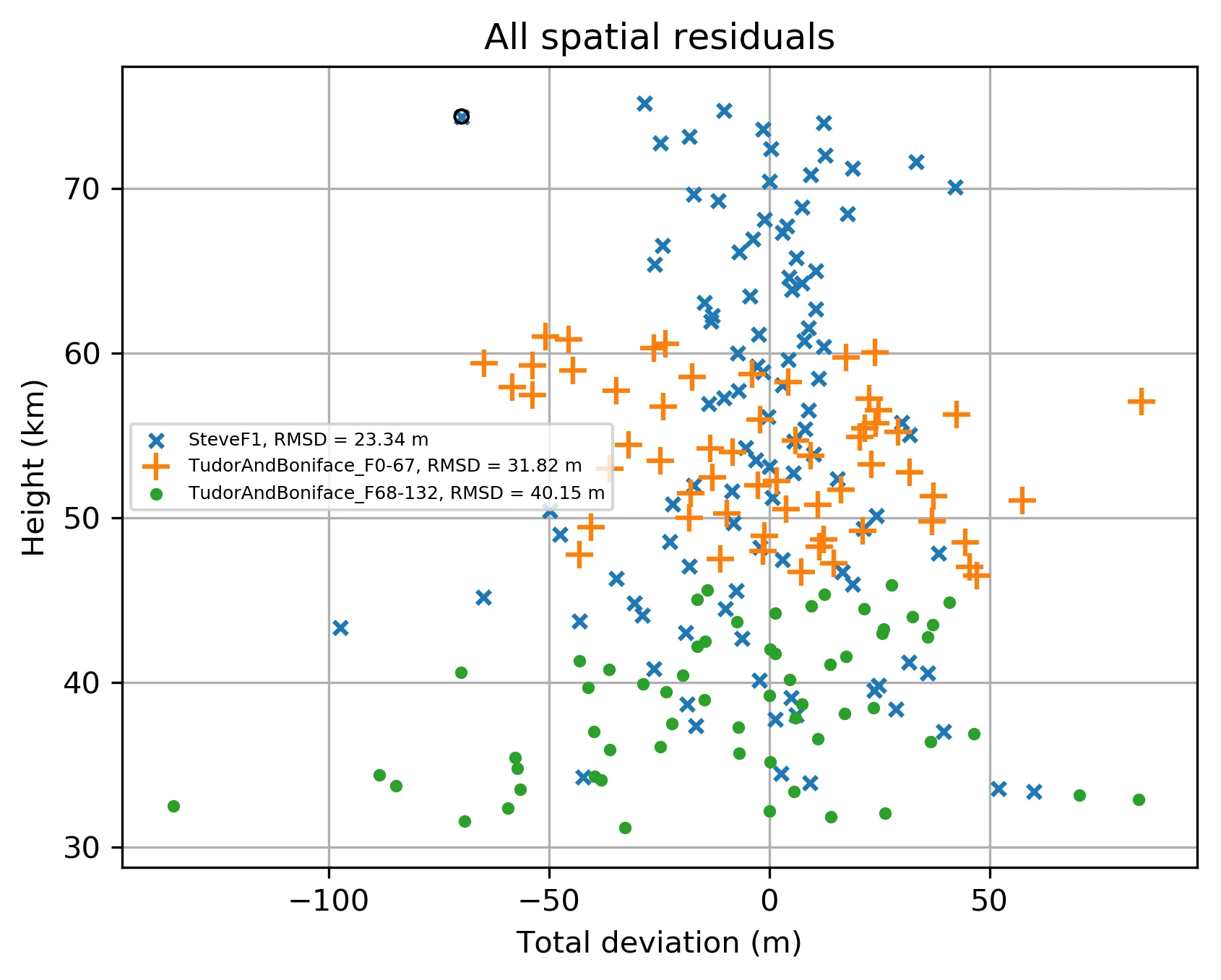
On 24 April 2025 at 18:30:57 UTC, a bright daytime fireball over Southcentral Alaska was detected by 37 seismic stations, 16 single infrasound sensors, and four infrasound arrays, yielding 30 ballistic and multiple fragmentation arrivals. The unprecedented density of seismoacoustic coverage enabled detailed reconstruction of the event using acoustic signals, with fragmentation source locations further guiding the identification of Doppler weather radar signatures of a meteorite fall. Incorporation of a radar-derived terminal point yielded a final trajectory solution, which agreed closely with an independent optical trajectory solution from video analysis. The reconstructed entry parameters from seismoacoustic analysis indicate a velocity of 25.3 km/s, an entry angle of 19{\deg}, and an energy release of ~38 t TNT equivalent. Assuming a chondritic composition, the pre-entry object diameter was ~0.7 m. Using orbital parameters from the optical solution, we estimate meteoroid composition as most likely a L-type ordinary chondrite. The event occurred in the sub-Arctic, where space-based optical systems face challenges in detection, demonstrating the critical role of dense ground-based seismoacoustic networks in characterizing highlatitude atmospheric entries. This uniquely well-recorded event demonstrates the capability of dense seismoacoustic networks to constrain bolide trajectories, energetics, and fragmentation, with radar and optical data providing critical confirmation and complementary perspectives. These results bridge the methodological gap between planetary-defense monitoring of natural impactors and space-traffic analyses of artificial reentries, illustrating how multi-sensor integration can deliver calibration-grade trajectories even for unpredicted events.
The meteor left a whopping 30 shockwaves, like throwing one stone into water sends out dozens of ripples, but here the ripples also traveled through the earth's depths.