A microphone is a transducer that converts acoustic pressure variations into electrical signals. Modern microphones often rely on micro-electromechanical systems (MEMS) technology, where a tiny diaphragm moves in response to sound waves, changing the capacitance of a sensing element. This capacitance change is then converted into a voltage signal. MEMS microphones are ubiquitous in smartphones, hearing aids, and voice-controlled devices due to their small size, low power consumption, and high reliability.
History
The first practical microphone was developed by Alexander Graham Bell and Thomas Watson in 1876 for the telephone. The MEMS microphone emerged in the 1980s, with the first commercial devices appearing in the early 2000s.
How it works
Sound waves strike a thin, flexible membrane suspended over a rigid backplate. The pressure difference between the front and back of the membrane causes it to vibrate, altering the gap between the membrane and the backplate. This changes the capacitance of the structure. An integrated circuit measures this capacitance change and outputs an electrical signal proportional to the sound pressure. The design of the membrane, its tension, and the acoustic ports determine the frequency response and sensitivity.
In practice
MEMS microphones are used in virtually all modern portable electronics, as well as in automotive systems for noise cancellation and in medical devices for hearing aids.
Fun fact
The smallest MEMS microphones are smaller than a grain of rice, yet they can capture the full range of human hearing.
Imagine a book with latches on its pages: you can only flip a page if you know how to click its edge. That is roughly how the mechanical metamaterial we are about to discuss works. Each cell is a small mass inside a larger one, connected by an elastic beam. The beam can sit in two stable positions, like a switch.
An interpreter gets distracted by every rustle in the hall, and a one-hour meeting stretches into two. The same happens with a capacitive gyroscope: to hear the nanometer-scale displacement of its proof mass, it needs perfectly tuned gaps between the plates. The smaller the sensor, the harder it is to maintain that precision.
In the 1980s, the DARPA speech recognition challenge settled the debate between statistical methods and hand-written rules, setting a common standard for the entire field.
A magnetic vortex is like a tiny whirlpool in the sea, except that instead of water, it's magnetization that swirls. Such vortices could become memory cells in future computers, but to write and read information, you need to be able to move each vortex individually. So far, this is done crudely — shifting a whole bunch at once.
The orchestra plays, but the conductor hears only a general hum. Each instrument plays its own part, but you can't tell where the flute is and where the double bass is. You need a spectrum analyzer — a device that breaks down sound by frequency.
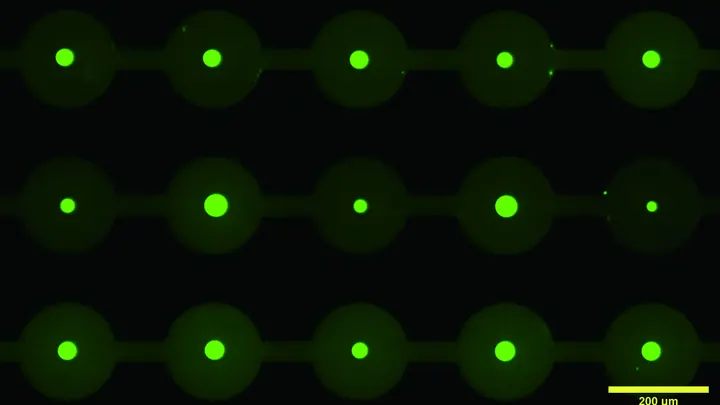
Blood vessel cells were seeded onto a transparent film just 700 nanometers thick — a hundred times thinner than a human hair. Flat electrodes are hidden beneath the film. They send a weak alternating current and listen as the resistance changes.
A magnetoencephalograph, a helmet-like device with hundreds of sensors, picks up the weak magnetic fields generated by active neurons. When a person listens to speech, these signals contain imprints of the heard words. But extracting them is tricky: signals from thousands of sources merge into a tangled mess.
Crystals glued to the outside and inside of a metal wall act as an invisible channel. One, receiving current, starts to tremble, and these vibrations, like ripples on water, spread out in all directions through the metal. The inner crystal catches this tremor and generates electricity again.
In fast-moving vehicles, mobile internet slows down: the signal, traveling at the speed of light, blurs like the scenery outside the window. Engineers have found a way to pack data more densely without letting them mix up. It's like a multi-lane highway where packet-cars drive not with a safe interval, but almost bumper-to-bumper.
Traditional hearing aids resemble a chef who cooks from a recipe blindly. They analyze the sound chaos from the microphone and amplify speech based on it. In a noisy café, this approach often errs. The new system behaves like an experienced cook: first processes the signal, then samples the result.
A typical cardioid microphone, like an ear, hears best from the front, but its readings blur when sound comes from the side. The solution is to gather several such 'ears' into a sphere. You get a sound ball that picks up signals from all directions. By comparing measurements, the system breaks down errors into simple components — much like spectroscopy splits light.
A drop of oil in a glass of water forms a sphere. Inside a living cell, a similar separation occurs, but instead of oil, proteins and nucleic acids form dense droplets — condensates. These droplets act as temporary workshops: they gather needed molecules, speed up reactions, and break apart when the task is done.
Light needs space. A camera lens sits several centimeters from the sensor so the rays have room to focus. Now, that gap has been squeezed to the thickness of a sheet of paper, and light still behaves as if it had traveled its rightful centimeters. That's what 'spaceplates' do: flat elements that mimic free-space propagation.
The brain is a fortress. It's protected by a dense layer of cells that only lets in what it needs. Drugs can't get through this barrier, which is why many brain diseases are so hard to treat.
Scientists have found a way to crack the fortress gates. They built a device that sends focused ultrasound into the brain. Tiny gas bubbles are injected into the blood.
Each vowel sound is a distinct shape of the mouth, tongue, and throat. When you say 'ah,' 'ee,' or 'oo,' not only does the air inside your head change, but so does the way radio waves pass through it. Researchers peered into this process using MRI scans taken right during speech and built a precise computer model of the head — from bones to soft tissues.
Quartz microbalances are thin plates that vibrate at a frequency of five million times per second. When a drop of liquid lands on the plate, the vibration changes: from these changes, you can determine the drop's mass and its elasticity.
A regular laser is a light amplifier in which atoms, after receiving energy, collectively emit waves of a single frequency. A maser does the same thing, but for microwaves — the invisible radiation that heats food in a microwave oven and carries signals in phones.
An ordinary lens always refracts light the same way. Its properties are frozen in glass forever. But now there's a surface that changes the game on the fly.
Scientists made an ultrathin film with resonant elements and infused it with liquid crystals — the same stuff used in phone screens.
Speech is like an orchestra where every note must sound at just the right moment. The brain turns a thought into a chain of sounds in a fraction of a second, and until now it was unclear how it manages this hierarchy — from individual sounds to syllables to whole words.
Quantum computers and sensors operate at microwave frequencies, but transmitting their signals over long distances is conveniently done via optical fibers, which use light.
A gas bubble in water sings loudly — this is Minnaert resonance: the heavy liquid prevents the bubble from compressing quickly, forcing it to vibrate. In air, there's no such effect: air is too light. But if you dress the bubble in a soft silicone shell, like rubber, it plays the role of the water mass. You get an 'elasto-bubble'.
An ordinary sheet of paper looks white because it scatters all light rays chaotically. But a butterfly's wing shimmers blue and green without a drop of paint: its surface is covered with microscopic grooves that dampen some light waves and amplify others. Engineers have long dreamed of replicating this trick: creating a material that colors itself simply by trapping light in the right places.
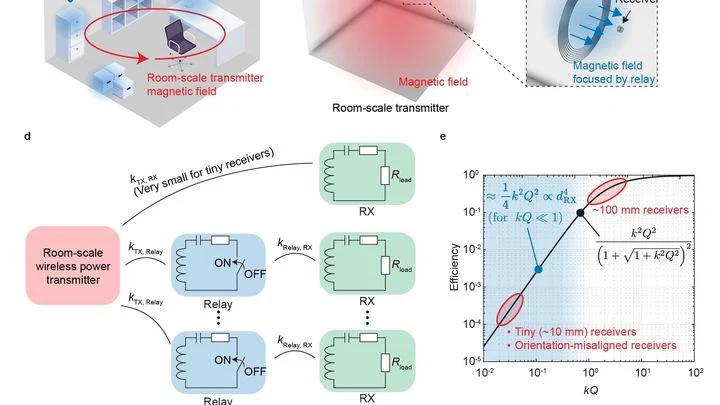
Think of wireless charging in a room as a pool where energy-water is everywhere, and tiny sensor-floats barely bob. Their induction coils are too small to efficiently scoop from this diffuse electromagnetic field. Unlike radio waves, the energy here doesn't travel at the speed of light: it lingers in the near field, waiting to be harvested.
A metal is a sea of electrons that move almost freely, colliding only occasionally. But in some materials, this sea suddenly becomes viscous and unpredictable: electrons stop behaving like independent particles. Physicists call this state 'non-Fermi liquid,' and it remains a puzzle.
Sound in a solid is waves of compression and rarefaction rippling through atoms, like ripples across a spring mattress. If you place obstacles with just the right spacing, waves at certain frequencies can't pass: they bounce back. Such a periodic structure is called a phononic crystal, and it works for sound the way a multilayer mirror works for light.
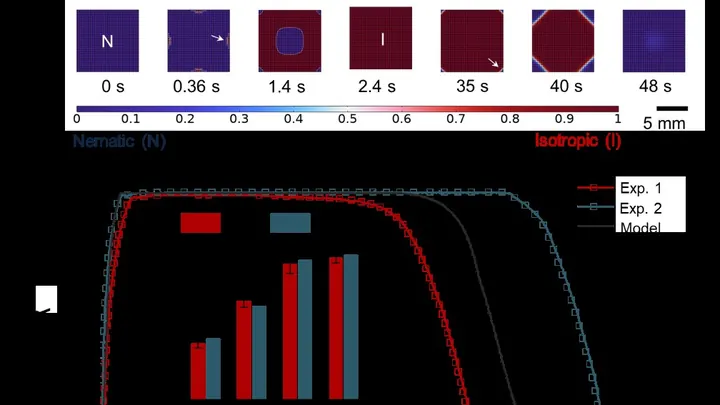
Radio waves surround us, but our eyes can't see them. This new sensor, the size of a fingernail, turns them into a colored patch on a tiny screen.
Inside the chip is a layer of liquid crystals — the same kind used in phone displays. Among them are embedded thin ferromagnetic nanowires. When a radio wave arrives, the nanowires heat up quickly.
Sound on a crystal surface is like ripples on water, but traveling through a solid. This ripple is called a surface acoustic wave: it moves a hundred thousand times slower than light, so it can be compressed into very short segments and fit on a tiny chip. Usually, such waves are launched by metallic combs made of aluminum or gold.
If you compress a plate with accordion-like cells, a kink wave runs through it, like a wrinkle in a rug when you push it with your foot. Such waves can switch the material between two stable shapes, and this is the basis of mechanical memory. But if a table leg gets in the way of the wrinkle, it gets stuck. In a new study, researchers showed how to nudge it loose without brute force.
Water in a narrow gap crawls on its own: that's the capillary effect that pulls sap up a stem. But if it hits a step, the liquid can freeze, like a traveler before a high threshold. Scientists built tiny glass channels and watched when a drop steps over the ledge and when it gets stuck.
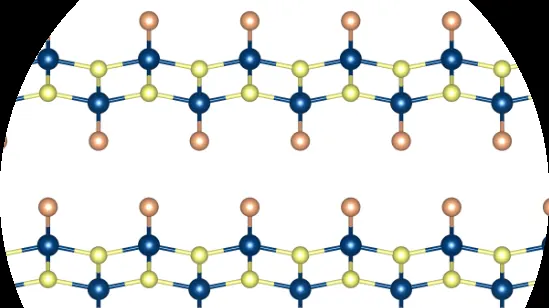
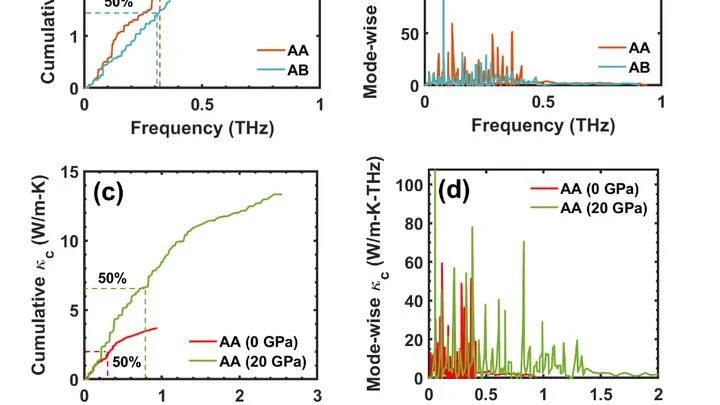
Heat dissipates poorly in thin layered materials, like a crowd in a narrow corridor. In ReS2 crystals, layers lie on top of each other, and heat can travel across them. Scientists measured how quickly this happens and found a surprise: when the layers are stacked directly one above the other, heat passes almost twice as fast as when they are shifted.
A microwave signal that doesn't jitter from interference is needed in both radar and telecommunications. Until now, a clean signal was obtained on bulky setups where lasers and resonators sat on an optical table. Now engineers have packed everything into a box the size of a cup—166 milliliters.
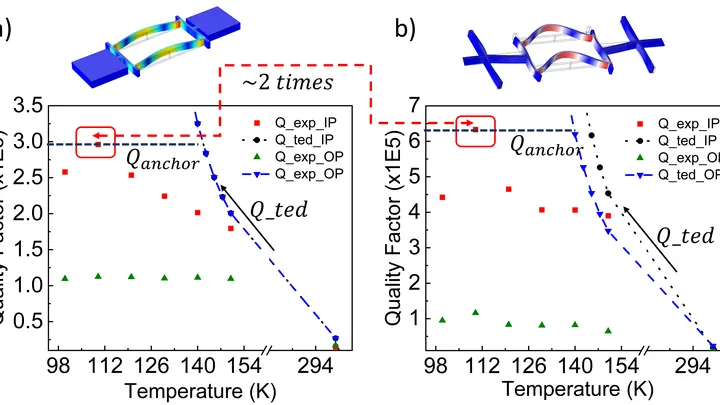
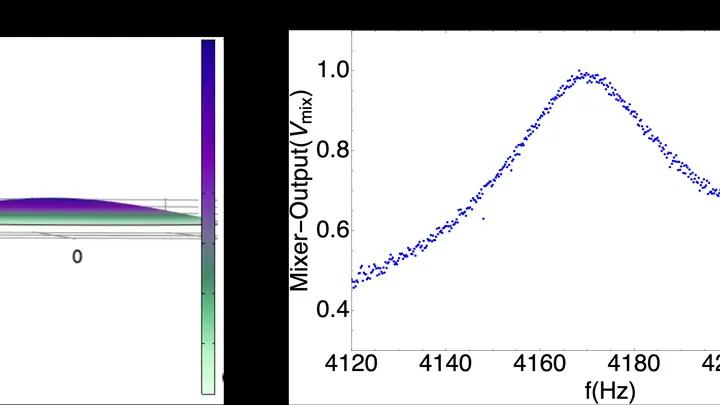
A thin film, clamped between two metal posts, trembles at the slightest nudge. Its movements are picked up by a microwave resonator — a cavity where radio waves bounce around like sound in an empty room. When the membrane shifts, the cavity's response changes.
A quantum computer is like an orchestra where each qubit is a musician, and a measurement is the conductor's attempt to hear who played what. But the hall is noisy: the signal fades like sound through a thick wall, and the conductor himself sometimes mixes up the notes.
An ordinary rubber pad dampens vibration the way a thick blanket muffles sound: the thicker and heavier, the better. Engineers have long dreamed of a material that is light yet "eats" oscillations as well as a massive damper.
Inside the receiver of a telescope aimed at the oldest glow in the universe sits a tiny thermometer chip. It's so sensitive that the heat from a single photon can warm it noticeably. But to hear that whisper of heat, you need a middleman — an amplifier that doesn't add its own noise.
A microwave oven heats food, but this circuit harvests energy from radio waves. Engineers have built a rectifier that converts 5.8 GHz microwaves into direct current. The big news: inside, there isn't a single capacitor: those little charge reservoirs that usually sit in every rectifier.
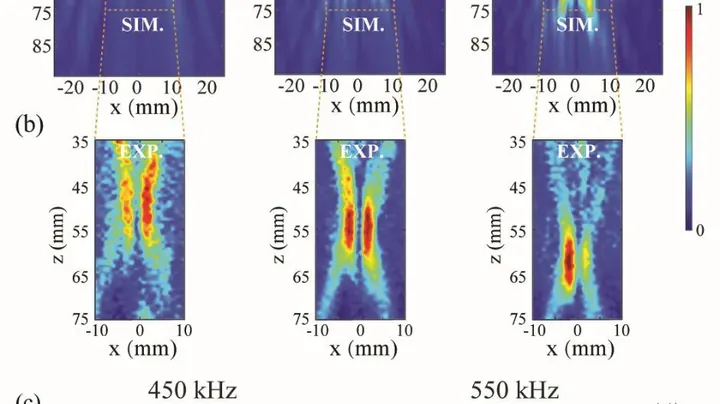
Sound can do more than be heard: it can push. An ultrasound vortex is a sound wave twisted like a whirlpool in a shell: silence at the center, rotating pressure at the edges. Such a whirlpool can grab tiny particles and carry them without a touch.
A drop of ink falls into a glass of water, and instead of a flat stain, a ring is born that immediately starts to spin. That's roughly what the birth of a skyrmion looks like: light emitted by a tiny source twists into a stable vortex. Until now, such vortices could only be produced by large lasers.
A thin, flexible beam shivers from a blow, and a wave runs along it like ripples on water. Along the beam, seven pairs are placed: a sensor feels the bending, and a motor immediately pushes the beam in response. Each pair is like a tiny tuning fork that oscillates in antiphase and quells the tremor at its spot. The wave cannot pass beyond — at certain frequencies, silence falls.
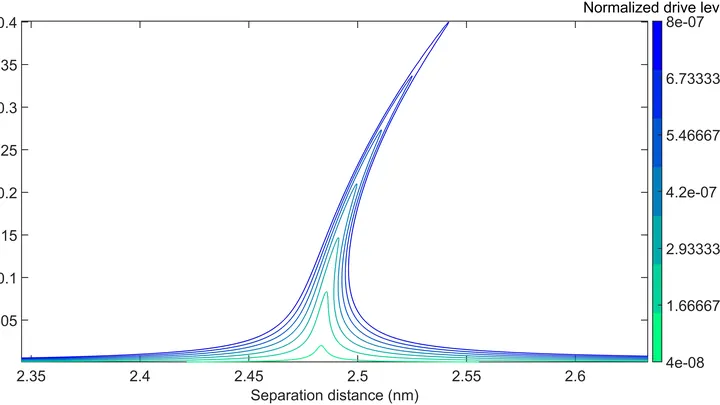
The tip of a tunneling microscope hovers above a surface at a distance smaller than the diameter of an atom. Usually, it feels out the topography like a finger reading a page of Braille. Now, that same tip has learned to listen to how a membrane the size of a fingernail trembles.