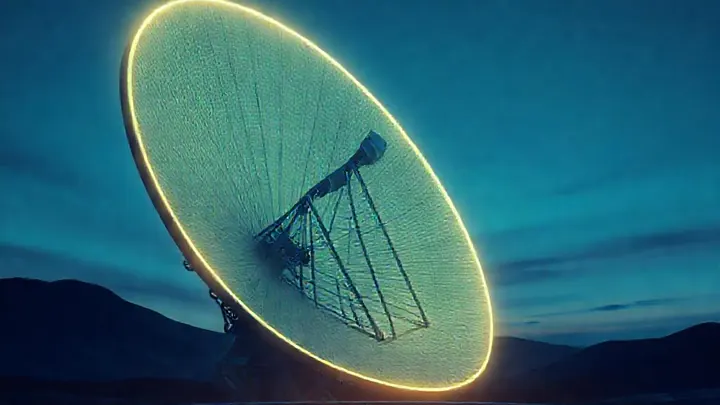
The Atacama Large Millimeter/submillimeter Array (ALMA) is a radio telescope composed of 66 high-precision antennas located in the Atacama Desert of northern Chile, at an altitude of about 5,000 meters. It observes the universe in millimeter and submillimeter wavelengths, a part of the electromagnetic spectrum between infrared and radio waves. This range is ideal for studying cold, dark regions of space — the places where stars and planets are born, and where molecules drift in the interstellar medium.
History
ALMA was inaugurated in 2013, a joint project of ESO, NSF, and NINS, with contributions from Chile and other partners. Its design grew from earlier millimeter arrays, but its scale and sensitivity make it a unique facility.
How it works
ALMA's antennas work together as a single interferometer: signals from each dish are combined electronically to create images with the sharpness of a much larger telescope. The high, dry site is crucial because water vapor in the atmosphere absorbs the faint millimeter waves from space. By detecting the faint thermal emission from dust and molecular gas, ALMA can map the distribution of cold material and trace the chemistry of star-forming clouds.
In practice
ALMA is used to study star formation, the chemistry of interstellar clouds, and the structure of distant galaxies, providing data that informs models of galaxy evolution and planetary system formation.
Fun fact
ALMA's antennas can be moved along tracks to reconfigure the array, allowing it to zoom in on details as small as a few milliarcseconds — equivalent to seeing a coin from kilometers away.
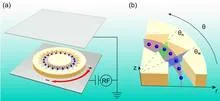
In a ring-shaped channel between two toothed rings, microspheres are suspended: some with a radius of 8 micrometers, others 14. The discharge is switched on, and the particles start moving. The small ones go one way, the large ones the other. It is like a shopping mall where escalators for people of different heights run in opposite directions.
In the basement of the laboratory, an 8 tesla magnet hums. Inside it, like a bell in a bell tower, hangs a hollow copper cylinder tuned to a single note. If an axion, a dark matter particle, flies by, the cylinder responds with a faint ring. The trouble is that ordinary copper muffles this ring: at high frequencies, current flows only through a thin skin of the metal, and losses grow.
A storm in the upper atmosphere lasts a few millionths of a second. A cosmic ray, a proton or a helium nucleus, strikes air molecules, sending a swarm of particles downward. Most of them stay together, but occasionally one particle gains so much energy that it surges ahead.
The night sky is full of rings and bubbles, but in the radio band they look different. In data from the Australian radio telescope ASKAP, a structure has surfaced that resembles two soap bubbles blown from the same straw.
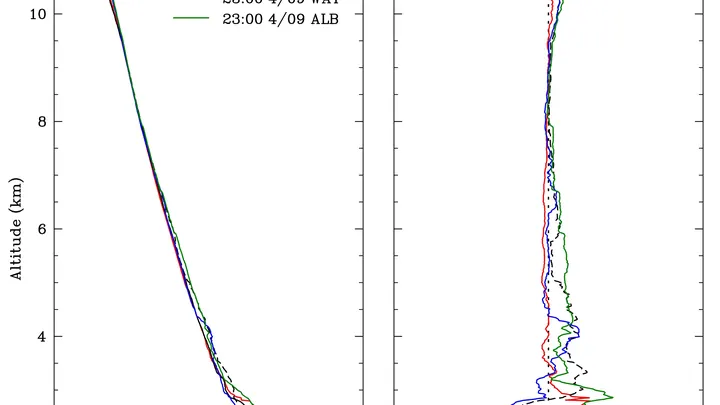
Every second, thousands of passenger aircraft in the sky transmit radio signals: that's how air traffic controllers track where each flight is. These signals don't travel in a straight line: air of varying humidity bends them like a lens. If you can measure that bending, you can work out where the air is drier and where it's more humid.
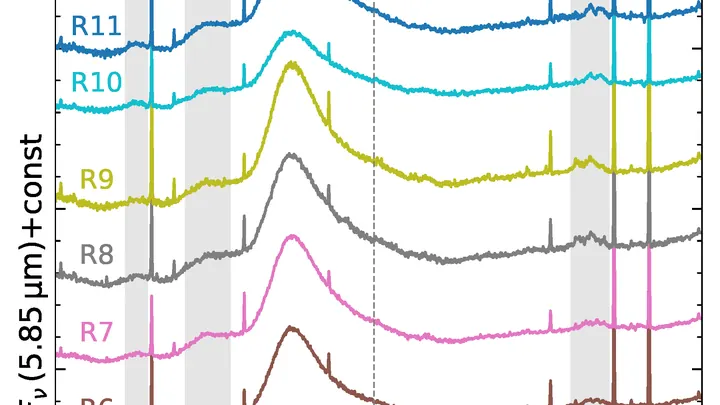
The Tarantula Nebula is a giant stellar nursery in a neighboring galaxy. Hundreds of thousands of stars are born there, and their light illuminates clouds of dust. This dust glows in the infrared, and its spectrum shows mysterious bands. For a long time, astronomers debated which molecules produce them.
The night sky is full of deceptive lights. Astronomers were searching for galaxies that ignited in the first few hundred million years after the Big Bang: their light has traveled to us for nearly 13 billion years. Six faint smudges were selected from images taken by the Hubble and Spitzer space telescopes.
The galaxy cluster RXC J0528.9−3927 is like a city shrouded in fog: at its center, a radio halo shines brightly, but farther out, beyond the usual boundaries, astronomers have spotted a barely visible glow. It stretches for two million light-years — three times farther than the halo itself.
Betelgeuse, the red supergiant familiar from Orion's shoulder, keeps surprising us. After the mysterious Great Dimming of 2019–2020, when the star suddenly dimmed, it didn't just recover; it changed its ways.
When designing smartphone antennas, engineers need a reference — something like a tuning fork for adjusting musical instruments. As Maxwell showed, radio waves and light are of the same nature, and the new antenna module uses 5G millimeter waves traveling at the speed of light.
The universe sounds with silence. The lion's share of matter — about 85%—remains invisible, manifesting only through gravity. Back when Vera Rubin Vera Rubin showed that galaxies spin as if wrapped in unseen mass.
When a giant planet grows, it pulls in gas. Some of that gas swirls around it into a small disk — called a circumplanetary disk. It is in such disks that moons are thought to form. For the planet PDS 70 c, located 370 light-years away, such a disk was directly observed using the ALMA antenna array in the millimeter range.
Two million years away, around the young star CI Tau, a gas-dust disk whirls — a protoplanetary cradle. ALMA observations have already shown rings and gaps in it, but the finest details remained invisible: their width is smaller than the instrument's resolution.
The universe is permeated by invisible mass, dark matter, whose existence was first proposed by Fritz Zwicky in the 1930s, based on his observations of galaxies moving in clusters.
The Universe at 700 million years old was a noisy construction site, just beginning to light up. Telescopes caught a signal from that distant epoch: the galaxy REBELS-25, massive and full of stellar fuel.
In an oven, a huge loaf of bread is baking. Inside the dough, there is a tiny, hottest spot: that's where the future loaf begins to rise. A hot molecular core (a region the size of the Solar System, where gas is heated to hundreds of degrees and compressed to billions of times the density of ordinary clouds) works in much the same way.
Dark matter is an invisible substance that reveals itself only through gravitational effects: it bends the light of distant galaxies, much like an unseen window that alters the path of light rays.
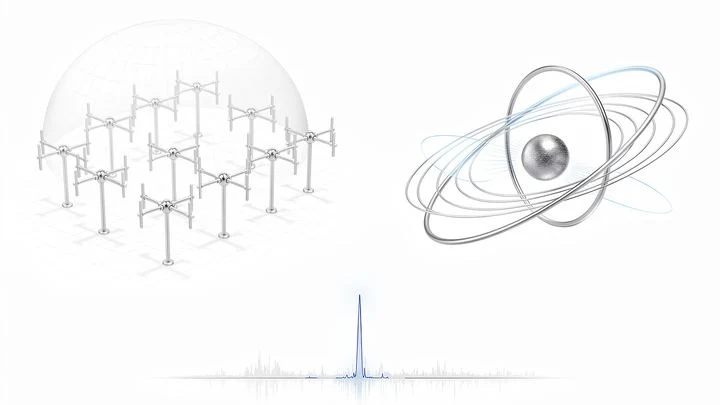
Listening to the cosmos requires patience and a finely tuned ear. Astronomers chose the most sensitive low-frequency instrument for this: the OVRO–LWA antenna array — 352 dipole antennas scattered across two and a half kilometers of California desert.
A lighthouse spins in dense fog. Its beam cuts through the gloom, but the fog itself remains invisible. That's roughly how astronomers search for dark matter: it doesn't emit light, yet it can affect the signals that reach us.
A magnifying glass focuses sunlight into a bright point. If the glass has a tiny flaw, the spot of light becomes distorted. Gravitational lensing works in a similar way: a massive galaxy bends light rays from a more distant source, creating an enlarged and sometimes distorted image.
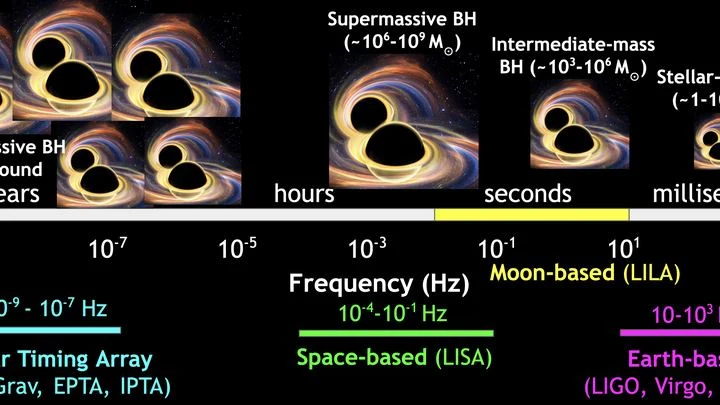
Gravitational waves are ripples in the fabric of space, like circles on water from a thrown stone. On Earth, they are drowned out by traffic, tides, and earthquakes, like a storm beating on a lake, making it impossible to notice faint splashes. The LILA project moves the detector to the Moon, where windless silence reigns.
Dark matter is invisible, but its gravity governs the motion of galaxies. What it's made of is a mystery. One idea: it consists of ultra-light particles akin to axions.
Searching for extraterrestrial signals is like trying to hear a whisper at a roaring stadium. The Green Bank Telescope listened to 70,000 stars, but 100 million bursts turned out to be earthly noise — from phones, satellites, microwave ovens.
Einstein's theory of gravity explains how mass warps space and time. Its predictions have been tested near Earth, but the most grueling tests lie around black holes, where distortions reach their breaking point. Until now, astronomers saw them as blurry smudges on an underexposed photo.
The universe is permeated by an invisible substance, dark matter, whose gravitational influence is obvious, but whose composition remains a mystery. One hypothesis suggests it consists of ultralight particles so light that they exhibit wave-like behavior, forming a kind of cosmic ripple.
A film of aluminum nitride, as thin as a soap bubble, hangs above a mirror with a micrometer-sized air gap between them. When invisible infrared light with a wavelength of about 15 micrometers hits it, the film starts to vibrate in sync with the light, like a string that responds only to its own note.
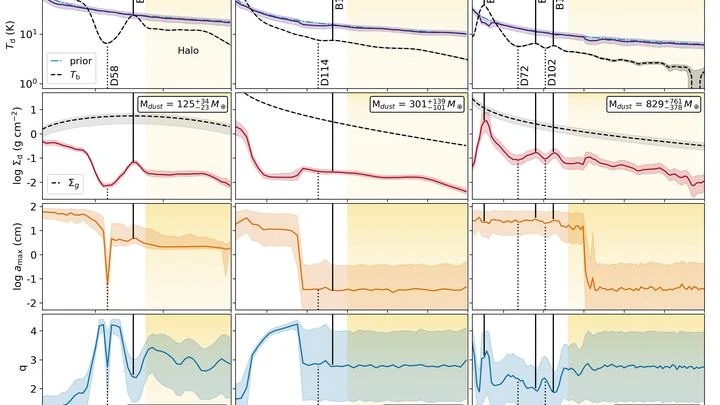
A young star is surrounded by a flat, rotating disk of gas and dust, like pizza dough that's been spun out. Planets are born inside such a disk. But around three stars (Elias 2-24, IM Lup, and DM Tau) astronomers noticed something odd: far beyond the edge of the bright disk stretches a barely visible but enormous dust halo.
In the distant universe, when it was just a couple of billion years old, many galaxies resembled boiling cauldrons: gas clumped so quickly that stars ignited one after another, and dust heated up and shone brightly in the submillimeter range.
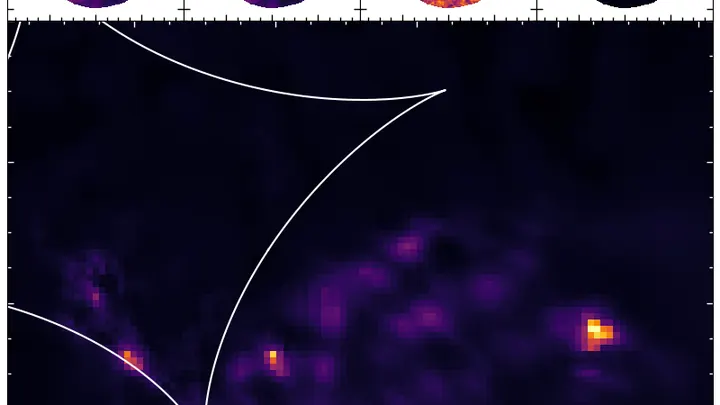
In a dense cloud of gas and dust where giant stars are born, the ALMA telescope has spotted something familiar. Four thin gas jets shoot out from the same region, each leaving behind a chain of bright knots, like a dashed line.
Around young stars, flat clouds of gas and dust swirl, like pizza dough from which planets will eventually be shaped. This cloud contains various chemical elements, and sulfur is one of the most elusive: it's hard to catch with telescopes because it hides in solid grains or escapes as gas.
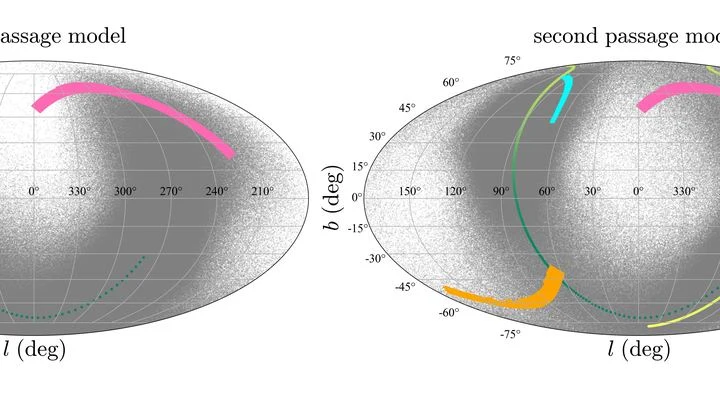
On the outskirts of our Galaxy, far beyond the familiar stellar disk, the Subaru Telescope has spotted something unexpected: a scattered cloud of stars spanning an area of one hundred square degrees across the sky.
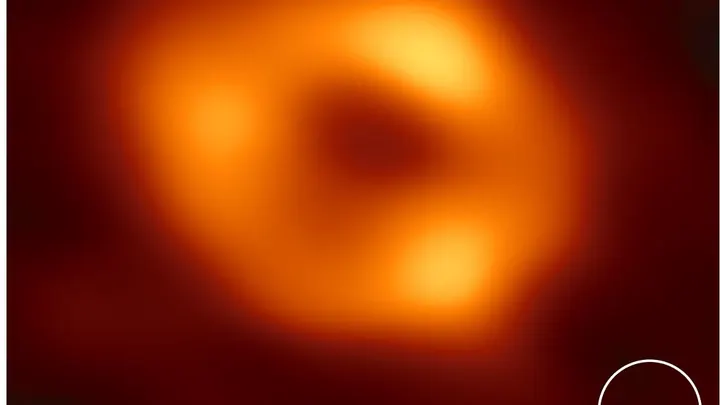
At the center of the Milky Way lies the supermassive black hole Sagittarius A*. It is four million times more massive than the Sun, but by cosmic standards it behaves quietly: it only occasionally flares up when it swallows a clump of gas.
Five galaxies that long ago stopped igniting new stars look like houses with darkened windows. But the ALMA radio telescope and the James Webb Space Telescope peered inside and saw that in these 'sleeping' houses, a fire still smolders.
The Fermi telescope spent 17 years recording gamma rays from the active nuclei of galaxies with giant black holes at their centers. The glow of their jets resembles a chaotic cacophony: it constantly changes.
Astronomers have tested the new Vera C. Rubin telescope in Chile, much like adjusting the focus and aperture on a brand-new camera. The first images covered a patch of sky the size of 60 full Moons, and immediately revealed millions of galaxies and stars. The imaging was done in various colors, from invisible ultraviolet to thermal infrared.
On April 24, 2025, a celestial drum boomed over Alaska. Sunlight outshone the flash, and satellites missed the meteor. But the earth and air acted like a giant percussion instrument: dozens of ground microphones picked up a low rumble, and vibration sensors detected tremors. This provided a precise 'melody' of its flight.
Cosmic rays are not light but charged particles bombarding Earth from all directions. Most of them are protons (hydrogen nuclei), but heavier nuclei also show up: helium, nitrogen, iron.
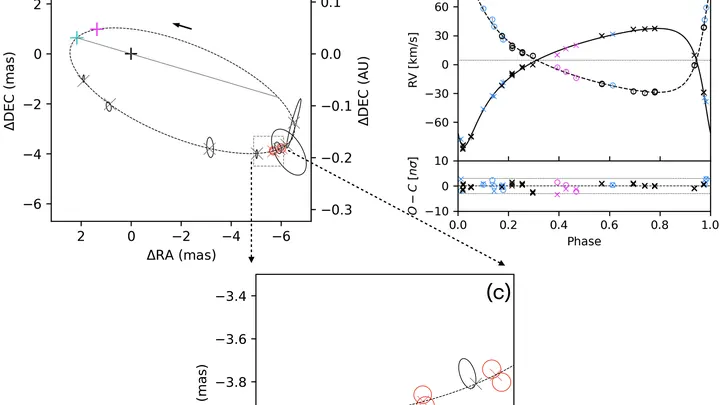
In the constellation Pisces, there is a star that people have seen for thousands of years, but only now have they discerned its inner structure. Alpha Piscium is not one star, nor even two, but a whole family: two pairs of stars bound by gravity. Astronomers had suspected that a third star lurked in the second pair, but they couldn't see it: it was too crowded.