The Very Large Array (VLA) is a radio interferometer in New Mexico, consisting of 27 antennas arranged in a Y-shaped configuration. It is one of the most productive ground-based observatories, used to study a wide range of astronomical phenomena, from the radio emission of galaxies and quasars to the remnants of supernovae and the magnetic fields around dead stars. The VLA's ability to combine signals from its antennas allows it to achieve the resolving power of a much larger telescope, effectively acting as a single dish up to 36 kilometers across.
History
The VLA was conceived in the 1960s and officially dedicated in 1980. It was designed by a team led by David Heeschen and built at the National Radio AstronomyObservatory (NRAO) in Socorro, New Mexico. The facility underwent a major upgrade completed in 2012, which replaced its original electronics with modern digital systems, significantly increasing its sensitivity and bandwidth.
How it works
The VLA uses the technique of aperture synthesis. Each of its 27 antennas, each 25 meters in diameter, collects radio waves from a celestial source. The signals are then combined using a technique called interferometry, where the time delays between antennas are precisely measured and correlated. By moving the antennas along the Y-shaped tracks, astronomers can sample different baselines, and through sophisticated computer processing, these data are synthesized into high-resolution images of the radio sky.
In practice
The VLA is used for a wide range of astronomical research, including mapping the radio emission from galaxies, studying the Sun, tracking spacecraft, and searching for transient phenomena like fast radio bursts. It also serves as a testbed for interferometric techniques used in other observatories.
Fun fact
The VLA has appeared in several movies, including the 1997 film 'Contact', where it was used as a fictional listening post for signals from extraterrestrial intelligence.
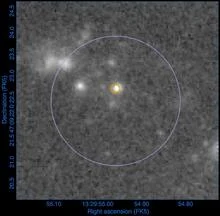
In the first few hundred million years after the Big Bang, the universe was a dark ocean in which the first stars and black holes ignited. Some of those black holes shot out narrow jets of plasma traveling at nearly the speed of light. If such a jet points straight at Earth, we see it as a bright spot: a blazar.
In the basement of the laboratory, an 8 tesla magnet hums. Inside it, like a bell in a bell tower, hangs a hollow copper cylinder tuned to a single note. If an axion, a dark matter particle, flies by, the cylinder responds with a faint ring. The trouble is that ordinary copper muffles this ring: at high frequencies, current flows only through a thin skin of the metal, and losses grow.
A radio telescope with thousands of antennas is like a giant ear that hears the whole sky at once. But an ear cannot draw a picture: signals from every pair of antennas must be multiplied, and in an array of ten thousand elements there are already fifty million pairs. A classical correlator does exactly that, and its complexity grows as the square of the number of antennas.
Galaxy Mrk 590 behaves like a radio receiver that sometimes picks up a signal and sometimes fades into static. Its supermassive black hole has been brightening and dimming for decades, and astronomers caught every such 'switch-on.' In 2017, the receiver came alive again, but the VLA radio telescope heard not the signal they expected.
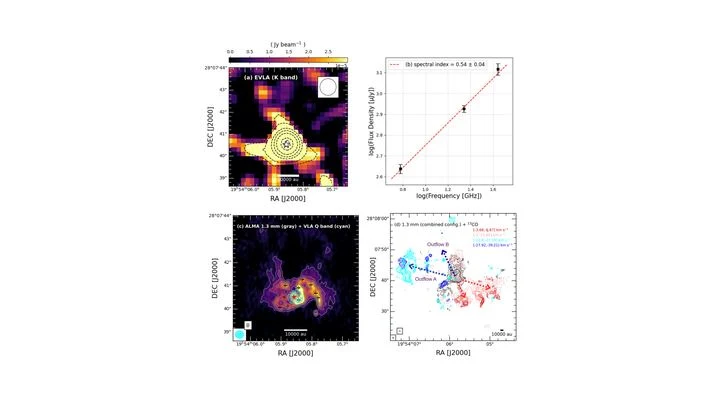
Radio telescopes listen to the sky like sensitive ears: they catch the whispers of distant explosions, the hum of galaxies, the crackle of pulsars. But sometimes they pick up a sound that isn't in the catalogs. In 2003, such a sound emerged in the constellation Aquila — a spot in the sky that had been quiet until it suddenly began to speak.
Somewhere in the depths of the Milky Way, radio pulses flare up from time to time — rare, steady, like the ticks of a distant metronome. These long-period radio transients were discovered only recently, and they immediately puzzled astronomers.
Gravitational waves from merging black holes sound like bass chords, pulsars tap out a rhythm, and the cosmic microwave background carries echoes of the Big Bang. But there is a silent player — dark matter, whose presence is betrayed only by gravitational effects.
A translator records a multi-hour conversation. If they try to hold the entire dialogue in their head, they're bound to garble details by the end. That's roughly how gravitational observatories work: they listen to the 'conversation' of massive bodies spiraling together.
Dark matter is an invisible substance that reveals itself only through gravitational effects: it bends the light of distant galaxies, much like an unseen window that alters the path of light rays.
A magnifying glass focuses sunlight into a bright point. If the glass has a tiny flaw, the spot of light becomes distorted. Gravitational lensing works in a similar way: a massive galaxy bends light rays from a more distant source, creating an enlarged and sometimes distorted image.
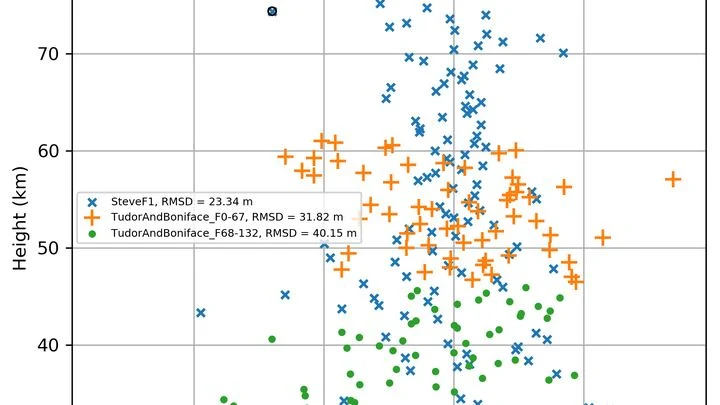
The ionosphere at an altitude of 70 kilometers acts like a giant mirror for radio waves. Ground antennas constantly beam signals into it and listen for the reflection. When a solar flare occurs on the Sun, a stream of X-rays reaches Earth in 8 minutes and compresses the lower layer of the ionosphere.
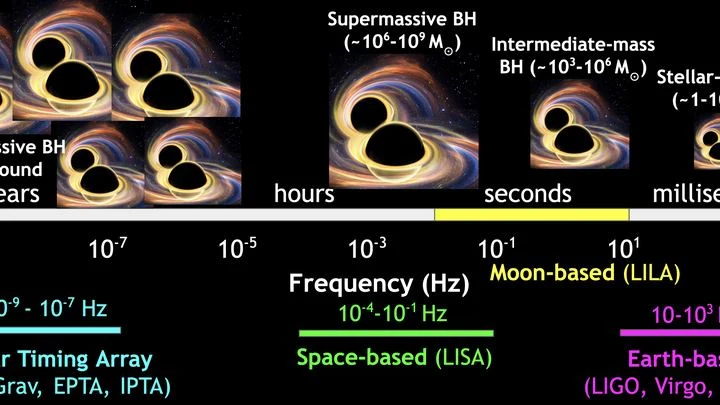
Gravitational waves are ripples in the fabric of space, like circles on water from a thrown stone. On Earth, they are drowned out by traffic, tides, and earthquakes, like a storm beating on a lake, making it impossible to notice faint splashes. The LILA project moves the detector to the Moon, where windless silence reigns.
Searching for extraterrestrial signals is like trying to hear a whisper at a roaring stadium. The Green Bank Telescope listened to 70,000 stars, but 100 million bursts turned out to be earthly noise — from phones, satellites, microwave ovens.
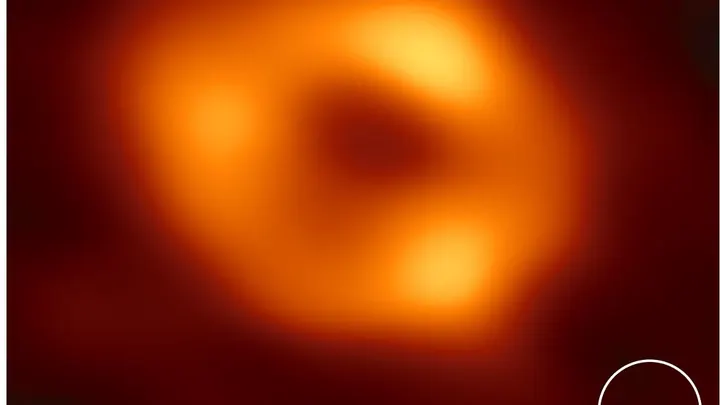
Einstein's theory of gravity explains how mass warps space and time. Its predictions have been tested near Earth, but the most grueling tests lie around black holes, where distortions reach their breaking point. Until now, astronomers saw them as blurry smudges on an underexposed photo.
An orchestra where musicians play in different cities, and the conductor hears them with a fraction-of-a-second delay. That's roughly how radio telescope networks like the Very Long Baseline Array work — a dozen antennas from Hawaii to the Virgin Islands catch the whispers of distant galaxies.
The Fermi telescope spent 17 years recording gamma rays from the active nuclei of galaxies with giant black holes at their centers. The glow of their jets resembles a chaotic cacophony: it constantly changes.
On April 24, 2025, a celestial drum boomed over Alaska. Sunlight outshone the flash, and satellites missed the meteor. But the earth and air acted like a giant percussion instrument: dozens of ground microphones picked up a low rumble, and vibration sensors detected tremors. This provided a precise 'melody' of its flight.
Cosmic rays are not light but charged particles bombarding Earth from all directions. Most of them are protons (hydrogen nuclei), but heavier nuclei also show up: helium, nitrogen, iron.
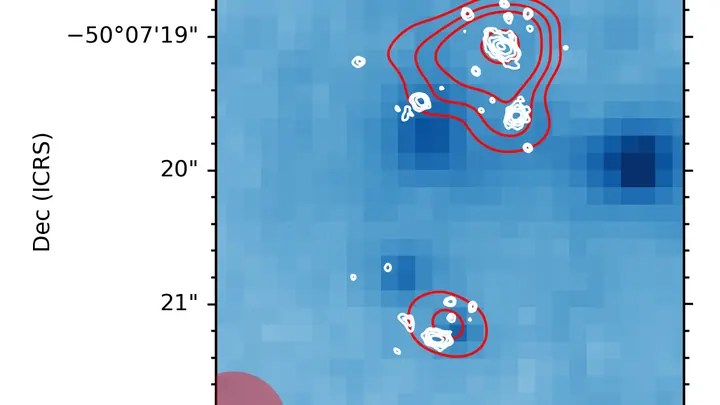
If a supermassive black hole lives at the center of a galaxy, it heats the infalling gas to incredible temperatures. That gas glows, and we see it as a quasar — the brightest beacon in the universe. But how do you measure the size of the light source itself?
The globular cluster M22 is a dense swarm of hundreds of thousands of stars, hanging in our galaxy like a glowing beehive. In such a crowded environment, stars often collide and swap partners, but massive objects like black holes were thought to be quickly ejected by gravitational interactions.
The night sky is no longer as quiet as it used to be. Thousands of satellites are whizzing overhead, and each one can accidentally emit radio waves, interfering with astronomers trying to listen to distant galaxies. To make sense of this noise, scientists pointed the 21CMA radio telescope in China at Starlink satellite passes.
According to Einstein's theory, massive objects cause spacetime curvature, like a heavy ball warping a rubber sheet. As they accelerate, they create ripples — gravitational waves, akin to the circles from a stone dropped in a pond.
The distant galaxy TXS 2005+403, located in the constellation Cygnus, behaves like a lighthouse whose beam shines through fog. Light from its active nucleus, a region where a supermassive black hole heats infalling matter, crosses clouds of charged gas in our Galaxy on its way to us.
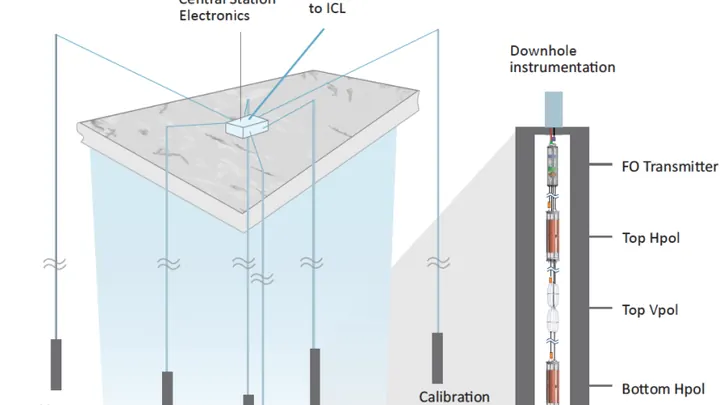
Deep within the Antarctic ice, at depths where sunlight never reaches, antennas hang suspended. They listen not for sounds but for radio waves, waiting for a signal from a particle that is nearly impossible to catch. A neutrino passes through the Earth like a bullet through fog, but occasionally, very rarely, it grazes an ice atom.
Around the young star MWC 480, a flat disk of gas and dust whirls, like a giant carousel where, instead of horses, you have building blocks for planets. Radio telescopes peered into this disk at different wavelengths, from millimeter to centimeter, and saw exactly where the dust accumulates and how large the grains are.
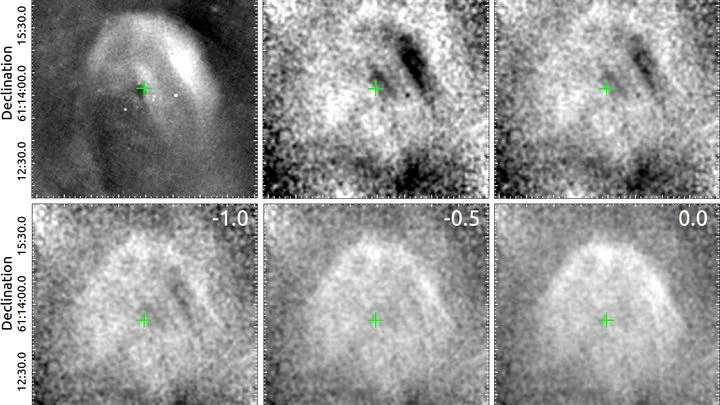
The VLA radio telescope peered into the Boomerang Nebula — a cloud inflated by the wind from a rapidly spinning neutron star. The new images reveal details as small as a lunar disk on the sky: an elongated core around the pulsar and a long arc curving around it from the north.
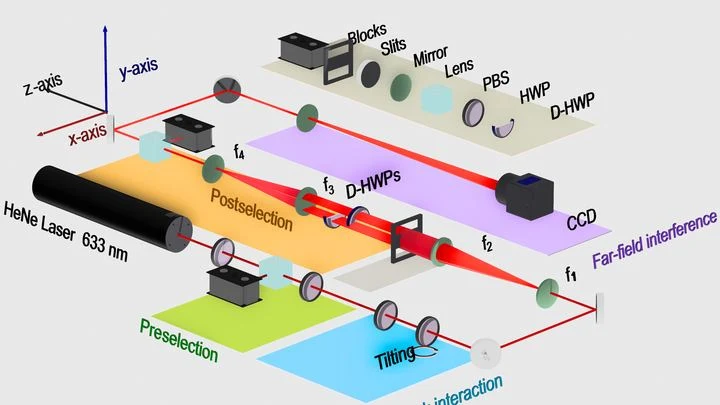
Light passing through narrow slits can reveal delays invisible to the eye. In a new experiment, physicists sent a laser beam through two slits simultaneously and measured how much one part of the wave lagged behind the other. The delay was a few attoseconds: that's one billionth of one billionth of a second.
A laser pulse racing through plasma is like a runner carving a path through a crowd. It shoves electrons aside, leaving behind a rarefied channel, just as the crowd parts for a sprinter. In this channel, the crest of the light wave moves slightly faster than light in a vacuum, and it is this speed that determines how efficiently the pulse transfers energy to particles.
Inside cold clouds of gas and dust where new stars ignite, astronomers have spotted unexpectedly delicate structures. The ALMA telescope, working in the millimeter range, has revealed more than 323 ultra-thin dust filaments within 121 massive clumps.
In the neighboring galaxy, the Large Magellanic Cloud, lives the binary system A0538-66. There, a neutron star — a tiny sphere the size of a city but heavier than the Sun — spins on its axis every 69 milliseconds.
Radio telescopes scattered across the globe pick up waves from distant black holes. But two telescopes placed almost side by side see only a blurry blob — fine details are beyond them. Usually, such pairs are considered useless and discarded. But that's a mistake: even a blurry blob holds clues.
At the center of a cosmic dust cloud, astronomers detected an invisible star. It's wrapped in a rotating gas disk. This disk works like a set of scales: the gas speed at different distances from the center reveals the star’s mass.
The pattern is simple: the closer to the center, the faster the motion.
For twelve years, astronomers at the LPA radio telescope in Pushchino have been listening to the same patch of sky — the direction of the galaxy 3C 33. In that time, they caught just six short radio signals, each lasting from one to four minutes.
At the heart of many galaxies lies an invisible beacon — a supermassive black hole. As it devours matter, it blasts a dazzling beam of gamma rays into space. If that beam points towards Earth, astronomers see a blazar — a bright but fickle point.
In 1181, Chinese and Japanese astronomers recorded the appearance of a 'guest star', a bright object that shone for six months in the constellation Cassiopeia and then vanished. Today, that spot hosts Pa 30: a nebula with a hot central source ejecting material at 16,000 km/s.
The Moon is not just a satellite; it is a potential gravitational bell. When massive bodies collide, spacetime shudders, and that shudder, gravitational waves, makes everything in their path vibrate.
At a distance of 8.58 megaparsecs, the spiral galaxy M51 spins its arms, while the VLA radio telescope in its most extended configuration observes it with a resolution of 0.16×0.14 arcseconds. That is like spotting a coin on the surface of the Moon from Earth.
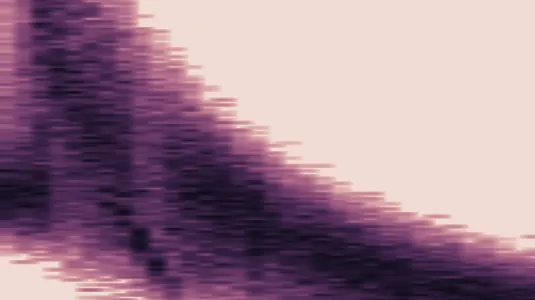
Every clear night, a telescope in the Chilean desert records light from distant stars, and in those recordings, like old ship logs, traces of weather remain. The thin dark bands in the spectrum are imprints of water vapor that hung over the observatory at the moment of observation.