The kilometer per second (km/s) is a unit of velocity commonly used in astronomy and astrophysics to express the speeds of celestial objects. It is defined as the distance traveled in one kilometer over the duration of one second. While everyday speeds are often measured in kilometers per hour or meters per second, cosmic velocities are so large that the kilometer per second provides a convenient scale: the Earth orbits the Sun at about 30 km/s, and the Sun orbits the Milky Way's center at roughly 220 km/s.
History
The unit became standard in the early 20th century as spectroscopic measurements of stellar velocities became routine, particularly after Vesto Slipher's observations of galaxy redshifts in the 1910s, which were reported in kilometers per second.
How it works
The unit is a straightforward ratio of distance to time, derived from the International System of Units (SI) base units. In practice, astronomers measure a star's speed by analyzing the Doppler shift of its spectral lines: a shift toward the blue indicates motion toward the observer, and a shift toward the red indicates motion away. The magnitude of the shift, combined with the known rest wavelengths, yields the radial velocity in km/s. For transverse motion, proper motion measurements across the sky are combined with distance to obtain a tangential speed, also expressed in km/s.
In practice
It is used universally in stellar kinematics, galaxy rotation curves, and cosmological expansion measurements, such as the Hubble constant, which is expressed in km/s per megaparsec.
Fun fact
The speed of light is about 299,792 km/s, so a star moving at 1 km/s is traveling at roughly 0.0003% of light speed.
Systems:SIOne kilometer per second is 1000 meters per second, defined as 1000 m/s.
It's like a sprint record: to break it, you need a perfect run-up. But for sub-millisecond pulsars, the run-up is too short. The fastest known pulsar, PSR J1748-2446ad, spins 716 times per second — faster than a kitchen blender. If it were the size of Earth, a point on its equator would move at about 0.24 times the speed of light. But why doesn't any pulsar spin even faster?
The solar wind is a continuous stream of charged particles flowing from the Sun. It has two main components: protons (hydrogen nuclei) and alpha particles (helium nuclei, four times heavier).
Decades of radio astronomy have listened to space, hoping to catch narrowband radio transmissions — the technogenic 'voice' of distant exoplanets. But our own technological evolution reveals a paradox: loud analog signals, like 1960s TV broadcasts, are just a brief squawk of a newborn civilization.
Perth residents know: when the daytime heat becomes unbearable, relief arrives from the ocean — a fresh breeze affectionately called the Freo Doctor. The same wind, only on a global scale, decides the fate of cosmic visitors plunging into the atmosphere. A meteorite fall is a two-act spectacle.
Interstellar space is not a cosmic desert, but a super-fast highway. Trillions of asteroids and comets from other systems race past us, yet camera-telescopes only catch a few. Imagine a night highway: the headlights of a distant car flash brightly, but if it zooms by too fast, the camera shutter can't click in time.
A giant cauldron of simmering soup stretches across millions of light-years. This is the atmosphere of the Perseus galaxy cluster — a cloud of scorching gas held together by gravity. Until recently, astronomers thought that in the center of this cauldron, the gas was calmly cooling, ready to condense into new stars.
The Sun's corona looks like a shaggy dandelion: bright petal-like loops hold hot gas near the surface, while long, tenuous jets escape into space between them. These jets, the heliospheric current sheet, stretch across the entire solar system.
A spinning top that whirls so fast it completes 220 rotations in a single second: that's exactly what China's FAST radio telescope has caught. This is the pulsar PSR J1810-0623, a neutron star the size of a city but with more mass than the Sun.
A standard laser rangefinder works like a stopwatch on a 100-meter dash: it times how long light takes to run to the target and back. But such a stopwatch has a limit: it ticks in steps of tens of picoseconds (trillionths of a second). In that step, light travels about a centimeter, so finer details are invisible.
Two laser beams, like two pencils, draw an invisible scale on the wall. One tip moves slightly faster than the other, and by the way their strokes alternately coincide and diverge, you can calculate the distance to the wall with an accuracy down to the thickness of a spider's thread.
In the new work, physicists made these two beams work continuously, without pauses.
For ten hours, the star HD 137010 dimmed a little, like a lamp with a speck of dust on it. The K2 telescope caught this in 2017, and in all the observing time, it happened only once. Astronomers realized: a planet had passed in front of the star.
This way of finding worlds is called the transit method. When a planet crosses the star's disk, the star briefly fades.
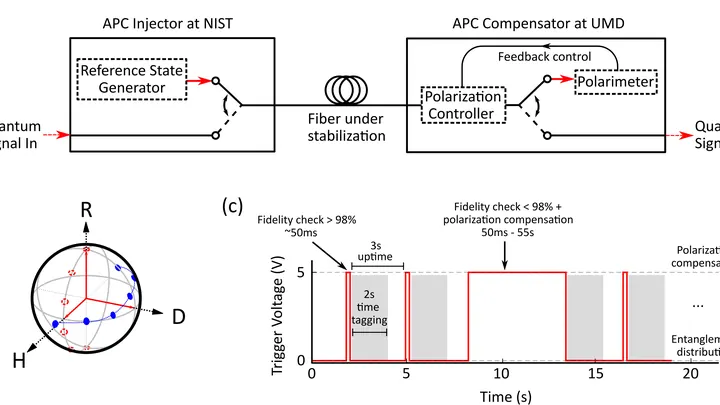
Two photons, like two halves of the same coin, fly tens of kilometers apart but remain linked: measure one, and you instantly know the state of the other. This property is called entanglement, and it underpins quantum communication.
The Solar System takes 210 million years to complete one orbit around the center of the Milky Way. The last time we were on this same side of the Galaxy, early dinosaurs were roaming the Earth. That number, 243.72 km/s, has now been refined thanks to rare stars that streak through the Galaxy like cannonballs.