The Australian Square Kilometre Array Pathfinder (ASKAP) is a radio telescope array located in Western Australia, designed to survey the southern sky at high speed. It consists of 36 dish antennas, each 12 meters in diameter, working together as a single instrument. ASKAP is a precursor to the future Square Kilometre Array (SKA) and has been operational since 2019, conducting large-scale surveys that have already led to significant discoveries in radio astronomy.
History
ASKAP was developed by the Commonwealth Scientific and Industrial Research Organisation (CSIRO) in Australia, with construction completed in 2012 and full operations beginning in 2019. It was designed as a technology demonstrator and survey telescope for the SKA project.
How it works
ASKAP uses phased array feeds (PAFs) on each dish, which allow it to observe a wide field of view (about 30 square degrees) simultaneously. This innovative technology enables rapid surveys of the sky, capturing radio emissions from celestial sources across a broad frequency range (700–1800 MHz). The signals from all dishes are combined using a powerful correlator to produce high-resolution images.
In practice
ASKAP is used for large-scale radio surveys, including detecting fast radio bursts (FRBs), mapping neutral hydrogen in galaxies, and studying transient cosmic events. Its wide-field capability makes it particularly effective for finding rare and short-lived phenomena.
Fun fact
ASKAP's phased array feeds were a world-first for radio astronomy, allowing the telescope to see an area of sky about 30 times larger than traditional radio telescopes at similar frequencies.
In the basement of the laboratory, an 8 tesla magnet hums. Inside it, like a bell in a bell tower, hangs a hollow copper cylinder tuned to a single note. If an axion, a dark matter particle, flies by, the cylinder responds with a faint ring. The trouble is that ordinary copper muffles this ring: at high frequencies, current flows only through a thin skin of the metal, and losses grow.
A storm in the upper atmosphere lasts a few millionths of a second. A cosmic ray, a proton or a helium nucleus, strikes air molecules, sending a swarm of particles downward. Most of them stay together, but occasionally one particle gains so much energy that it surges ahead.
The night sky is full of rings and bubbles, but in the radio band they look different. In data from the Australian radio telescope ASKAP, a structure has surfaced that resembles two soap bubbles blown from the same straw.
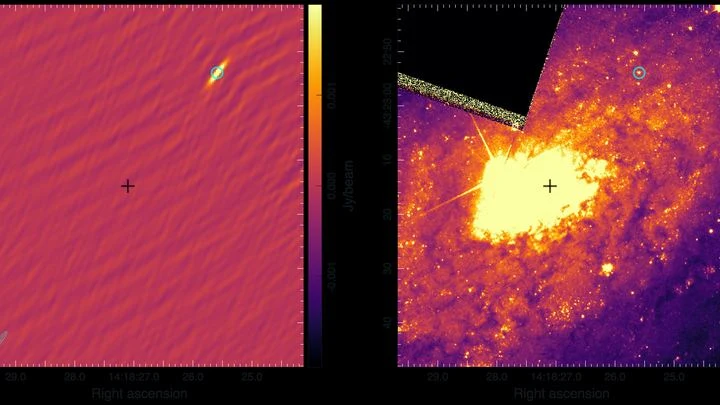
At the heart of nearly every large galaxy sits a supermassive black hole. Usually it behaves quietly, but sometimes, like a waking volcano, it spits out narrow plasma jets. These jets glow in the radio band, making the galaxy 'radio-loud.' Astronomers have long known this happens, but they couldn't catch the very moment of switching on.
A lighthouse flashes for a fraction of a second and goes dark again. The MeerKAT telescope in South Africa catches such flashes in the radio band. During its observations, it picked up 27 new sources that no one had seen before. Neutron stars are the remnants of exploded stars, compressed to the size of a city.
When an orchestra of thousands of musicians plays in harmony, the credit goes not only to each player's talent but also to the invisible work of the conductor.
At the heart of the system is a rail with clip-on antennas moving along it, each emitting a radio signal. The smartphone receives these and, knowing the speed of light, calculates the distance to each antenna from the time delay.
Throw a stone into water: right at the point of impact, the waves are chaotic — that's the near field. Farther out, they spread in smooth circles — the far field. This same principle governs antennas for terahertz communications — the future of super-fast internet.
3I/ATLAS burst into the Solar System like an uninvited guest, a gift of fate for hunters of extraterrestrial intelligence. This comet-like wanderer from the depths of the Galaxy flew close enough to be heard in all its details — unlike distant exoplanets.
At the center of many galaxies lurks a supermassive black hole, ejecting relativistic plasma jets over hundreds of kiloparsecs. One such is the radio galaxy ESO 137-G007 in the Norma Cluster, known as the “Corkscrew Galaxy” for its twisted jets.
In 2007, astronomers heard a mysterious millisecond click from space — that's how fast radio bursts, or FRBs, were discovered. Since then, they've become a cosmic-scale detective story: as bright as an entire galaxy and compressed into an instant, these signals race through the Universe at the speed of light.
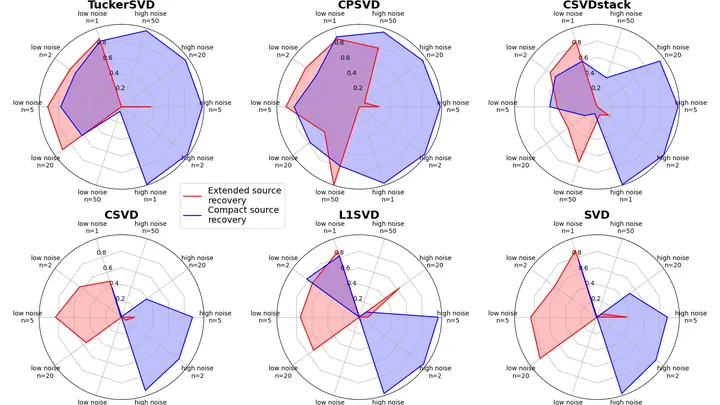
Imagine a philharmonic orchestra playing, but the microphone picks up only a blended roar — a tutti where double basses, flutes, and timpani all merge. Physicists have grappled with a similar task for decades, staring at fields of density, temperature, or magnetic induction.
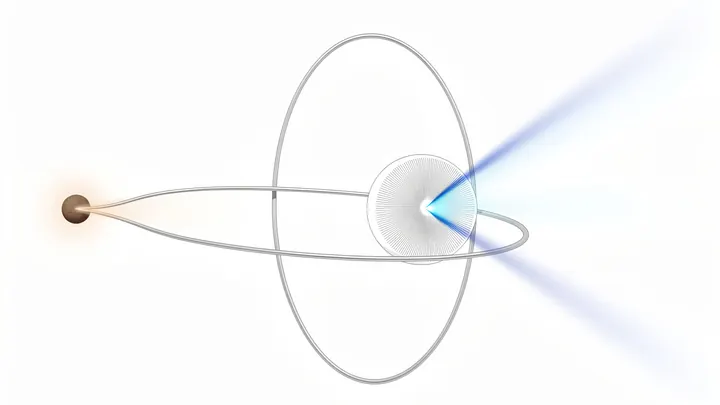
Long-period radio transients (LPTs) are a mysterious class discovered only recently. Their pulses last minutes or hours, and their nature was completely unknown. ASKAP J1745-5051, caught by the Australian telescope ASKAP, became the first to get a full explanation.
In 2022, astronomers began discovering strange cosmic beacons — long-period radio transients. Unlike fast pulsars, discovered by Jocelyn Bell Burnell in 1967, these objects flared with periods of tens of minutes and hours.
A lighthouse spins in dense fog. Its beam cuts through the gloom, but the fog itself remains invisible. That's roughly how astronomers search for dark matter: it doesn't emit light, yet it can affect the signals that reach us.
For decades, the search for extraterrestrial intelligence has waited for quiet, coherent signals from space — a kind of 'whistle' in the radio silence. However, our own technosphere has created a continuous radio background — the hum of a vast metropolis, emitted by all communications, radars, and broadcasting stations.
Searching for extraterrestrial signals is like trying to hear a whisper at a roaring stadium. The Green Bank Telescope listened to 70,000 stars, but 100 million bursts turned out to be earthly noise — from phones, satellites, microwave ovens.
A supernova explosion is the death of a massive star, leaving behind a gas cloud. If there's plenty of hydrogen around, the shock wave spreads like an echo from a distant gunshot.
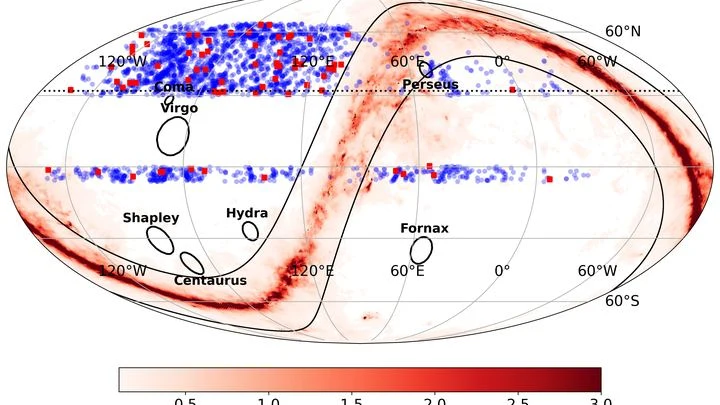
The night sky sometimes throws up riddles that take your breath away. One of them is a ring of galaxies stretching across a third of the horizon. Astronomers have named it the “Giant Ring on the Sky”: a cluster of galaxies stretched into a thin filament and closed into a circle about 400 megaparsecs in diameter.
The night sky looks calm, but if you listen in on the radio band, it's full of short clicks and rustles. Astronomers are combing the sky for solitary radio pulses — bursts lasting milliseconds that come from various corners of the Galaxy and beyond.
One such search is underway at the 100-meter radio telescope in Effelsberg, Germany.
On April 24, 2025, a celestial drum boomed over Alaska. Sunlight outshone the flash, and satellites missed the meteor. But the earth and air acted like a giant percussion instrument: dozens of ground microphones picked up a low rumble, and vibration sensors detected tremors. This provided a precise 'melody' of its flight.
Thousands of kilometers of fiber-optic cables lie on the ocean floor. They carry internet traffic, but the cables themselves sense the slightest vibrations in the water and the seabed. If you listen closely to such a cable, you can hear a blue whale singing or the ground trembling thousands of kilometers away.
If a supermassive black hole lives at the center of a galaxy, it heats the infalling gas to incredible temperatures. That gas glows, and we see it as a quasar — the brightest beacon in the universe. But how do you measure the size of the light source itself?
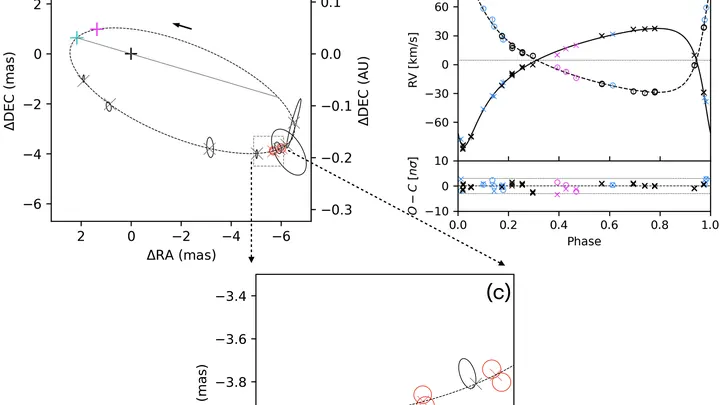
In the constellation Pisces, there is a star that people have seen for thousands of years, but only now have they discerned its inner structure. Alpha Piscium is not one star, nor even two, but a whole family: two pairs of stars bound by gravity. Astronomers had suspected that a third star lurked in the second pair, but they couldn't see it: it was too crowded.
The TESS telescope, like a patient sentinel, stares at the same stars for months, waiting for a planet to momentarily block its star's light. But the sentinel has blind spots: some dim red dwarfs only came into its field of view for a short time, so their planets could have gone unnoticed.
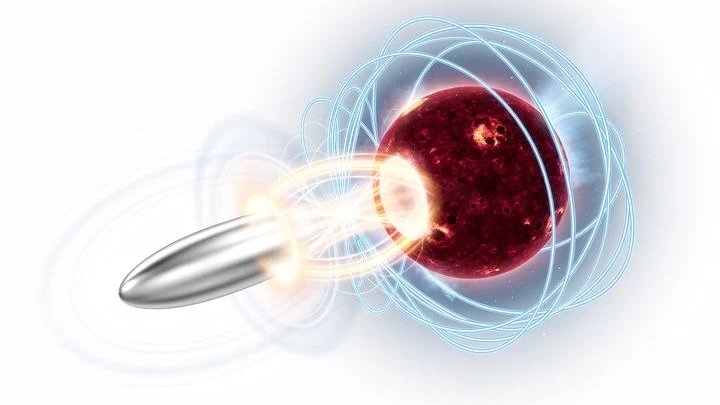
Astronomers caught a signal from a cosmic lighthouse — a radio pulsar with a period of 36 minutes. Unlike ordinary pulsars (neutron stars that spin hundreds of times per second), this one barely turned. It transmitted pulses for only eight days and vanished, visible only in the radio range.
The night sky is no longer as quiet as it used to be. Thousands of satellites are whizzing overhead, and each one can accidentally emit radio waves, interfering with astronomers trying to listen to distant galaxies. To make sense of this noise, scientists pointed the 21CMA radio telescope in China at Starlink satellite passes.
For a long time, astrophysics was dominated by the belief that giant jets of radio emission, radio outbursts blasting from central regions, were the exclusive privilege of elliptical galaxies. It was thought that only their calm, featureless internal environment could allow such colossal fountains of energy, powered by supermassive black holes, to form.
When two galaxies collide, their central black holes begin a long dance of approach. Until they merge into one, we can see a pair of quasars — bright beacons that ignite as the black holes consume gas and dust. Such pairs in the sky are like two lighthouses standing close together, each shining from its own harbor.
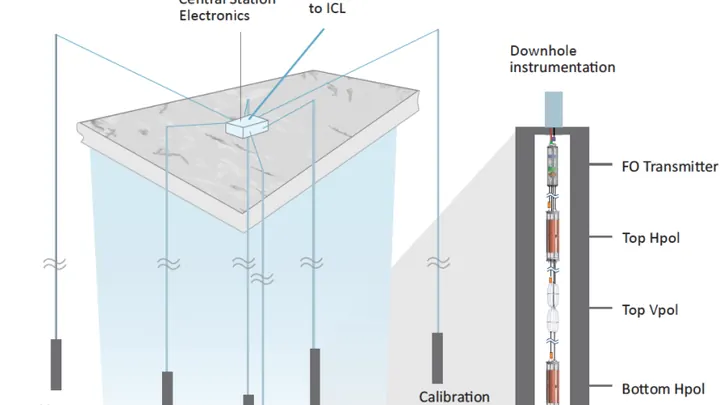
Deep within the Antarctic ice, at depths where sunlight never reaches, antennas hang suspended. They listen not for sounds but for radio waves, waiting for a signal from a particle that is nearly impossible to catch. A neutrino passes through the Earth like a bullet through fog, but occasionally, very rarely, it grazes an ice atom.
Radio telescopes are like ears listening to space. Usually, there's just one ear: it picks up a signal from a single tiny spot in the sky. That's slow. The Parkes telescope in Australia now has 72 ears working at once.
In the neighboring galaxy, the Large Magellanic Cloud, lives the binary system A0538-66. There, a neutron star — a tiny sphere the size of a city but heavier than the Sun — spins on its axis every 69 milliseconds.
Light from the hottest young stars usually cannot leave its galaxy: hydrogen absorbs it, like a thick curtain blocking a sunbeam. But sometimes the curtain parts, and ultraviolet photons burst into intergalactic space.
Light aimed at a metal needle typically scatters sideways, and only a small fraction collects at the very tip. To squeeze it into a spot just a few atoms across, microscope optics are made expensive and bulky, and the distance to the sample becomes tiny. The new work proposes a tip that focuses light on its point by itself, like a funnel gathering rainwater into a narrow neck.
For twelve years, astronomers at the LPA radio telescope in Pushchino have been listening to the same patch of sky — the direction of the galaxy 3C 33. In that time, they caught just six short radio signals, each lasting from one to four minutes.
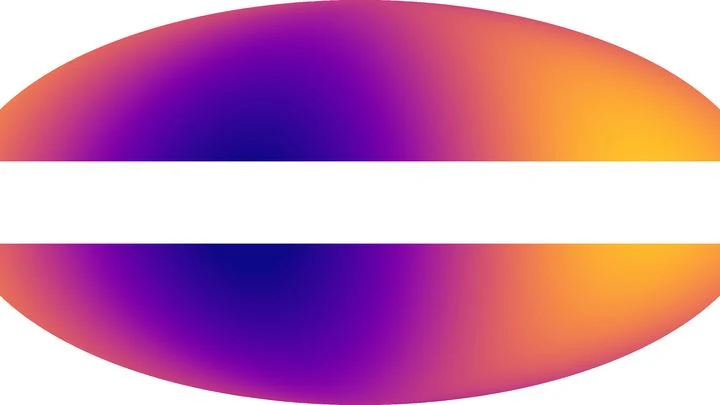
A distant radio signal travels toward us through gas, and the more gas it encounters, the more the signal is 'slowed down.' Astronomers use this to weigh the invisible envelope of our Galaxy: its halo. But if the halo is uneven, like a thick scarf draped over the shoulders, measurements in different directions will differ.
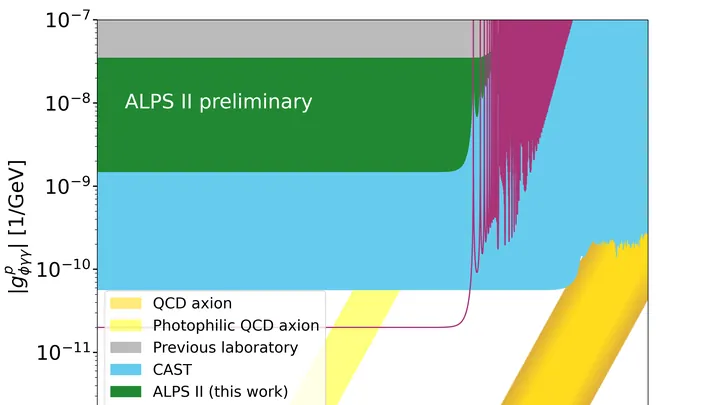
At the DESY lab, the ALPS II experiment was launched to hunt for axions — hypothetical ghost particles that might make up dark matter. This invisible mass acts like a skeleton, preventing galaxies from flying apart due to their spin.