How to Hear the Earth's Crust Cracking in Advance express
Seismologists catch every underground tremor the way a doctor listens to a heart. But small earthquakes have weak and fuzzy signals: it's hard to tell exactly where the rock shifted. Usually, scientists look at the first wave motions: compression or dilation. But if the tremor starts gently, without a sharp snap, the picture gets blurred.
The new method FocMecDR does things differently. Instead of analyzing each tremor in isolation, it compares two neighboring earthquakes whose wave paths are nearly identical. One serves as a 'reference' with a known slip mechanism. The second is adjusted to match it, like a translator checking a tricky phrase against an already translated one. This way, the precise rupture direction can be extracted even from a weak signal.
This approach opens the door to assessing a fault's 'readiness' for a large earthquake. When stress in the crust becomes homogeneous, like a taut string, it's a warning sign. Perhaps one day seismologists will be able to warn of major tremors not just seconds in advance, but days.
Original abstract
as written by the authors arXiv:2603.27860
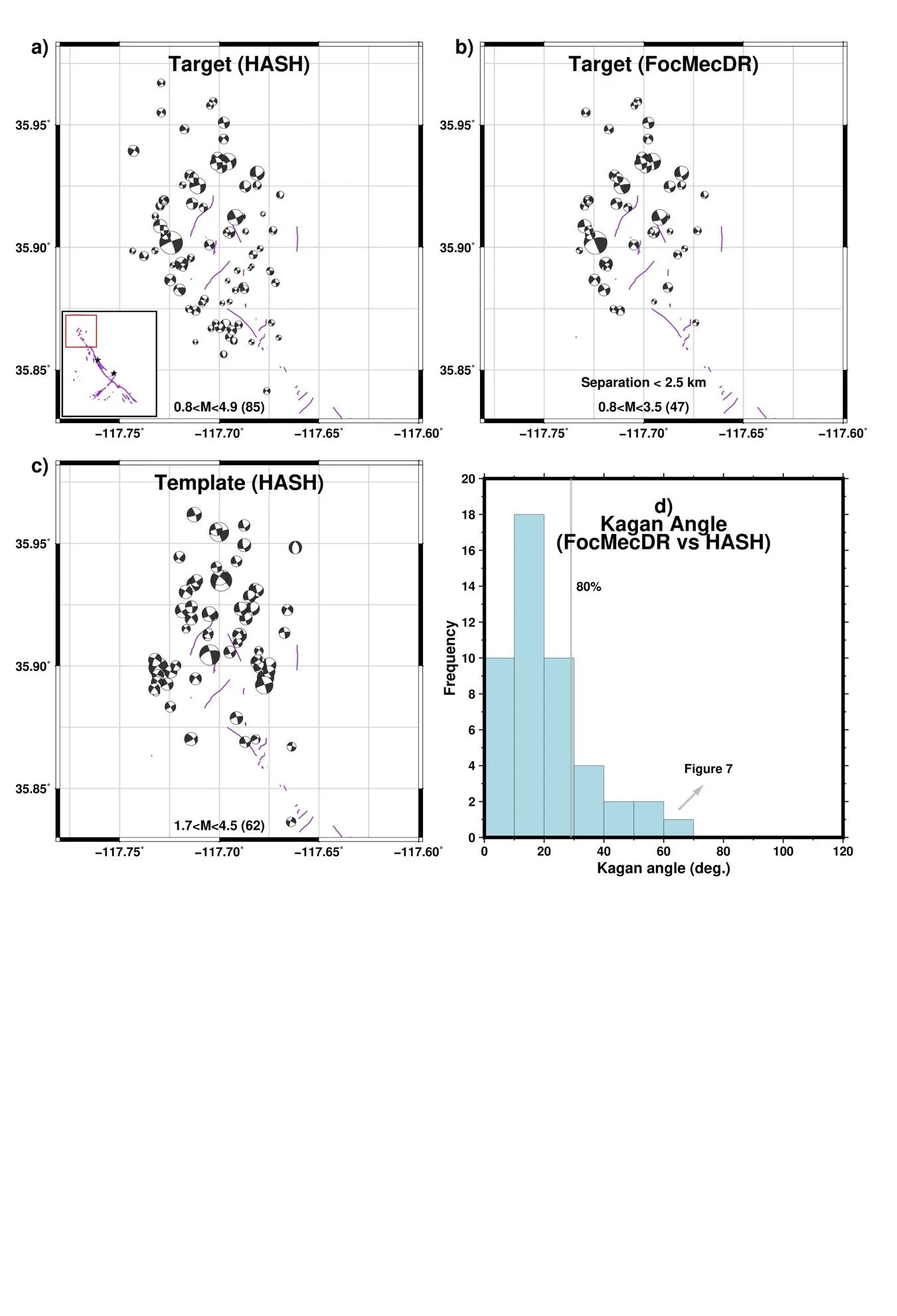
Focal mechanisms of small earthquakes are critical for characterizing faults and regional stress. P-wave polarities and S/P amplitude ratios (e.g., in HASH) are widely used to determine focal mechanisms for small earthquakes, but first-motion picking can be difficult for emergent onsets, and S/P ratios are often highly inconsistent because of imperfect velocity models and unknown site responses. Here, I present FocMecDR, a relative focal-mechanism inversion method that uses relative polarities and double ratios of S/P amplitudes. Analogous to double-difference earthquake location, FocMecDR uses a reference event with a known focal mechanism to solve focal mechanisms for nearby earthquakes by minimizing the misfit between observed and theoretical S/P amplitude double ratios while enforcing cross-correlation-based relative polarities. Extensive synthetic tests demonstrate the effectiveness and accuracy of the method. Field verification using an antisimilar earthquake pair and aftershocks from the northwestern end of the 2019 Ridgecrest rupture zone further confirms its reliability. Application to the foreshocks preceding the 2019 Ridgecrest mainshock reveals a highly uniform stress field during nucleation, suggesting a possible framework for evaluating fault-zone stress and rupture readiness before large earthquakes.
The word 'seismograph' comes from the Greek words 'seismos'—shaking, and 'grapho'—to write. The first such device was invented by Chinese scholar Zhang Heng back in 132 AD: a bronze vessel with a pendulum that dropped a ball into a frog's mouth during an earthquake.
In Isaac Asimov's novel 'The End of Eternity,' technicians control time, but even they cannot predict earthquakes, the dynamics of the Earth's crust are too chaotic.