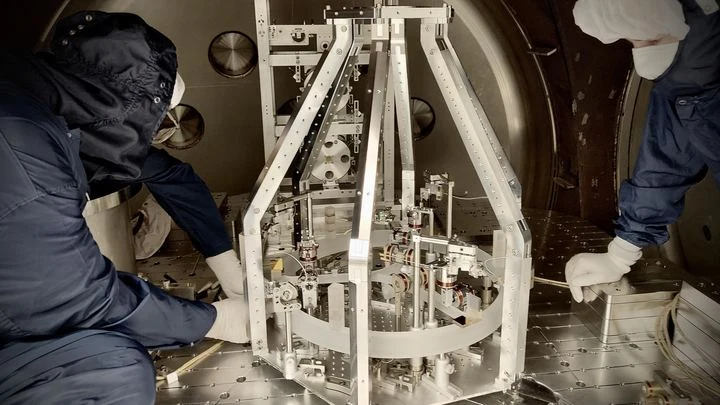
A seismometer is an instrument that detects and records ground motion, from the faintest tremor to the violent shaking of a major earthquake. It works by sensing the displacement, velocity, or acceleration of the ground relative to a reference mass that remains nearly stationary due to inertia. Modern seismometers are so sensitive they can pick up vibrations from ocean waves, distant storms, and even the subtle pull of the Moon on the Earth's crust.
History
The first practical seismometer was invented in 1875 by Filippo Cecchi in Italy. Earlier devices, like the Chinese seismoscope from 132 AD, could indicate the direction of an earthquake but did not record its motion over time.
How it works
The classic design uses a mass suspended by a spring or pendulum. When the ground moves, the frame of the instrument moves with it, but the mass tends to stay put due to inertia. The relative motion between the mass and the frame is measured, typically with a coil and magnet (electromagnetic) or a laser interferometer. This signal is amplified and recorded digitally, allowing scientists to reconstruct the ground motion over time.
In practice
Seismometers are essential for earthquake monitoring and early warning systems, and they are also used to study the Earth's interior structure, detect nuclear explosions, and monitor volcanic activity.
Fun fact
Seismometers are so sensitive that they can detect the tiny ground movements caused by a person walking nearby, which is why they are often installed in quiet, remote locations.
Imagine a string stretched between two tuning pegs. The slightest touch makes it vibrate, and from the pitch you can guess exactly how it was plucked. Physicists at the University of Arizona have stretched a similar string — not on a musical instrument, but on a silicon membrane just a hundred nanometers thick.
A magnet weighing just a few grains of sand hovers in midair with no support. It doesn't touch the walls, doesn't rub against bearings — it just hangs in a magnetic trap like a speck of dust in a sunbeam. Researchers have turned this tiny object into an ultra-sensitive compass: the device detects changes in the magnetic field of 23 femtotesla.
If a smell seeps into a room through a slightly open door, you could stand in the middle and sniff. But the most accurate way to catch the moment the smell arrives is to stand right at the threshold. A cell behaves much the same way when it needs to measure the concentration of a substance around it.
The orchestra plays, but the musicians can't hear each other. The conductor keeps stopping the music and walking over to each player to tune the instrument. That's roughly how space telescopes with segmented mirrors work.
A regular radar works like an amateur photographer: it takes a series of blurry snapshots and tries to stitch them into a panorama. Details are smeared, and in a long corridor or crowd, the robot easily gets lost.
The principle is simple: like a bat, the radar emits a wave and catches the echo.
When a building collapses, steel rebar turns into a chaotic magnetic compass. Entropy, a measure of disorder, increases, but it's this very disorder that points to voids where people might be.
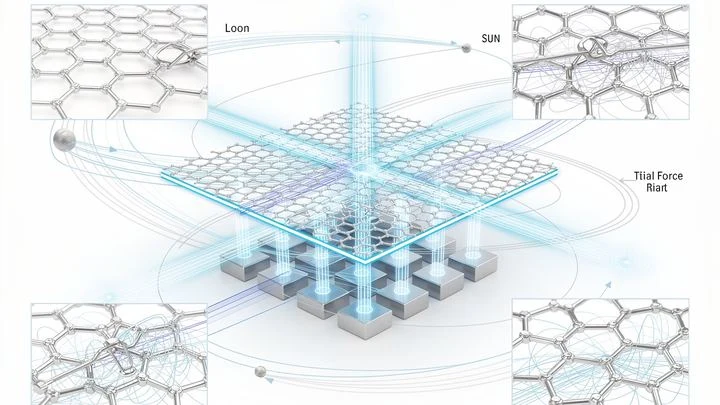
In the quiet of a laboratory, a graphite flake hovers above a magnetic grid. This is not just a demo of diamagnetism's magic — it's listening to the Universe. Like a spider casting its web to catch vibrations from an invisible world, this flake has become a gravitational web.
A levitating dust grain in an optical trap is an ideal pendulum for measuring gravity. It hangs in vacuum, never touching the walls, and its motion depends only on external forces. The new work proposes an improved sensor: a mechanical 'squeezed' qubit based on a nonlinear oscillator.
Gravitational waves are ripples in space from the mergers of black holes and neutron stars. Existing detectors, built with contributions from Kip Thorne and Rainer Weiss, work like highly sensitive microphones but only hear the highest 'notes'.
Back in the 1960s, physicist Joseph Weber tried to catch gravitational waves using aluminum cylinders: they were supposed to tremble like tuning forks from the ripples of spacetime.
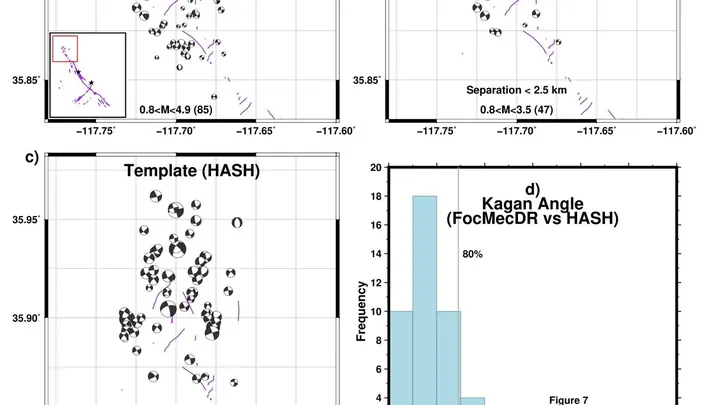
Seismologists catch every underground tremor the way a doctor listens to a heart. But small earthquakes have weak and fuzzy signals: it's hard to tell exactly where the rock shifted. Usually, scientists look at the first wave motions: compression or dilation. But if the tremor starts gently, without a sharp snap, the picture gets blurred.
Thousands of kilometers of fiber-optic cables lie on the ocean floor. They carry internet traffic, but the cables themselves sense the slightest vibrations in the water and the seabed. If you listen closely to such a cable, you can hear a blue whale singing or the ground trembling thousands of kilometers away.
In laboratories where atoms are cooled to near absolute zero, even a tiny change in the magnetic field throws off all the settings. Conventional sensors, Hall plates or coils with ferrite cores, sit a few centimeters away from the vacuum chamber because they themselves create interference.
A seismometer is the planet's ear. It picks up the faintest tremors in the ground and turns them into an electrical signal. But this ear isn't perfect: its sensitivity depends on temperature. In the cold and in the heat, the instrument hears slightly differently, and that introduces error into measurements.
Even Einstein predicted gravitational waves — a trembling of the very fabric of spacetime. Today they are captured by gigantic installations like LIGO, created thanks to Rainer Weiss and Kip Thorne.
Ultra-precise scales that catch the slightest changes in gravity work like a keen ear: they hear even the whisper of distant underground voids or the tremors of the Earth's crust. But such instruments have a hidden enemy: their own internal clocks. Time inside the sensor also jitters, and this jitter smears the picture.
A spring scale in a geologist's backpack responds sensitively to every mountain and valley beneath their feet. But springs get tired, and their readings drift — the instrument needs frequent recalibration against a reference. An atomic gravimeter measures gravity flawlessly, but it's the size of a refrigerator and doesn't like being jostled.
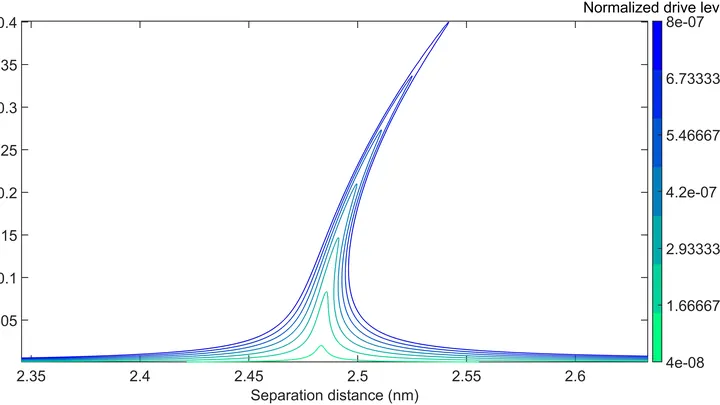
The tip of a tunneling microscope hovers above a surface at a distance smaller than the diameter of an atom. Usually, it feels out the topography like a finger reading a page of Braille. Now, that same tip has learned to listen to how a membrane the size of a fingernail trembles.
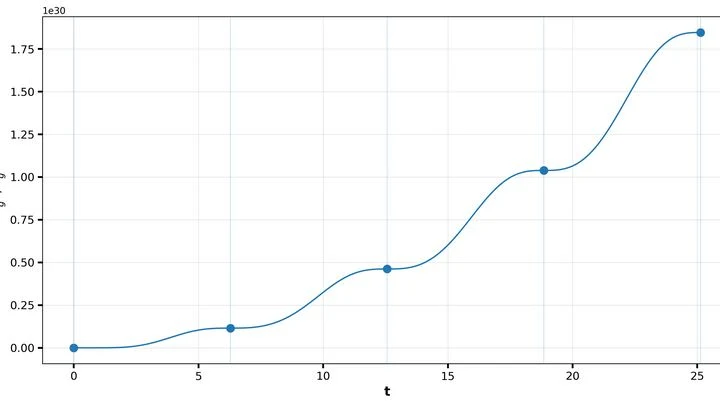
According to Einstein's theory, Earth's rotation drags space-time itself along — like a spoon dragging thick honey. This effect is incredibly weak: about one revolution in billions of years. But it can be caught.
A meteorologist looks at a map where clouds gather in flocks, like birds before a storm. Each spot on the radar could be a future downpour or just noise. Earth system forecasting is like trying to assemble a puzzle with thousands of pieces that keep changing shape.