The crust of a neutron star is the thin, solid outer layer that sits atop the star's incredibly dense interior. Although it is only about a kilometer thick — a mere skin compared to the star's roughly 10-kilometer radius — it is the most rigid material known in the universe. This crust is not a uniform shell; it is composed of a lattice of atomic nuclei, mostly iron and other heavy elements, immersed in a sea of free electrons and neutrons. The crust is prone to cracking, and these cracks are thought to be the source of some of the most energetic phenomena observed in neutron stars, such as starquakes and glitches.
History
The concept of a solid crust on neutron stars was developed in the late 1960s and early 1970s, with key contributions from theorists like Malvin Ruderman and others who studied the structure and dynamics of these compact objects.
How it works
The crust forms as the neutron star cools after its birth in a supernova explosion. The outer layers solidify into a crystalline lattice, while the inner regions remain a fluid of neutrons and protons. The crust is held together by the immense gravitational pressure, but it is also under enormous stress from the star's rapid rotation and magnetic field. When the stress exceeds the breaking strength of the lattice, the crust fractures, releasing energy in the form of seismic waves and possibly altering the star's rotation. This process is analogous to earthquakes on Earth, but on a vastly larger scale.
In practice
Studying the crust helps astrophysicists interpret observations of pulsar glitches and starquakes, providing insights into the internal structure and equation of state of neutron stars.
Fun fact
The crust of a neutron star is so strong that it can support 'mountains' only a few millimeters high, yet these tiny deformations can emit gravitational waves detectable by observatories like LIGO.
Pulsar PSR J0614-3329 spins 318 times per second. A point on its equator moves at about 10% of the speed of light. From a distance, the star looks like a lighthouse spinning so fast that its beam blurs into a continuous ring.
Deep inside a neutron star, where matter is compressed to the density of an atomic nucleus, neutrons form a superfluid and protons form a superconductor. A neutron vortex is a quantized vortex in the superfluid, akin to a miniature whirlpool that cannot stop spinning.
At the center of a neutron star, matter is compressed so tightly that a teaspoon weighs a billion tons. You'd think there's no better place to look for signs of quantum gravity. But between the laboratory and the fundamental scale lies a chasm of 10⁸⁰ in density.
Three doors lead into this room.
A neutron star is what remains after a massive star explodes. Its matter is compressed so tightly that a teaspoonful would weigh billions of tons. Under such conditions, protons and neutrons can rearrange, and new particles (hyperons, similar to neutrons but containing a 'strange' quark) can appear.
An interpreter gets distracted by every rustle in the hall, and a one-hour meeting stretches into two. A neutron star compresses a solar mass into a sphere the size of a city, and the matter in its core is denser than an atomic nucleus. Physicists cannot probe its structure in the lab: the required pressures are unattainable.
A sculptor shapes mountains from magnetic fields and heat, but the stone resists. A neutron star, the ultra-dense remnant of a supernova explosion, in a binary system pulls matter from its companion star. This infalling matter heats the star's crust unevenly, while the magnetic field tugs from within.
Two nuclei with the same number of particles but different neutron skin shapes collide at speeds close to the speed of light. Ruthenium-96 and zirconium-96 are like twins, one with a slightly thicker coat. This difference changes how particles carry charge in the fireball of the collision.
A lighthouse doesn't flash steadily but in short, bright pulses. The neutron star in the system 4U 1323-62 is such a lighthouse in the X-ray range. It pulls gas from a companion star, and when enough material accumulates on its surface, a thermonuclear explosion occurs — an X-ray burst.
The atomic nucleus is not a bag of marbles but an ordered structure where protons and neutrons fill shells, much like electrons in an atom. When a shell is filled, the nucleus becomes especially stable, and the number of particles is called magic. For calcium with 20 protons, the classic magic neutron numbers are 20 and 28.
The atomic nucleus is usually pictured as a dense ball where protons and neutrons are mixed together. But in some isotopes, neutrons can stick out far beyond this ball, forming a diffuse shell — a neutron halo. This is especially common in nuclei with many more neutrons than protons.
A white dwarf is the former core of a star like the Sun, squeezed down to the size of Earth. A teaspoon of its material would weigh several tons. A neutron star is an even denser remnant: a city the size of Manhattan, but with more mass than the Sun.
A neutron star is the ultra-dense remnant of a supernova: the mass of the Sun packed into a sphere the size of a city. For billions of years, it travels through space, gathering around itself invisible matter, dark matter, which emits no light but pulls with gravity.
In nuclear physics, a puzzle has long been nagging: why among elements lighter than bismuth, only technetium (No. 43) and promethium (No. 61) have no stable isotope at all? All their neighbors in the periodic table can boast at least one long-lived variant, but these two seem to fall out of the general pattern.
Edge of the spotlight. Remove the dazzling light of the central star, and a theater of shadows emerges. The James Webb coronagraph, like a dense curtain, hid the star TW Hydrae — and on a stage 120 astronomical units long (four times the distance to Neptune), its protoplanetary disk came alive.
A star's radius drops by a thousand kilometers. Not because its mass increased, but because its own magnetic field squeezed the crust like an invisible corset.
89 milliseconds. That's how long a vortex avalanche lasts that abruptly speeds up the rotation of the Vela pulsar — one of the most famous 'glitching' pulsars. Pulsars are rapidly spinning neutron stars born in the collapse of supernovae.
A heaping teaspoon, and the scale reads a billion tons. That's roughly what a teaspoon of neutron star matter would weigh if you could scoop it up and put it on a scale. Such objects are born after a supernova explosion: the star's core collapses into a sphere the size of a city, and the density exceeds that of an atomic nucleus.
At the center of every atom lies a nucleus — a dense ball of protons and neutrons. These particles don't just crowd together randomly; they fill strict energy levels, much like floors in a skyscraper. When a floor is completely filled, the nucleus becomes especially stable — physicists call this a magic number.
The interiors of neutron stars are a realm of degenerate matter. Here, protons condense into a superconducting condensate, threaded by quantum vortices. Imagine tiny magnetic tops: each carries a quantum of magnetic flux and glides through the electron fluid.
Neutron stars — remnants of supernovae — are among the densest objects in the Universe. Their central density exceeds nuclear density many times over, and gravity is surpassed only by black holes.
In nuclear physics, the belief long reigned that two neutrons cannot form a bound state — they attract too weakly and immediately fly apart. However, on the surface of neutron-rich nuclei, where the matter density drops to a thousandth of normal nuclear density, the situation changes dramatically.
Hundreds of light-years away, there's a planet that looks like a giant mirror. LTT9779b reflects most of the light that hits it — far more than you'd expect from a Neptune-sized body. Astronomers have long debated what makes it so shiny: a thick carbon-rich haze or a layer of clouds.
The James Webb Space Telescope has helped settle the debate.
Neutron stars are the final chord in the evolution of massive suns. Born in the cataclysm of a supernova, they pack a mass comparable to the Sun's into a sphere the size of an earthly metropolis.
A neutron star is the core left behind after a massive star explodes. Its matter is so compressed that a teaspoonful would weigh billions of tons. But the exact size and mass of such objects remain debated. A team of astronomers studied the system EXO 0748-676, where a neutron star pulls matter from a normal companion star. It occasionally flares up and then quiets down.
Hidden in the globular cluster Terzan 5 is the binary system IGR J17480-2446. One of its members is a neutron star that behaves strangely. It spins at just 11 hertz (11 revolutions per second) and cools suspiciously slowly after an outburst. Usually, such stars spin hundreds of times faster and cool briskly — here, it's the opposite.
In the depths of the ocean, where light never reaches, a plan is taking shape to capture particles that barely interact with anything. Geoneutrinos, tiny messengers from the scorching mantle, are emitted during the decay of uranium and thorium. Their flux carries information about how much heat lies hidden beneath our feet.
When two superdense stars circle in a tight dance, the space around them shudders. This shudder, gravitational waves, is caught by giant detectors on Earth. But deciphering the signal is tricky: you need to figure out what exactly you're dealing with — a pair of black holes or neutron stars.
The atmosphere of Titan, discovered by Christiaan Huygens, is opaque to ordinary telescopes. But spectral analysis finds 'windows' of transparency — narrow regions where the haze parts.
A neutron star is a gravitational lens that focuses our attempts to glimpse dark matter. Through its ultra-dense matter, like exotic glass, we search for the axion — an elusive particle that could explain the hidden mass of the universe.
The story began with a puzzle: in the 1930s, Fritz Zwicky noticed that clusters of galaxies behave as if an enormous invisible mass is hidden within them. Half a century later, Vera Rubin confirmed that stars on the outskirts of galaxies rotate too fast to be held by visible matter alone.
Neutron stars are cosmic 'ice cubes' of unimaginable density: a tablespoon of their material would outweigh Mount Everest. It was a mystery what lay in their cores: ordinary neutron matter (a giant atomic nucleus) or exotic quark matter, where particles are not bound into neutrons.
Somewhere in the galactic bulge, a massive star lies dormant, ready to trade quiet burning for collapse. Its core will exhaust its fuel, and in a fraction of a second, a neutron star or black hole will be born, releasing 10⁵⁸ neutrinos — almost all the energy of the explosion.
Among the hundreds of moons in the Solar System, Nereid dances the most desperate dance: diving toward Neptune as close as 1.4 million kilometers, then soaring away to 9.7 million — all within less than an Earth year. An eccentricity of 0.75 — the brand of a captured wanderer.
Imagine a spinning top the size of a city, weighing more than the Sun and making hundreds of revolutions per second. That's a neutron star — the remnant of an exploded star. Occasionally, its rotation suddenly speeds up, as if something inside has switched. Astronomers call these jumps glitches and suspect that invisible vortices in the star's superfluid interior are to blame.
Neutron stars are super-dense spheres of the remnants of exploded stars. Some of them we see as pulsars — cosmic lighthouses sending out radio bursts. What's inside them long remained a mystery. Physicists assumed that hidden fields could affect their structure, but it was believed that if the field is short-range, its effect is negligible.
Inside a neutron star, matter is compressed so intensely that atomic nuclei fuse into long strands and flat sheets. Astrophysicists call these structures nuclear pasta. At their surface, the density of matter plummets to nearly zero, like diving out of thick jelly into thin air.
It's this sharp transition that creates the unusual effect.
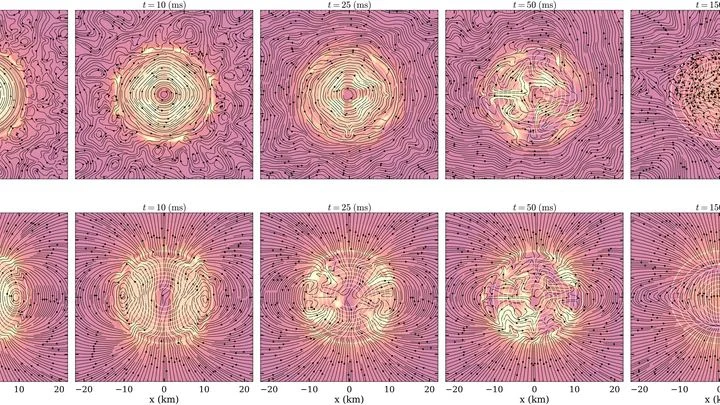
A neutron star is a sphere the size of a city but with the mass of an entire Sun. Its magnetic field can tear atoms apart from thousands of kilometers away. Yet until now, it was a mystery how this field is arranged inside: whether it is twisted into tight ropes or more like neat lines radiating from the poles.
Imagine a packed dance floor where dancers glide without any friction — passing through each other without a touch. That's a superfluid. In a neutron star's crust, neutrons could behave this way, but a rigid lattice of ions gets in the way, like suddenly sticking the dance floor full of pillars.
In the standard picture, black holes are the undisputed density champions: all their matter is squeezed into a single point. Imagine the entire mass of Mount Everest packed into a grain of salt. But physicists have found a theoretical trick.
A supernova is the final explosion of a massive star, scattering its material over light-years. Inside the expanding shell, a neutron star remains, and the shell itself continues to plow through interstellar gas for thousands of years.