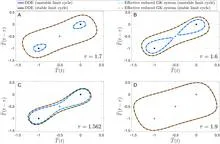
A Hopf bifurcation is a critical point where a system that was sitting still suddenly starts to oscillate. Imagine a ball resting at the bottom of a bowl: it stays put. If the bowl's shape slowly changes until the bottom becomes a small hill, the ball rolls off — but in a Hopf bifurcation, instead of flying away, the ball settles into a steady circular motion around the hill. The system trades a stable fixed point for a stable periodic cycle.
History
Named after Eberhard Hopf, who published the mathematical conditions in 1942, though the phenomenon was earlier recognized in fluid dynamics by Alexander Andronov and others in the 1930s.
How it works
The system has a control parameter, like the strength of a force or a flow rate. As this parameter crosses a threshold, a pair of complex-conjugate eigenvalues of the linearized dynamics crosses the imaginary axis. Below the threshold, small disturbances die out; above it, they grow and then saturate into a limit cycle. The amplitude of the oscillation grows continuously from zero, so the transition is often smooth rather than abrupt.
In practice
It explains the onset of vortex shedding behind a cylinder, the flutter of airplane wings, and the emergence of oscillations in chemical reactions like the Belousov–Zhabotinsky reaction.
Fun fact
The same mathematics describes the transition from a steady flame to a flickering one in a candle under certain conditions.
If you squeeze water between two glass plates so that only two layers of molecules fit, it becomes something between a liquid and ice. At room temperature, molecules in such a trap still move but arrange themselves into a semblance of a crystal lattice.
In some materials, electric current can flow without any loss: this is superconductivity. But before becoming a superconductor, a substance often passes through a strange state: electrons already sense each other and form pairs, yet they cannot move in unison.
A ball on a slope with two pits usually rolls into the nearest one and comes to rest. But if the slope is slightly deformed and 'remembers' recent nudges, the ball can hang around halfway for a long time — in a narrow spot it doesn't want to leave. That's exactly the trick physicists played with light.
In a pot of boiling water, steam bubbles rise and pop. In the quantum world of a superfluid, bubbles behave differently: they can collide and give birth to vortices — tiny swirling flows, like whirlpools in a river.
Scientists modeled such a liquid using a holographic approach.
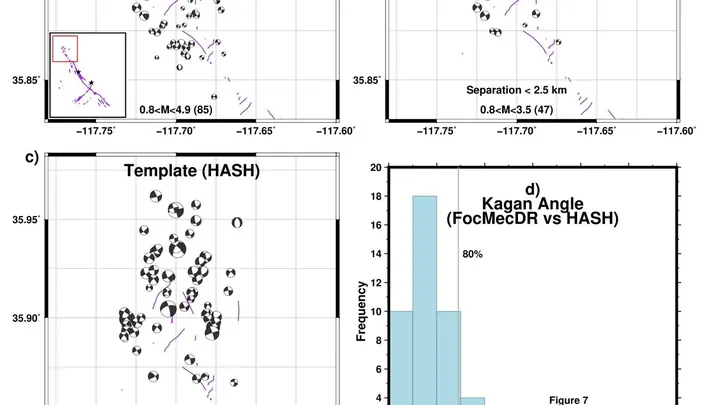
Seismologists catch every underground tremor the way a doctor listens to a heart. But small earthquakes have weak and fuzzy signals: it's hard to tell exactly where the rock shifted. Usually, scientists look at the first wave motions: compression or dilation. But if the tremor starts gently, without a sharp snap, the picture gets blurred.
A quiet tube with a heated grid inside. The voltage on the grid is suddenly raised, and the tube starts to hum, sustaining itself. This is not a malfunction but a transition to another stable state, like a ball rolling over a hill into a neighboring hollow.
Cells on the surface of an embryo resemble grains of rice that can align in one direction. This order is called nematic. It arises when cells start acting in concert, like a school of fish swimming in the same direction.
Bacteria in a drop of water jostle and swim: each on its own, but together they create patterns. With weak motion, the fluid churns like soup on a high flame: vortices collide, and the flow direction changes every second. This is called bacterial turbulence.
Snap the bottom of a soda can: it will dent inward and stay that way. Press again: it pops outward. That's bistability: a system with two stable states, like a light switch. An elastic arch is the simplest example. It can curve upward or downward, and to flip it, you need to apply force.
An ordinary top spun on a table slows down smoothly: friction with the air and the surface gradually eats away its energy. But if a top levitates in a magnetic field and barely touches anything, its rotation can behave surprisingly capriciously.
The Pacific Ocean remembers. Water warmed off the coast of Peru drifts slowly westward, and six months later its heat returns to South America. Scientists call this six-month journey the delay. It turns a simple climate model into a maze where the route depends not only on your current position but also on where you were half a year ago.
The ocean off Peru is not just warm: it pulses. Every few years, the winds die down, warm water creeps eastward, and fishermen are left empty-handed. This is El Niño, and its arrivals do not follow a simple schedule. Some researchers blamed random weather gusts, others sought chaos in the climate system itself.
Every few years, the Pacific Ocean off the coast of Peru warms up, and then fields dry out in Australia while deserts in Chile get drenched. This phenomenon is called El Niño.
A pendulum swings steadily until gusts of wind disturb it. Each push shifts the rhythm slightly, and soon the beats no longer match the metronome. Natural oscillators live the same way: the heart, populations, climate cycles—they all oscillate, but randomness constantly interferes.