Plasma Pulse: What Makes a Tokamak Tremble express
Inside a tokamak, a donut-shaped device where magnetic fields confine plasma, the hot gas of charged particles can start to tremble. At first, everything is calm, but then the temperature drops sharply, and sawtooth edges appear on the graph. These events are called sawtooth oscillations, and they can interfere with the start of a fusion reaction.
For the first time, scientists have calculated in detail how such oscillations arise in the planned SPARC reactor. They used a computer model that accounts for the three-dimensional behavior of plasma and its electrical properties. It turned out that the main culprit is an internal instability, similar to the twisting of a bundle of magnetic field lines. When the twisting becomes too strong, the plasma suddenly rearranges, and the temperature drops.
The calculations showed that even a small change in temperature or the shape of the current inside the plasma can strongly affect the moment of the crash. If stabilizing factors, such as fast particles, are not taken into account, the crash occurs almost immediately after the twisting reaches a critical level. This means that in the real SPARC, sawtooth oscillations may start earlier than expected and will need to be controlled.
Understanding these oscillations will help predict more precisely how much heat the plasma loses, and ultimately bring the launch of the first fusion power plants closer.
Original abstract
as written by the authors arXiv:2604.02172
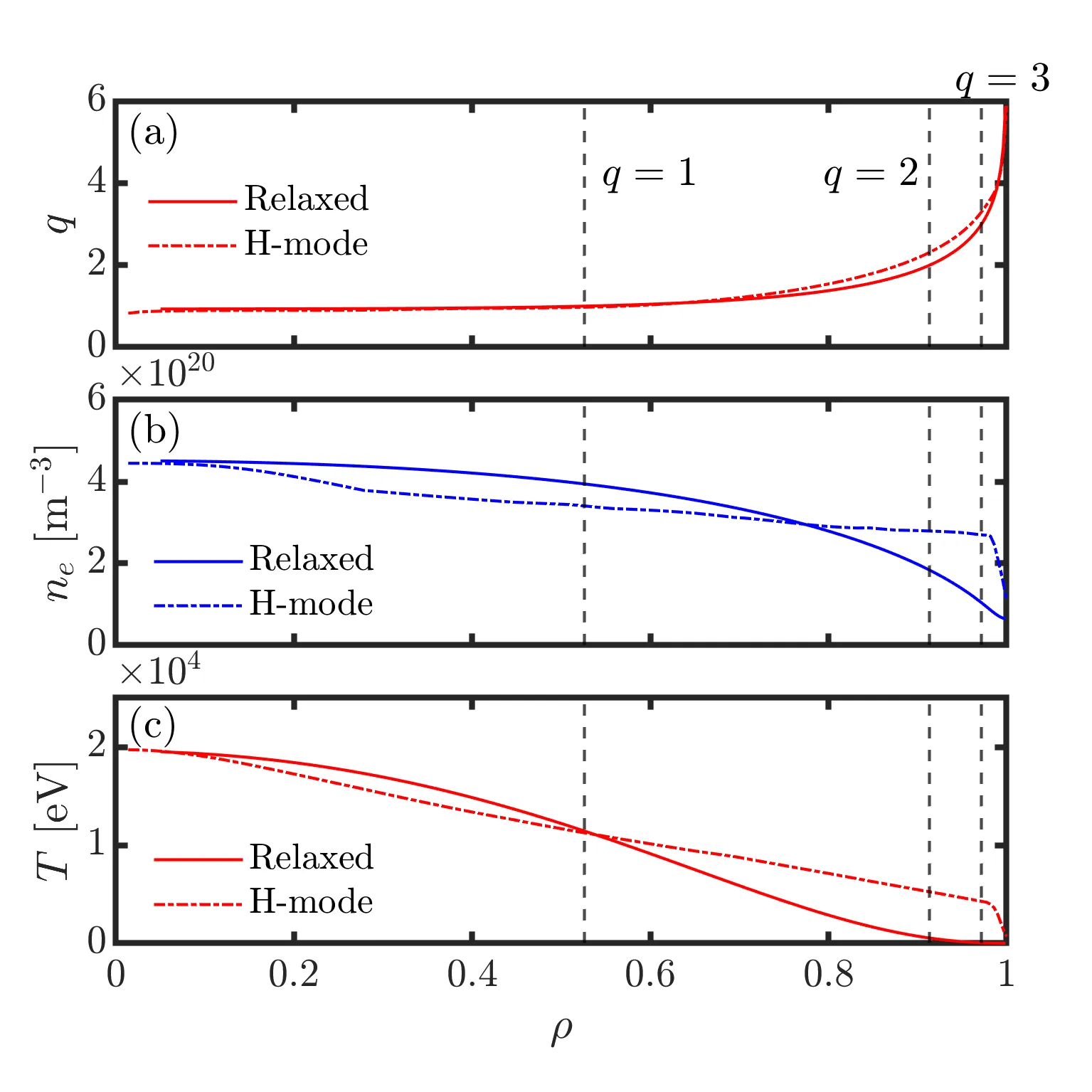
A relaxed baseline case, based on the SPARC Primary Reference Discharge (PRD) design point, is used to conduct a thorough investigation for the most unstable low-$$n$$ MHD instabilities for the first time. The simulations use the high-fidelity 3D extended-MHD code M3D-C1. The linear simulation, by scanning over the resistivity, identifies a dominant internal kink mode at the $$q=1$$ surface with a toroidal mode number $$n=1$$. Both the current and the pressure profiles are strongly affecting the kink instability in the baseline case. The linear growth rate is sensitive to the keV-level temperature profile and the on-axis $$q_0$$ around unity. A simplified 1D eigenvalue solver shows a good qualitative agreement for the observed pressure effects. In 3D nonlinear simulations, the marginally unstable case gives a moderate sawtooth crash soon after $$q_0$$ drops below unity, likely because of the lack of stabilizing effects in our simulations, such as heating and energetic particles. When both the current and the pressure drives exist (the baseline case), a strong sawtooth is observed, which features a magnetic reconnection event and a hollowed pressure profile. This can be explained by mixing both the Kadomtsev and Wesson models. The actual sawtooth crash may occur in SPARC before $$q_0$$ drops far below unity due to the sensitive changes of the instability around $$q_0\sim 1$$. The sawtooth-like oscillations shown in low-$$\beta$$ simulations also provides an opportunity to investigate periodic sawtoothing timescales in SPARC. This work forms a basis for understanding particle and heat transport under the influence of MHD instabilities, which can be essential for properly assessing the performance of the SPARC tokamak and future fusion pilot plants.
Sawtooth oscillations are named so because on a temperature graph they look like saw teeth: a slow rise and a sharp drop.