Scientist

David Bohm

1917–1992 · quantum mechanics, plasma physics, philosophy of science
American-British theoretical physicist whose work spans quantum mechanics, plasma theory, and the philosophy of mind. He proposed an interpretation of quantum mechanics with hidden variables (pilot-wave theory) and together with Y. Aharonov predicted the Aharonov–Bohm effect.

Biography

Born in Wilkes-Barre, USA. PhD from the University of California, Berkeley. He worked at Princeton University but due to McCarthy-era persecution left the United States. He taught at the University of São Paulo (Brazil) and Birkbeck College in London. His ideas were long rejected but later gained recognition.

Key discoveries

💡 Due to political persecution, Bohm could not attend the defense of his own dissertation; his advisor Robert Oppenheimer represented him.
"He argued that quantum theory requires a new view of reality in which the whole determines the behavior of the parts, not the other way around."
Concepts
plasmaquantum entanglementquantum measurement
Laws
Aharonov-Bohm effect
Scientists
Alain AspectErwin SchrödingerDavid DeutschJohn Stewart BellNiels BohrSerge HarocheCharles BennettJohn von Neumann

Related articles

Mesoscale2010-01-222 minarXiv:1001.4048express
Diamond memory for a quantum processor
A superconducting qubit, a tiny loop with zero resistance, crunches problems faster than you can blink. But cut the power, and everything it has calculated vanishes. Like a chef who cooks without writing down the recipe: as long as he's at the stove, he remembers every step, but an hour later — nothing. The authors of the study propose writing the result into diamond.

Quantum Physics2011-10-132 minarXiv:1110.2978express
Quantum Memory in Diamond
A tiny diamond with defects, nitrogen atoms that replaced carbon, hides an unusual feature. Around each defect, an extra electron spins like a top that can be tilted by radio pulses. On its own, this top is too quiet to reach a superconducting qubit — an artificial atom operating at temperatures colder than outer space.
Light as a Conductor: How Lasers Make Atoms Dance in Unison
In a dark room, a laser beam draws a bright spot on the wall. Light seems warm and uncontrollable, but for three decades physicists have used it as a conductor's baton, making atoms dance in unison.
Quantum Physics2018-11-052 minarXiv:1811.01693express
Chilling the Quantum Brain
A quantum computer is like an orchestra where every musician plays an invisible instrument. Instead of violins and trumpets, there are qubits — fragile particles that are easily knocked off beat by the slightest heat or noise.
Quantum Physics2019-09-252 minarXiv:1909.11775express
A Diamond Quantum Orchestra
Inside a diamond, you sometimes find tiny flaws — a spot where a carbon atom is replaced by nitrogen, with a vacancy right next to it. Physicists call this an NV center (a nitrogen-vacancy defect). Such a defect acts like a magnetic needle that can store information in its spin.
stat.ME2022-05-192 minarXiv:2205.09252
Breaking Point in the Flow of Functions
A seismograph records underground tremors: the smooth line suddenly jerks and changes its character. Similarly, functional data, such as ocean temperature maps or brain signals, may shift their shape at some point. The new algorithm FSBS catches such breakpoints, even when each curve is measured at only one point and noise drowns the signal.
An Orchestra of Every Note: How Classical Machines Play Quantum Music
In 2023, a group of researchers at Oak Ridge National Laboratory ran a simulation of a 61-qubit quantum circuit on the Theta supercomputer. Storing its state vector would have required 32 exabytes of memory, more than the total capacity of all hard drives on the planet. But thanks to data compression, they fit it into 768 terabytes.
Quantum Physics2025-01-091 minarXiv:2501.05598express
Quantum Networks: How Optical Switches Link Processors
A single quantum processor is like a solo musician. It can play a simple tune, but a symphony requires an orchestra. To solve problems that demand enormous computational power, processors must be networked.
A Robot Traffic Cop for Quantum Gates
A quantum computer is an orchestra where every qubit must come in exactly on cue. But instead of a conductor with a baton, we have an arbitrary waveform generator (AWG) that delivers microwave signals lasting tens of nanoseconds.
Quantum Physics2025-04-253 minarXiv:2504.18527express
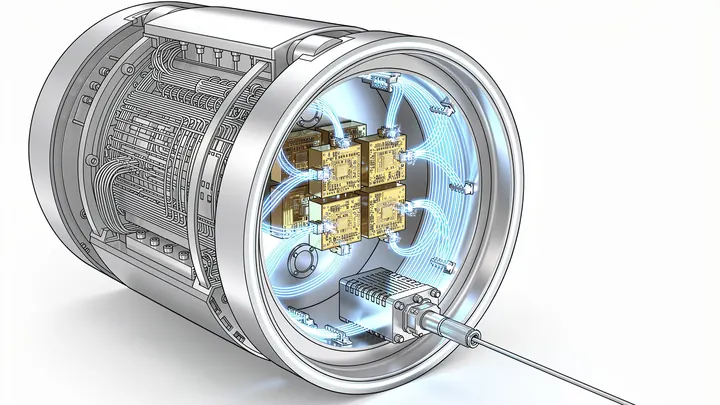
The Cold Brain of a Quantum Computer
Imagine an orchestra where every musician plays an instrument that breaks at the slightest warmth. The conductor is the quantum processor, and the musicians are the qubits — fragile carriers of quantum information. To keep them in harmony, you need a whole team of tuners sitting in the next room, sending commands through a soundproof wall.
The Skyrmion Dance: How a Magnetic Vortex Conducts the Quantum Orchestra
A quantum computer is like an orchestra where strings and brass play in different languages. Superconducting processors operate with microwave photons in centimeter-scale circuits, while spin qubits, such as nitrogen-vacancy centers, store…
Symphony of Imaginary Frequencies: Quantum Decay of the Inverted Well
At the hilltop of classical physics, a particle is frozen in unstable equilibrium. The slightest nudge — and it rolls down with increasing speed. In the quantum universe, no nudge is needed: the uncertainty principle itself acts as an all-pervading wind, blowing the particle off the peak.
Light in a Cryostat: How Imperfect Converters Build Quantum Bridges
A superconducting quantum processor is like a microscopic metropolis locked in a cryogenic fridge: streets of superconducting lines, blocks of qubits. Each resident demands silence and cold, but expanding the city inside a single cryostat is like stacking skyscrapers in a cramped courtyard — wires heat the environment, noise builds up, coherence threatens to collapse.
Quantum Measurement as a Deformation of Perception: The Bloch Sphere and the Birth of Categories
Quantum mechanics gave us a captivating image: a system’s state is not a frozen point but a wave of possibilities, dancing in an abstract space. Thanks to the work of Шрёдингера and Дирака, we represent it as vectors in Hilbert space.
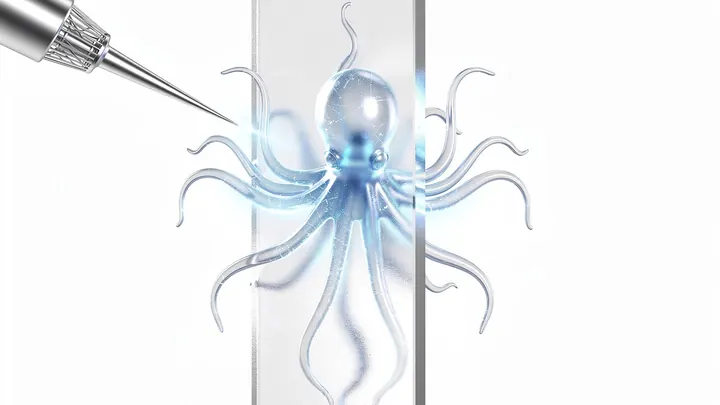
Dance of the Octopus Electron: What Quantum Tunneling Says About the Nature of Reality
A tiny tungsten tip with a radius of less than a hundred nanometers is the perfect stage for watching a quantum performance. Apply an electric field of a few volts per nanometer, and electrons start flying out of the metal: that’s field emission.
Quantum Boomerang: Fugue in a Detuned Orchestra
Quantum walking is not a series of random steps, but a musical score where the piano of space sounds under the conductor's baton of the internal state. The coin sets the tone. Until now, it was believed that detuned keys (phase disorder) mute any melody, leading to Anderson localization — a ringing silence.
Quantum Data Centers: How Entanglement Weaves the Network
Inside a cryostat cooled to tens of millikelvins live superconducting qubits. There aren't many of them: tens, at most hundreds. Crosstalk and thermal noise prevent packing more. But cracking RSA-2048 requires anywhere from ten thousand to ten million physical qubits.
Bicycle Architecture: A Quantum Computer from Modules
A quantum computer is like an orchestra: each musician plays their part, but the slightest false note ruins the symphony. The physical qubits it is built from are noisy and error-prone. To protect computations, they are combined into logical qubits using quantum error correction.
Non-Hermitian Gates: The Price of Imaginary Speed-Up
In 2019, a group of theorists asked a simple question: what would happen if you embedded a single irreversible element into an ordinary quantum computer, a gate that slightly "eats" probability? The answer was devastating. Any such gate, no matter how weak, instantly turns the machine into a device capable of solving problems in the class PostBQP = PP.
Vortices on the Quantum Stage
Two vortex rings launched one after the other pass through each other and swap places. This dance, first seen in the 19th century with smoke rings, has now been reproduced on a quantum processor. Vortices are the actors on a quantum stage where time plays the role of an extra dimension.
A Time Machine in a Superconducting Circuit
In a dark laboratory where superconducting chips are cooled to thousandths of a kelvin, a qubit spins under the influence of a magnetic field. A regular qubit rotates in one direction. An antiqubit, its mirror twin, rotates in the opposite direction. Together they form a pair that senses the field twice as sharply as any ordinary pair.
Quantum Clamp: Film Thickness Rewrites the Pauli Limit
A magnetic field of 8 tesla is 200 times stronger than Earth's field. Under such a field, superconductivity in a thin film of palladium ditelluride not only survives but persists down to 20 millikelvin, which is a hundred times colder than outer space. For comparison, a thick film of the same material has a critical field 80 times smaller.
Schrödinger's Cat from Mechanical Vibrations
The resonator vibrates at 100 megahertz, and its mechanical damping is only 15 hertz. That is like a bell that rings for thousands of years after a single strike. Next to it sits a qubit, a quantum two-level element that decays in milliseconds. It is this contrast in lifetimes that opens the door to Schrödinger's cat.
The Dance of Entangled Muons: The Music Never Changes
Two muons are born in the decay of an eta meson and fly apart, linked by quantum entanglement. One experimenter, Alice, measures the spin of the negative muon, while another, Bob, records the direction of the positron from the decay of the positive muon. It would seem that the order of events should affect the correlations.
The Coil That Wraps Itself
At 78 K, a crystal of Mn₃Si₂Te₆ turns into an inductor that needs neither copper wire nor a superconductor. The electrons inside it spontaneously organize into closed vortices with a definite sense of rotation: chiral orbital currents.
Noise as an X-ray: How Hidden Triplet Superconductivity Emerged at a Superconductor-Iron Interface
Run a current through a contact between a superconductor and a ferromagnet, and you will hear the whisper of the quantum world. In the lab at 0.3 K, that whisper turned into a roar: the shot noise—electrical noise due to the discreteness of charge—was a hundred times louder than theory allows for ordinary contacts.
Memory without memories: how a quantum system remembers the local while forgetting the global
A chain of twenty-four atoms, arranged with optical precision, begins its evolution from a state resembling a chessboard: every other atom is excited, and neighboring excitations are forbidden. After a few microseconds, the global picture becomes so entangled that the original pattern is no longer discernible.
Quantum Physics2025-10-151 minarXiv:2510.13577express
Noise That Helps: A Quantum 'Pendulum' on a Chip
In the quantum world, noise usually destroys orderly behavior, like random jolts damping a pendulum. But on IBM quantum processors, physicists discovered the opposite: structured noise can prolong and even create rhythmic oscillations. It's like a pendulum that swings harder from seemingly chaotic yet internally synchronized pushes.
Quantum Physics2025-10-221 minarXiv:2510.19769express
Magnetic Vortex Becomes a Quantum Bit
Magnetic vortices in superconductors, like whirlpools in water, typically scatter energy and quickly vanish due to internal friction — dissipation. This hampers their use in quantum chips. But in a film of tiny aluminum grains, a vortex gets trapped and resembles a whirlpool in a narrow well: it spins either one way or the other.
Mesoscale2025-10-231 minarXiv:2510.21029express
Quantum Physics2025-10-291 minarXiv:2510.25982express
Photo Editor for Quantum Computers
Atomic qubits 'snap' computations in microseconds, but capturing the result with a light-sensitive camera stretches out to milliseconds — thousands of times longer.
Quantum Physics2025-10-301 minarXiv:2510.26605express
Exoplanets2025-11-011 minarXiv:2511.00525express
How to Find Life: Look for Molecular Diversity
The chemical composition of a sample is like a soundscape. A living forest sounds polyphonic: chirping, rustles, the hum of insects. A barren desert is just the whistle of the wind.
Quantum Physics2025-11-031 minarXiv:2511.02125express
Quantum Computer Reveals Hidden Electron Pairs in Materials
Ordinary wires: electrons jostle, lose energy, and heat up: that's resistance. In superconductors, some electrons pair up in sync, like dancers swirling without collisions. But these pairs hide: you can't see them directly, only infer their presence from flawless coordination.
Quantum Physics2025-11-071 minarXiv:2511.05465express
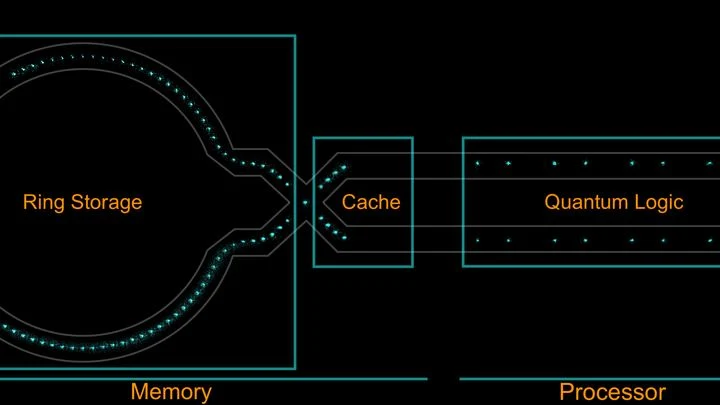
New Quantum Computer Fires Up 98 Ions
In the new Helios processor, 98 barium ions circle along a closed loop, like horses on a carousel. This architecture allows any ion to exchange data with any other, making the system flexible and powerful. Laser pulses, like a conductor's baton, issue commands at the speed of light.
Materials2025-11-131 minarXiv:2511.10160express
Biological Physics2025-11-141 minarXiv:2511.13768express
Quantum Secrets Inside Viruses
A virus of carbon life is a tiny container where the hereditary thread is compressed to the limit, like spaghetti in a tightly packed pot.
Quantum Physics2025-11-181 minarXiv:2511.14547express
Temperature Changes the Number of Dimensions in Quantum Systems
Usually, we think of the number of dimensions as fixed: length, width, height. But in the quantum world, even that can be changeable. A new theory describes systems where dimension isn't a constant but a quantum property, capable of being different simultaneously. A balloon is flat when cold, round when warm.
Quantum Physics2025-12-112 minarXiv:2512.10706express
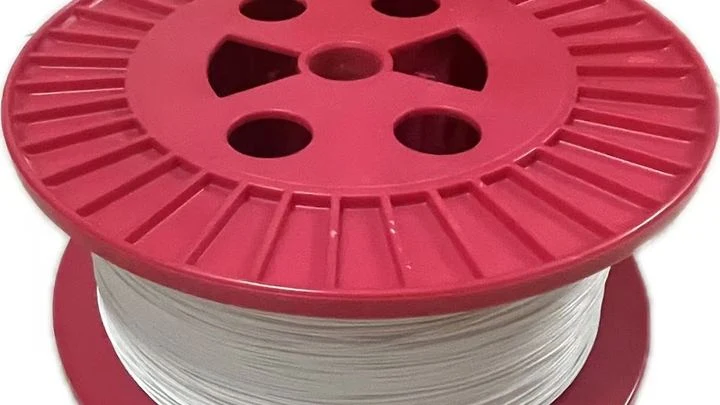
Light Instead of Wires: A Quantum Computer on Fiber Optics
A massive refrigerator the size of a wardrobe hums, maintaining an interior colder than outer space. At its heart lies a silicon chip with tiny superconducting loops — qubits. But to make the chip work, dozens of thick copper cables snake from room temperature down to it.