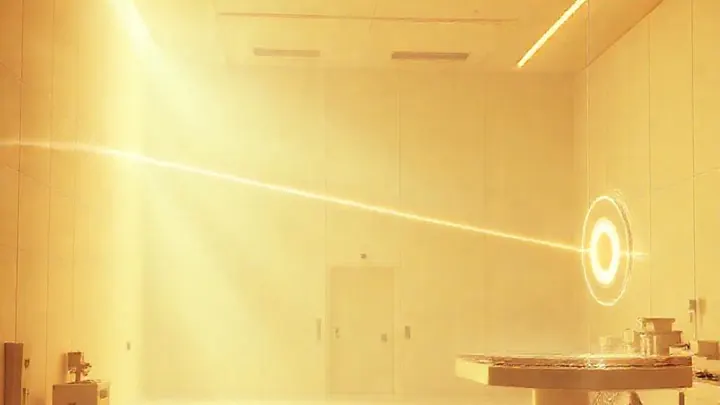
A tokamak is a device designed to harness nuclear fusion, the process that powers the Sun and other stars, by confining a superheated gas of charged particles known as plasma within a doughnut-shaped chamber. The plasma, heated to temperatures of hundreds of millions of degrees, must be kept away from the reactor walls or it would instantly cool and damage them. The tokamak achieves this using a powerful combination of magnetic fields that twist and loop around the chamber, creating an invisible magnetic cage that holds the plasma in place. This confinement is a delicate balancing act, as the plasma is inherently unstable and prone to disruptive events that can break the magnetic cage and release its energy in a burst.
History
The tokamak concept was developed in the 1950s and 1960s by Soviet physicists, with the first working device, T-1, built at the Kurchatov Institute in Moscow. The name is a Russian acronym for 'toroidal chamber with magnetic coils.' Results from the T-3 tokamak in 1968, showing dramatically better confinement than other designs, convinced the international community of its promise.
How it works
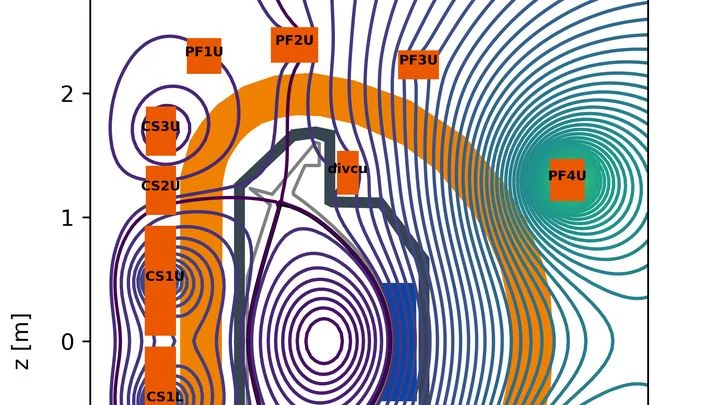
The tokamak's magnetic field is a composite of three parts: a strong toroidal field generated by external coils that runs around the ring, a poloidal field created by an electric current driven through the plasma itself, and a vertical field that helps control the plasma's position. The combination of these fields creates a helical, twisted path for the plasma particles, which prevents them from drifting to the walls. The plasma current is induced by a central solenoid acting as the primary coil of a transformer, with the plasma acting as the secondary. This current also heats the plasma, though additional methods like neutral beam injection or radio-frequency waves are used to reach fusion temperatures.
In practice
Tokamaks are the leading candidate for a practical fusion reactor, with large-scale projects like ITER in France and JET in the UK dedicated to proving the technology can produce net energy. They are also used in research to study plasma physics, materials science under extreme conditions, and the behavior of runaway electrons, which can damage reactor components.
Fun fact
Runaway electrons in a tokamak can reach energies of tens of mega-electronvolts, enough to bore holes through the reactor's metal walls if not controlled.
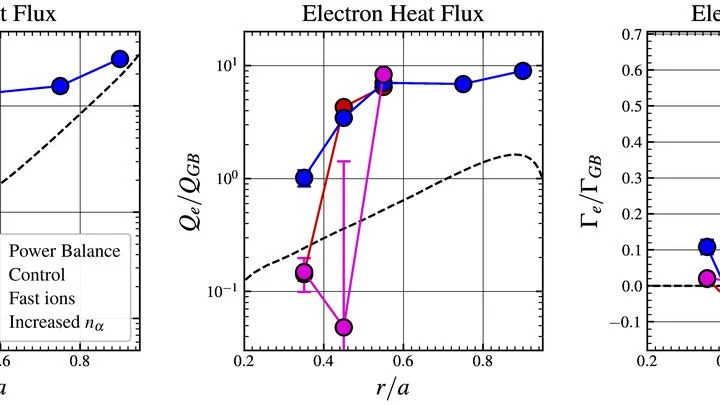
A vacuum cleaner sucks in dust even if there is more of it near the nozzle. The same happens in a tokamak: plasma particles are drawn toward the center, even though their density is higher at the edge. This phenomenon is called particle pinch, and it contradicts the usual rule that everything tends to move from dense regions to sparse ones.
A navigator with a paper chart plots the route before setting sail. If the ocean changes—the current shifts, the wind picks up—the chart stays the same. The ship follows an outdated path, and the crew has to correct the course by hand.
An ordinary lamp shines steadily, while a lighthouse flashes. Scientists in London have made a tiny diamond work like a lighthouse, but not for light — for radio waves. To do this, they added a bit of nitrogen to the crystal and then shone a green laser on it.
Inside a solar flare, magnetic field lines snap like stretched rubber bands and reconnect — releasing in minutes enough energy to power humanity for millions of years. In the lab, this process, magnetic reconnection, could long be triggered but not stopped. Now physicists have a switch.
A fusion reactor is like a super-hot furnace where plasma reaches millions of degrees. The walls are made of tungsten, the most refractory metal there is. But even tungsten needs protection: fast particles from the plasma bombard the surface and knock atoms loose. These ejected atoms enter the plasma and cool it down, like a spoonful of cold milk in hot tea.
Microwave plasma in a vortex is like a kitchen mixer that simultaneously heats and stirs the gas. In the reactor, the gas is swirled, and microwaves heat it to thousands of degrees, tearing carbon dioxide molecules apart. Scientists created a computer model of such a reactor to understand how pressure affects the process.
A magnetic mirror is a tube open at both ends. The magnetic field inside is arranged so that hot plasma doesn't leak out: at the ends, the field lines bunch up like a cork in a bottle. Plasma particles flying toward the exit are repelled by these "corks" and bounce back. But some still escape: that's the classic "loss cone" argument.
The race for fusion energy is like trying to bottle a lightning bolt. For decades, physicists have struggled to recreate on Earth the processes that power the Sun. The main challenge is getting light nuclei to fuse despite their mutual repulsion, while extracting more energy than was spent heating and confining the plasma.
In boiling water you can see a prototype of a quantum trick: if part of the liquid turns into long-lived vapor bubbles, the main mass cools down. This is exactly what happens when you sharply jolt a system of interacting electrons: doublons flare up — pairs of particles that absorb excess energy and don’t decay for an astonishingly long time.
Water boils in a pot: bubbles churn, heat quickly escapes into the air. In the center of the ARC fusion reactor, plasma behaves similarly — except instead of bubbles, there are turbulent eddies, and instead of air, there's a magnetic field that must hold the heat.
Space is full of invisible sprinters — particles racing nearly at the speed of light. They are caught in the solar wind, near neutron stars, and even in the intergalactic void between galaxies. But what accelerates them where there are no shock waves or magnetic reconnections?
Imagine a powerful hair dryer that blows not warm air but white-hot plasma, such devices are called plasma wind tunnels. They are used to test on Earth how a spacecraft will enter the atmosphere.
In a pot of boiling soup, churning currents carry heat to the walls, and the soup cools. In a tokamak, a huge magnetic bottle for plasma, the same thing happens: turbulent eddies carry energy outward, hindering the ignition of a fusion reaction. But sometimes the plasma seems to find a way to calm itself.
Water in a cup cools down in minutes. Gas in a room spreads evenly in seconds. But if you trap atoms in a tube as thin as a laser beam and give them a good kick, they will take several seconds to "cool" toward equilibrium — an eternity by atomic standards.
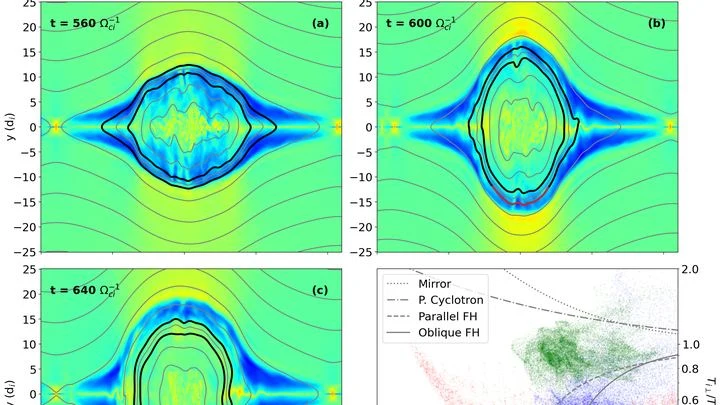
Space plasma is not a calm gas but a boiling soup of charged particles threaded with magnetic fields. These fields behave like stretched rubber bands: sometimes they snap and immediately reconnect, but in a different configuration. This process, called magnetic reconnection, releases enormous energy.
About 380,000 years after the Big Bang, the universe cooled enough for electrons and protons to finally combine into neutral hydrogen. Although this event is called recombination, it was actually their first meeting — the heat had kept them from sticking together until then.
The Sun sometimes produces giant clouds of plasma that try to escape into space. But often they fail: an invisible magnetic cage keeps them near the surface. Such failed eruptions are called "trapped."
Scientists built a computer model to understand exactly how this cage works.
Hot plasma in a tokamak is like a temperamental beast: you need to hold it in, but not let it overheat. In the ASDEX Upgrade reactor, researchers found a regime where plasma eddies solve this problem on their own. Stochastic modeling showed that oscillations at the plasma edge fling out blobs, like bubbles from a boiling pot.
A soup pot is usually round, and a frying pan is flat. The shape of the cookware determines how the boiling water sloshes around. In a tokamak, a device where superheated gas is confined by magnetic fields, the shape of the plasma is also chosen deliberately.
Before every tokamak startup, a device where superheated gas is held by magnetic fields, operators spend hours calculating how the plasma will behave. Mistakes are too costly: one wrong parameter can ruin the experiment.
A laser strikes a target, and a cloud of plasma, accelerated to hundreds of kilometers per second, shoots into the chamber. The chamber isn't empty: it's filled with a tenuous gas that plays the role of the cosmic medium. The plasma slams into this gas like a speedboat hitting still water, shoving it aside.
A fusion reactor is an attempt to hold a miniature sun in a magnetic cage. To get more energy out of it, you need to squeeze the plasma denser. But tokamaks have an invisible fence: once the density crosses a certain line, the plasma shudders and falls apart. This disruption is one of the main mysteries on the road to clean energy.
Plasma in a fusion reactor is like a swarm of fireflies that you need to keep inside an invisible jar. It used to be thought that the jar's walls had to be perfectly smooth, or the fireflies would find a crack and escape. New work shows that the jar can be glued together from pieces with noticeable seams, and the swarm will still stay inside.
A fusion reactor is like an orchestra, where the plasma is the melody and the magnetic coils are the musicians. If one instrument plays out of tune, the whole symphony falls apart.
Igniting a miniature sun is a long-held dream of humanity. Typically, scientists try to confine scorching plasma (a gas of charged particles) at temperatures of hundreds of millions of degrees. But plasma tends to escape magnetic traps, and confinement comes at enormous cost.
Five charged calcium atoms hover in a trap, held by electric fields. Laser cooling saps their excess energy, and they line up into a tiny pyramid with a square base. But this pyramid doesn't stay put: every now and then it flips over, as if someone tosses it into the air and catches it upside down.
For two atomic nuclei to fuse, they must overcome their fierce electric repulsion — like trying to bring two angry bulls together. Normally, only monstrous energy does the trick, as in stellar cores, where Hans Bethe explained fusion back in the 1930s.
Six barium ions lined up in a flat hexagon inside a Paul trap, a device that holds charged particles with oscillating electric fields. But a slight change in the shape of the trapping potential made the crystal rearrange: one ion moved to the center, and the other five formed a ring around it.
A drop of ink in a glass of water quickly spreads, tinting the whole liquid. Similarly, electrons in a metal move freely, like molecules in a gas. But when a magnetic impurity, an atom with its own magnetic moment, enters this medium, something strange happens.