The Universe's Hidden Currents express
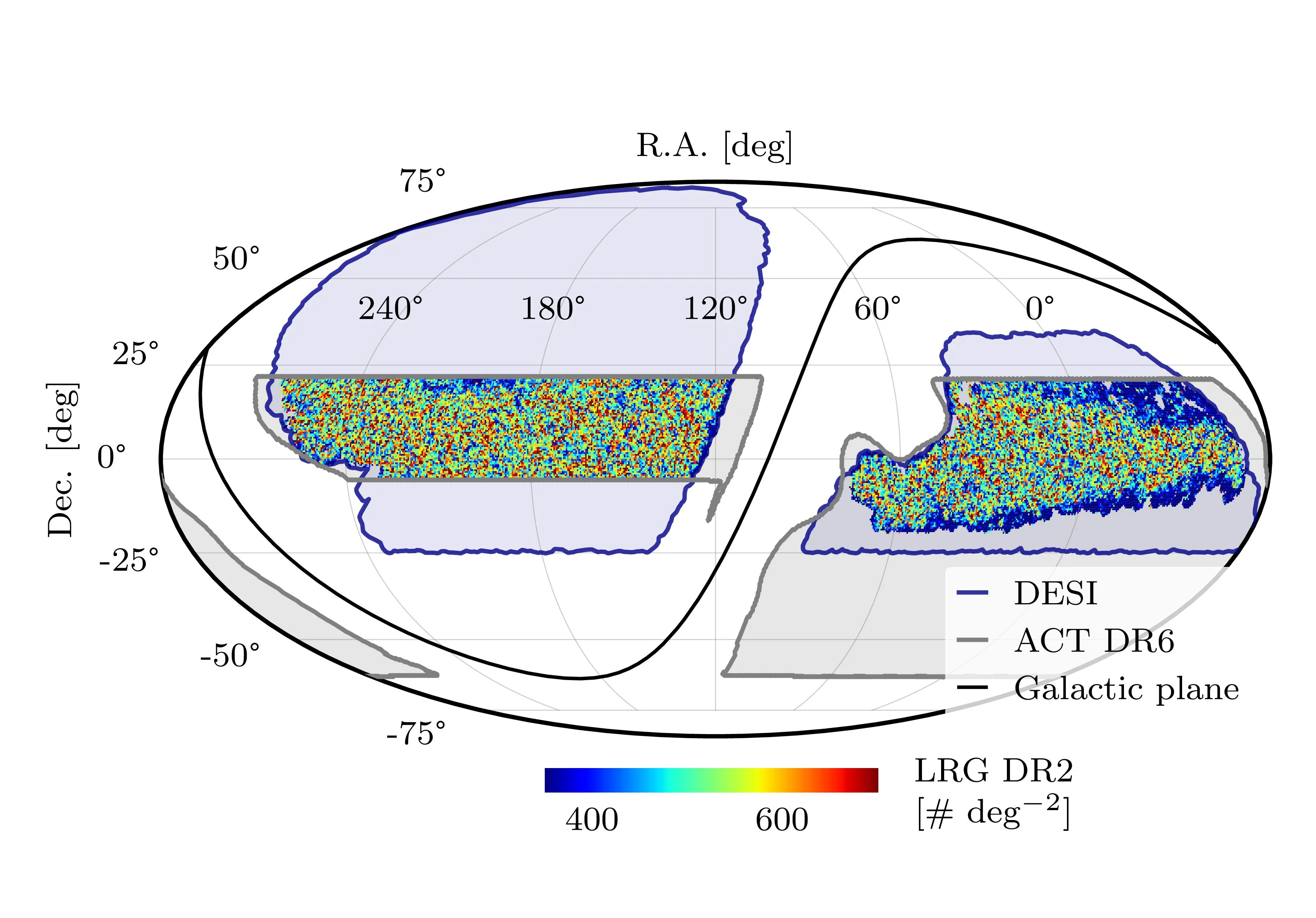
In Chile's Atacama Desert stands a telescope that doesn't look at stars, but at the oldest light in the Universe — the cosmic microwave background. This light has been traveling to us for nearly 14 billion years, ever since the Universe became transparent. On its way, it passed through clouds of hot gas around galaxies. Electrons in that gas give photons a gentle nudge, like a breeze blowing on drifting pollen. This slightly changes the light's temperature: in one spot it becomes a few millionths of a degree warmer, in another, cooler.
Overlay this temperature map onto a map of galaxy positions, and a pattern emerges. Where galaxies are abundant, gas moves toward them, pulled by their gravity, and the light from there arrives with a barely perceptible shift. Astronomers took data from the ACT telescope and the new DESI survey, which measured distances to millions of galaxies and quasars. By combining them, they saw these flows for the first time not only around massive red galaxies, but also around lighter blue galaxies and bright quasars.
Such a flow map is a new tool. Previously, astronomers could only see where matter had gathered, not how it moved. Now the motion is visible too. This helps weigh invisible dark matter, which pulls everything with its gravity, and check whether there were any irregularities left over from the Big Bang. The first measurements have already given the most precise limit on such irregularities to date.
The desert telescope looks into the past, while the galaxy map shows the present. Together, they reveal how the Universe has flowed and continues to flow — how invisible rivers of gas and galaxies keep moving under the pull of gravity.
Original abstract
as written by the authors arXiv:2604.04867
Joint analyses of high-resolution CMB temperature maps with galaxy surveys provide a unique way to reconstruct the radial velocity field of the underlying matter distribution via the kinematic Sunyaev-Zeldovich (kSZ) effect. Using data from the Atacama Cosmology Telescope (ACT) DR6 and the Dark Energy Spectroscopic Instrument (DESI) DR2, we present radial velocity reconstructions for luminous red galaxies (LRGs), emission-line galaxies (ELGs), and quasars (QSOs). Leveraging the spectroscopic data, we are able to reliably model the foreground contamination and report a negligible impact on our main observables. We detect the velocity-galaxy cross-correlation at $$17.0\sigma$$ for LRGs, and for the first time, at $$8.3\sigma$$ for ELGs and $$6.8\sigma$$ for QSOs. We further report the first detection of the velocity-velocity correlation using LRGs at $$3.1\sigma$$, as well as the highest cumulative detection of the kSZ effect to date at $$20.8 \sigma$$. Similarly to previous results, we find a lower amplitude of the kSZ signal compared to our fiducial halo model prediction and electron profile assuming a Battaglia profile. Combining these new observables, we obtain constraints on local-type primordial non-Gaussianity (PNG): $$f_{\rm NL}^{\rm loc} = 15.9_{-34.4}^{+34.6}$$ at 68\% confidence, which represents the tightest constraint to date derived from the velocity field. The measurements presented here already exhibit lower noise on a per-mode basis than the galaxy auto-correlation on the largest scales, $$k<0.004~\rm{Mpc^{-1}}$$, highlighting the key role these observables will play in the context of future CMB experiments such as the Simons Observatory.
The cosmic microwave background is radiation left over from the Big Bang. It uniformly fills the entire sky, and its temperature is just about 2.7 degrees above absolute zero.
In Carl Sagan's novel 'Contact,' the heroine listens to signals from space, and the background ripple of microwave radiation becomes the key to the mystery — here, too, scientists read the Universe's history in a barely perceptible ripple.