In 1969, Soviet astrophysicists Rashid Sunyaev and Yakov Zeldovich predicted that hot intergalactic gas in galaxy clusters should leave an imprint on the cosmic microwave background. Plasma electrons, accelerated to enormous speeds, transfer energy to photons via inverse Compton scattering. The effect is like a 'fog' of electrons that slightly tints the background light. This allows us to see galaxy clusters at any distance, since the surface brightness of the effect does not depend on distance.
History
Predicted in 1969 by Rashid Sunyaev and Yakov Zeldovich in the context of studying the interaction of the CMB with hot intergalactic plasma. Nearly two decades later, in the early 1980s, the effect was first detected in clusters (e.g., the Coma cluster) using radio telescopes. It was further developed with the launch of space observatories WMAP and Planck, which provided detailed SZ effect maps, and with ground-based instruments like SPT and ACT. Sunyaev and Zeldovich also described the kinetic version of the effect, related to the bulk motion of the cluster.
How it works
Used in cosmology to detect and study galaxy clusters at high redshifts, estimate their mass and structure. Because the surface brightness of the SZ effect does not depend on distance (unlike apparent brightness), it serves as a powerful tool for cosmological tests, including constraints on dark energy parameters and cosmological models. The applicability is limited by the need to accurately separate the SZ signal from primary CMB anisotropy, as well as from dust and synchrotronemission.
In practice
An independent method to measure distances to galaxy clusters and study the large-scale structure of the Universe.
Fun fact
The Sunyaev-Zeldovich effect was one of the first methods to confirm the existence of dark energy, when it was used to measure distances to distant clusters and compare them with the expansion model.
In July 1969, as Apollo 11 flew toward the Moon, astronauts noticed something unusual: brief flashes of light that appeared even with their eyes closed. At first, this was attributed to fatigue, but the flashes recurred in different crews. Gradually, it became clear: cosmic rays were to blame — tiny particles hurtling through space at tremendous speeds.
An accountant tallies up all the factories, warehouses, and shops, but the balance doesn't add up — half the inventory seems to have evaporated. That's roughly how astronomers have spent decades searching for ordinary matter in the present-day Universe.
The hot gas in galaxy clusters shines in X-rays, and a significant portion of that light comes from iron atoms that have lost many electrons. These atoms leave characteristic bright lines in the spectrum, like fingerprints. Astronomers use them to determine the temperature, density, and motion of the gas.
Light from the very beginning of the cosmos has been traveling toward us for 13.8 billion years. During that time, its polarization, the direction of its oscillations, might have been twisted, like a compass needle that someone quietly nudged. Physicists call this phenomenon cosmic birefringence.
380 thousand years after the Big Bang, the universe cooled enough for light to decouple from plasma. That cosmic microwave background still pervades space, like the first chord of a symphony, the echo of a fiery beginning.
The cosmic microwave background is not just a faint glow with a temperature of 2.7 K. It's a snapshot of the Universe 380,000 years after the Big Bang, when the primordial plasma finally became transparent to light. But for theoretical physicists, what came before is far more interesting.
The cosmic microwave background is the petrified light of the first moments. Shortly after the Big Bang, microscopic quantum fluctuations were stretched by inflation to the scales of galactic superclusters.
The very first moments of the Universe's life resemble tuning a complex musical instrument. Quantum fluctuations, stretched by rapid inflation, became the 'notes' from which galaxies later formed. In the new work, physicists considered an unusual opening chord — a superoscillating state.
Light passes through a crumpled film — and comes out slightly altered. In much the same way, gravitational waves born in the early universe feel the lumpy distribution of galaxies and dark matter.
A giant cloud of invisible matter acts like a funhouse mirror — distorting the light from a distant galaxy. From these distortions, astronomers can weigh the cloud and peer into its depths.
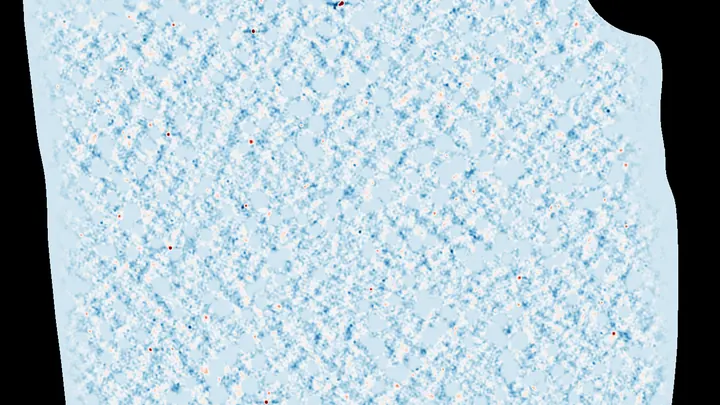
Moving clumps of galaxies and invisible dark matter create wakes in the afterglow of the Big Bang, like boats stirring a pond. This wake, the moving lens effect, is so subtle it shifts the light’s temperature by only a few millionths of a degree: comparable to detecting a candle’s heat from across a continent.
An orchestra of millions of instruments plays a single note, but each enters at its own moment and with its own volume. That's how the stochastic gravitational wave background sounds — a hum from black hole mergers that are individually indistinguishable.
A pond with ripples spreading from a fallen stone. So it is on cosmic scales: a sudden burst of energy in the dark sector, an invisible substance that emits no light, creates ripples in the fabric of space. These ripples alter the path of light particles traveling to us from the very birth of the cosmos.
The authors of the new study built a mathematical framework to describe these distortions.
A detector filled with superfluid helium-4 is like a perfectly still lake. The liquid doesn't slosh or bubble: it's frozen in a single quantum state. An invisible guest, a dark matter particle, flies through it. It doesn't shine or leave a track. But sometimes it nudges a helium nucleus.
When the first stars ignited, their ultraviolet light began stripping electrons from hydrogen atoms. The universe transformed from a neutral fog into transparent plasma. This process, cosmic reionization, proceeded unevenly: slowly at first, like a fire catching in damp wood, then faster as the flames spread through dry tinder.
Take two heavy balls and place them a meter apart: they attract each other with a force that weakens by a factor of four when you double the distance. Newton discovered this law, and it works in a room, in the solar system, in a galaxy. But does it still hold when we're talking about hundreds of millions of light-years?
Astronomers found a way to test this directly.
In Chile's Atacama Desert stands a telescope that doesn't look at stars, but at the oldest light in the Universe — the cosmic microwave background. This light has been traveling to us for nearly 14 billion years, ever since the Universe became transparent. On its way, it passed through clouds of hot gas around galaxies.
The James Webb Space Telescope has spotted ancient galaxies harboring supermassive black holes — far too massive for their young age after the Big Bang. There wasn't enough time for normal growth, so they must have formed differently.
When two galaxy clusters collide, shock waves are born in the space between them, like the sonic boom from a supersonic jet, but instead of air, it's the tenuous gas. These waves compress the gas and accelerate charged particles to enormous energies.
A swimmer cutting through water at the speed of the waves running on it finds themselves in a strange position: the waves they themselves generate can neither overtake them nor fall behind. They pile up at the swimmer's bow and freeze. A similar phenomenon occurs when a light source moves inside a medium at a speed matching the speed of energy transfer of the waves.
The cosmic microwave background is faint light left over from the Big Bang. It fills the sky uniformly, but it encounters obstacles along the way. One such obstacle is galaxy clusters, which contain very hot gas. When CMB photons pass through this gas, some of them get an extra kick and change energy.
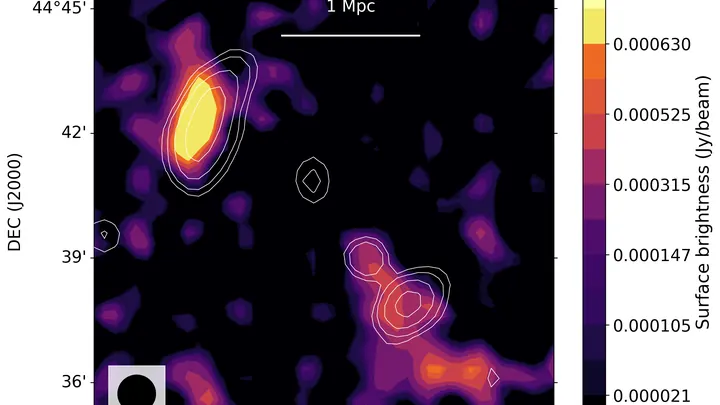
In the Coma galaxy cluster, about 320 million light-years away, an invisible cloud stretches out. It shines in the radio band: this is a radio halo, a giant collection of charged particles accelerated to nearly the speed of light.
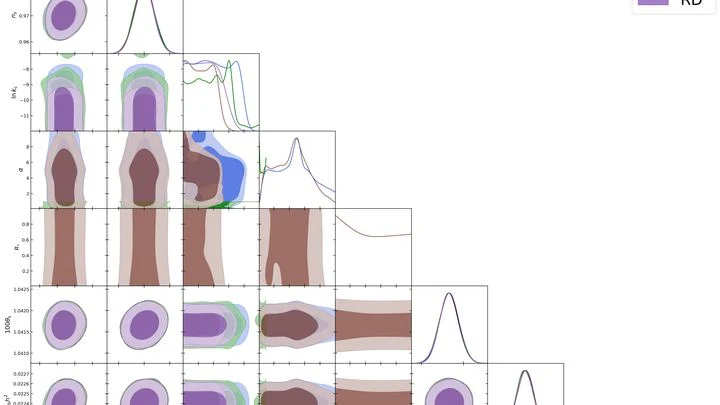
The universe is like an ocean, where waves of different lengths roll onto the shore. The longest waves are the giant fluctuations in the distribution of matter that we see in the cosmic microwave background. Standard theory says such waves should exist on all scales.
Light from the earliest epoch of the universe has been traveling toward us for billions of years. On its way, it passes by enormous galaxy clusters. Their gravity slightly bends this light, just as a shop window distorts the view of the street behind it. As clusters grow, the bending becomes more noticeable. This effect is known as the Rees-Sciama effect.
In the frozen desert of Antarctica, the SPT-3G telescope peers deep into the universe. Its target is the ancient microwave radiation left over from the Big Bang. But on its way to us, this radiation passes through giant galaxy clusters filled with scorching gas.
In the Antennae Galaxies, which are crashing into each other, giant gas clouds collided at a speed of 50 kilometers per second. It's like two trains hurtling toward each other — the impact compressed the gas, and it ignited with new stars.
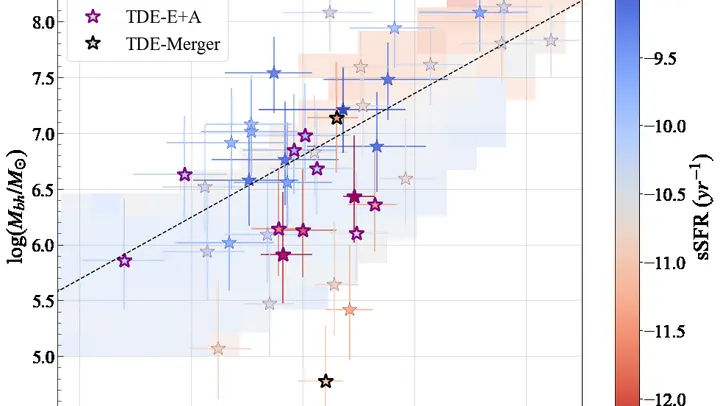
You can't see a black hole until a star wanders too close. Then tidal forces stretch the star like a cook rolling out dough, and some of the material falls into the hole, flaring up as a final goodbye. Such events, called tidal disruptions, are a rare chance to weigh a black hole that would otherwise remain invisible.
At the South Pole, where the air is dry and transparent to millimeter waves, stands a telescope that looks not at stars but at the oldest light in the universe. This light is the cosmic microwave background — the radiation left over from the Big Bang, filling the entire sky.
At the heart of the galaxy cluster RXCJ1558.3-1410, an invisible drama unfolds. Hot gas there is cooling, but something prevents it from collapsing and birthing new stars. Astronomers pointed a radio telescope at this cluster and saw a faint glow — a mini-halo.
Cosmic neutrinos are ghost particles, passing freely through the Earth. The IceCube telescope in the ice of Antarctica once caught such a neutrino, and it matched an infrared flare. That flare turned out to be the moment a black hole tore a star apart in a distant galaxy.
According to the Big Bang theory, developed by Georges Lemaître, the Universe began from a hot dense point and then rapidly expanded — an inflation proposed by Alan Guth. Echoes of that time reach us as a faint glow — the ancient light.
Our Sun emits streams of neutrinos — particles that barely interact with matter. Passing through the dense solar material, they change their type — scientists call this 'flavor.' It's like a voice that changes as it moves through a crowd: the thicker the crowd, the more it gets distorted.