Solar Flare: How Magnetic Knots Ignite the Fire express
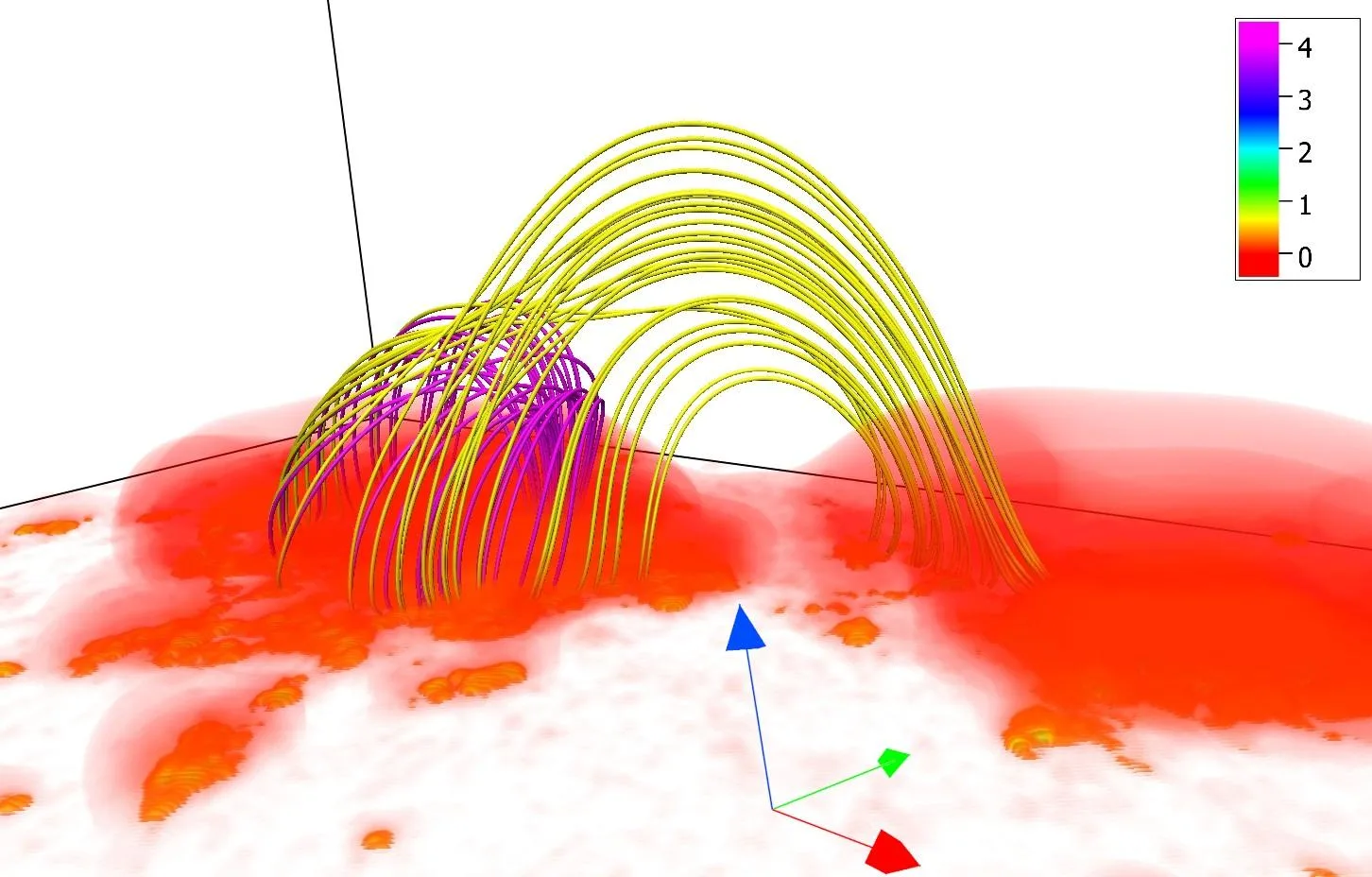
Sometimes bright loops flash on the Sun — solar flares. They resemble giant electric discharges, but instead of wires, there are magnetic fields. Inside an active region, magnetic lines tangle like threads in a ball, and when they snap and reconnect, energy is released. In this work, scientists found the exact spot where this happens.
They studied a medium-sized flare (class M2.1) in active region NOAA 12268. First, they reconstructed the magnetic field before the flare from observational data. It turned out that above the flare region there is a special structure — a hyperbolic flux tube of curved magnetic field. This is a place where magnetic lines converge and diverge, like water in a funnel. Nearby, at the base, there are two layers where the field changes particularly sharply — quasi-separatrix layers.
Then the scientists ran a computer simulation that mimics the behavior of plasma and the magnetic field. In the simulation, a thin current sheet formed inside the hyperbolic flux tube, where magnetic lines of opposite direction met and reconnected. Simultaneously, at the base, field lines began to slip along those very layers: this is called slipping reconnection. According to the authors, it was this that triggered the main reconnection in the tube.
As a result, the reconnection energy flowed downward to the Sun's surface and ignited bright ribbons — the very flare ribbons seen in telescopes. So the chain is: first slipping reconnection at the base, then main reconnection in the hyperbolic flux tube, and that gives the flare's light.
It's like first giving a slight tug on the threads in a ball, and then the whole ball suddenly rearranges and releases energy. Understanding such details helps better predict solar flares, which affect space weather and our technology.
Original abstract
as written by the authors arXiv:2604.10684
In this paper, we identify the magnetic reconnections at the hyperbolic flux tube (HFT), aided by slipping reconnection at quasi-separatrix layers (QSLs), which are pivotal to the occurrence of a confined M2.1 class flare in NOAA active region 12268. The magnetic field topology before the flare's onset is obtained through a non-force-free-field extrapolation scheme that accommodates a non-zero Lorentz force. A key aspect is the presence of an HFT in the computational domain above the flaring region, along with two QSLs at the lower boundary. To simulate the dynamics of the active region, we conduct a data-constrained magnetohydrodynamics (MHD) simulation initiated by the extrapolated field. The dynamics captured in the simulation document the formation of a current sheet within the HFT configuration, leading to magnetic reconnection at the HFT. Additionally, we observe the slipping motion of the footpoints of the magnetic field lines in the QSLs at the bottom boundary, which indicates the occurrence of slipping reconnection in the QSLs. Importantly, the magnetic reconnection at the HFT is suggested to be the primary driver in the development of the intricate flare brightenings and the flare ribbons.
The energy of a single solar flare can be billions of times greater than the energy of all the atomic bombs ever detonated by humanity.
In the movie 'Star Trek', solar flares have threatened ships more than once, and crews had to urgently change course.