object

current sheet

A thin, sheet-like region where electric current density is high, central to magnetic reconnection.
19 related articles

Description

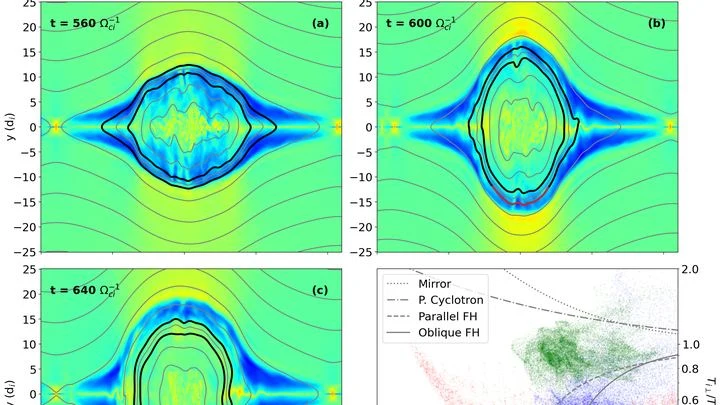
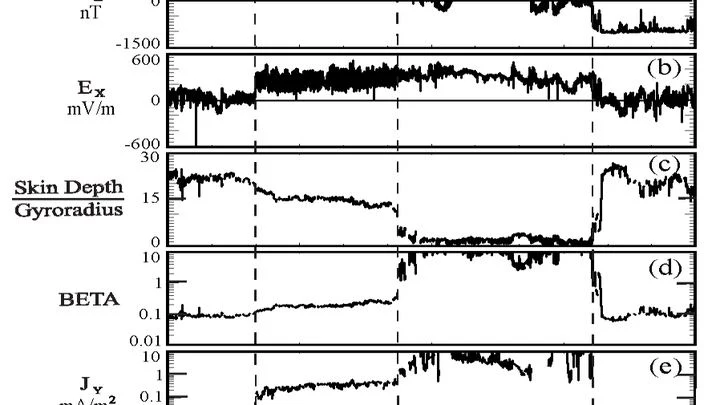
A current sheet is a thin, often planar region in a plasma where the electric current density is exceptionally high. These structures form at boundaries where magnetic fields change direction abruptly, such as the interface between the solar wind and Earth's magnetosphere, or in the solar corona above sunspots. Current sheets are the primary sites of magnetic reconnection, a process that converts magnetic energy into kinetic and thermal energy, powering solar flares, auroras, and geomagnetic storms.

History

The concept was developed in the mid-20th century, notably by Hannes Alfvén and Peter Sweet, with later refinements by Eugene Parker and Harry Petschek in the 1950s–1960s.

How it works

When magnetic fields of opposite polarity are pushed together, they cannot simply overlap; instead, they form a thin boundary layer. The magnetic field gradient across this layer induces a strong electric current that flows along the sheet. Under certain conditions (e.g., when the plasma resistivity is finite), the sheet becomes unstable and breaks, allowing magnetic field lines to 'reconnect' — snapping and reattaching in a new configuration. This releases stored magnetic energy explosively, accelerating particles and heating the plasma.

In practice

Understanding current sheets is crucial for predicting space weather, designing magnetic confinement fusion devices like tokamaks, and interpreting observations of solar flares and astrophysical jets.

Fun fact

The tail of Jupiter's magnetosphere, shaped by current sheets, extends more than 600 million kilometers — farther than the distance from the Sun to Jupiter itself.

Related articles · 19

Reconnection Layer Thickness: Four Probes versus One
Four witnesses to a single crossing. On November 10, 2017, the four MMS spacecraft flew through an invisible boundary in the solar wind where magnetic field lines reconfigure and release energy.
Opposing Caravans in Magnetron Plasma
Two caravans travel toward each other along a narrow road. One is wide and slow, carrying a load of density. The other, a string of light carts carrying current, slips between the first. Thus, in a magnetron discharge, two structures rotating in opposite directions coexist: the density spoke and the current filaments.
A Laser Switch for Magnetic Storms
Inside a solar flare, magnetic field lines snap like stretched rubber bands and reconnect — releasing in minutes enough energy to power humanity for millions of years. In the lab, this process, magnetic reconnection, could long be triggered but not stopped. Now physicists have a switch.
Stellar2026-07-301 minarXiv:2607.28089express
Twisted Crown: How a Magnetic Vortex Rewrites Sunspots
The solar corona lives its own turbulent life. Magnetic fields here are governed by the motions of the dense surface — the Sun's photosphere — but occasionally they rewrite the magnetic pattern themselves.
High Energy2026-06-111 minarXiv:2606.13953express
Twisted Solar Loop Reveals the Secret of Magnetic Explosions
A tightly twisted phone cord snaps and scatters sparks. Magnetic fields on the Sun behave the same way: they twist, break, and reconnect, powering flares. For the first time, astronomers have witnessed this process directly. One loop was twisted by 540 degrees — one full turn and then half again. That’s three times more than previously thought possible.
Stellar2026-06-092 minarXiv:2606.10411express
Magnetic Ropes on the Sun: A New View from the Chromosphere
A sunspot cools, and above it a dark filament, a prominence, hangs for weeks. Inside it, like a compressed spring, hides the magnetic field. It can be laid out in neat arches, or it can be twisted into a tight rope.
High Energy2026-05-071 minarXiv:2605.06085express
Charged Layers in the Pulsar Wind
A thin layer of oil on the surface of water breaks into separate droplets at the slightest disturbance. Something similar happens in the pulsar wind — a stream of particles ejected by a rapidly rotating neutron star. This stream also contains plasma layers, which can break apart into clumps — magnetic islands.
Exoplanets2026-04-281 minarXiv:2604.25253express
Jupiter's Tail Is Wired Differently
A planet's magnetic field is like an invisible shield: it catches charged particles from the solar wind and stretches out behind the planet into a long tail, like a fluttering scarf.
High Energy2026-04-231 minarXiv:2604.22059express
The Final Symphony of Neutron Stars
Two neutron stars — these are ultra-dense remnants of dead stars, each the size of a city but heavier than the Sun. Their existence was predicted back in 1934 by Fritz Zwicky. A teaspoon of this matter weighs billions of tons. When two such objects draw close before merging, their magnetic fields twist and snap like taut strings.
Stellar2026-04-031 minarXiv:2604.02901express
Möbius Strip in Space: How Magnetic Fields Heat Plasma
Space plasma is not a calm gas but a boiling soup of charged particles threaded with magnetic fields. These fields behave like stretched rubber bands: sometimes they snap and immediately reconnect, but in a different configuration. This process, called magnetic reconnection, releases enormous energy.
Stellar2026-03-231 minarXiv:2603.21885express
Solar Storms Trapped in a Cage
The Sun sometimes produces giant clouds of plasma that try to escape into space. But often they fail: an invisible magnetic cage keeps them near the surface. Such failed eruptions are called "trapped." Scientists built a computer model to understand exactly how this cage works.
Stellar2026-03-161 minarXiv:2603.15930express
Solar Wind: Fast Streams Inside Slow Ones
The Sun's corona looks like a shaggy dandelion: bright petal-like loops hold hot gas near the surface, while long, tenuous jets escape into space between them. These jets, the heliospheric current sheet, stretch across the entire solar system.
Mesoscale2026-03-021 minarXiv:2603.02173express
A Translator Layer Inside a Metal
Light hits a thin film, and an electric current instantly appears in it. This is how a pair of two materials works: molybdenum disulfide and cobalt. The first is a semiconductor, the second is a magnet. Between them, as it turns out, an invisible intermediary layer is born.
Plasma Physics2026-02-271 minarXiv:2602.23683express
Magnetic Reconnection: From Gentle Flow to Explosion
In plasma where some atoms remain neutral, magnetic field lines can rearrange at different speeds. This is like two rubber bands that are initially stuck together, then suddenly snap apart and contract, releasing energy.
Plasma Physics2026-02-241 minarXiv:2602.21422express
How a calm flow turns itself into a storm
A calm river suddenly starts churning in the middle of a flat stretch: that's the puzzle the authors of a new study set out to solve. They took a thin layer of charged gas with a very weak magnetic field and tracked on a computer what would happen to it. At first, everything flows smoothly, like water from a tap.
Stellar2026-02-121 minarXiv:2602.11853express
A Solar Flare in Three Dimensions
A solar flare is like a giant spring that gets twisted and twisted, and then suddenly snaps. The energy stored in the magnetic field is unleashed into space within minutes, heating plasma to millions of degrees.
Stellar2026-02-042 minarXiv:2602.05024express
Solar Flare: How the Magnetic Field Loses Its Strength
A solar flare is like a tightly coiled spring suddenly uncoiling. In the Sun's corona, energy accumulates in the twisted magnetic field, and then it is abruptly released, accelerating particles and heating plasma.
Stellar2026-02-021 minarXiv:2602.01742express
The Solar Knot That Unties Itself
The Sun frequently launches narrow plasma jets, coronal jets, that resemble fountains of superheated gas erupting from the star's atmosphere. One such eruption, which occurred on November 10, 2022, caught scientists' attention: it was accompanied by a C1.1-class flare and had an unusually wide cone.
High Energy2026-01-252 minarXiv:2601.17955express
Magnetic Fields That Rearrange Themselves
In a pot of boiling soup, small bubbles churn, but gradually large-scale flows come to dominate. Something similar happens in cosmic plasma, where magnetic fields behave like tangled threads.