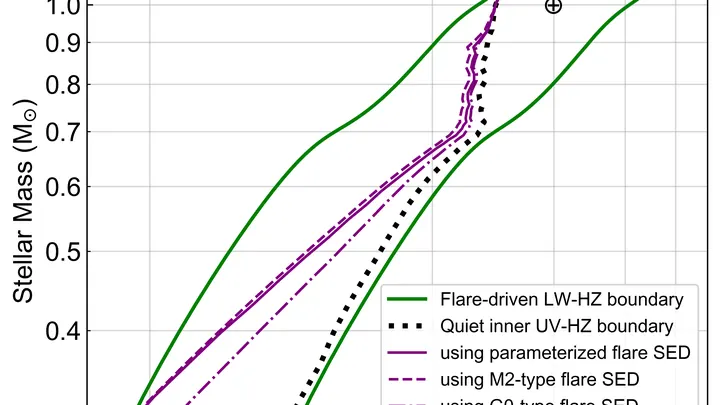
A solar flare is a sudden, intense burst of radiation from the Sun's surface, typically associated with magnetic activity in sunspot regions. While the seed definition notes that solar flares are usually hotter than those on cooler stars, the research context reveals a more nuanced picture: flares on different stars, such as the ultracool dwarf TRAPPIST-1, can be 'cold' in comparison, challenging simple assumptions about stellar flare temperatures. The phenomenon involves the rapid release of magnetic energy, accelerating particles and emitting light across the electromagnetic spectrum, from radio waves to X-rays and gamma rays.
History
Solar flares were first observed independently by Richard Carrington and Richard Hodgson in 1859, who saw a white-light flare during a geomagnetic storm. The term 'solar flare' was coined later, and systematic study began in the 20th century with the advent of spectroscopy and space-based observatories.
How it works
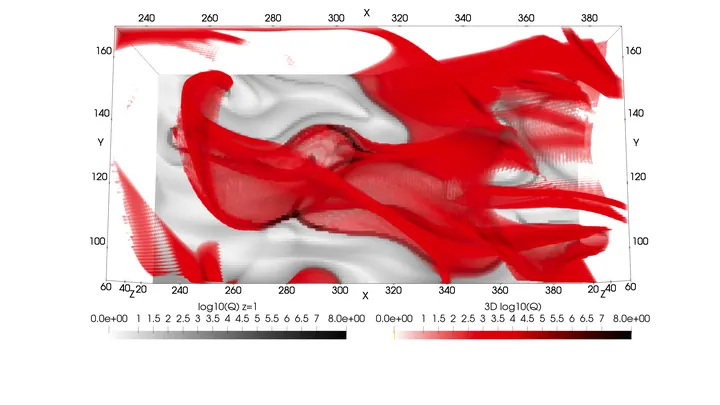
The mechanism begins with the twisting and tangling of magnetic field lines in the Sun's corona due to differential rotation and convection. When these field lines reconnect, they release stored magnetic energy, heating plasma to millions of degrees and accelerating electrons and protons. These accelerated particles then travel along magnetic loops, producing radiation through processes like synchrotronemission and bremsstrahlung. The titles suggest that the energy release can involve multiple acceleration stages, as seen in 'Солнечная вспышка с двумя ускорителями', and that the geometry of magnetic loops influences the flare's duration, with longer loops leading to slower flares.
In practice
Understanding solar flares is crucial for space weather forecasting, as they can disrupt satellite communications, GPS navigation, and power grids on Earth. Radio observations, like those from MeerKAT, help monitor and predict these events.
Fun fact
Some solar flares emit light in spectral lines that 'should not' be there, such as certain helium lines, which appear only under extreme conditions and were once thought impossible to observe in solar flares.
In active galactic nuclei, supermassive black holes are surrounded by a dense ring of dust that acts like a curtain: it hides everything happening at the center. If a star ventures too close to the black hole, tidal forces tear it apart, and the resulting flare is usually visible in optical and X-ray light.
In a pot on the stove, water starts to churn from the bottom long before the whole thing boils. Bubbles of steam rise from the base even though the burner itself hasn't heated up yet.
In a pot on the stove, water starts to churn from the bottom long before the whole thing boils. Bubbles of steam rise from the base even though the burner itself hasn't heated up yet.
On the surface of the Moon and asteroids, you can find pits smaller than a pinhead but with shiny, melted rims. Such marks are left by tiny meteorites, but the exact impact speed at which melting occurs remained unclear.
In a binary star system, one star pulls matter from its companion. Over centuries, this material settles onto the surface of a neutron star — the ultra-dense remnant of a dead star. This process, called accretion, usually proceeds smoothly. Gravity behaves as general relativity predicts, without surprises.
A star wrapped in an invisible blanket warms up more than it should. That's exactly how ten red dwarfs look, which astronomers from the Hephaistos project have been monitoring. These stars lie within 300 parsecs (about 1000 light-years) of us and emit far more infrared energy than their modest sizes can explain.
The Sun is constantly struck by blows — magnetic reconnection in the plasma releases energy, making the corona flare up. After each such blow, magnetohydrodynamic waves linger in the plasma loops, like the fading ring of a bell.
The Sun continuously scribbles magnetic fields across its surface. These patterns are not mere ripples but a handwriting in which nature has encoded warnings of flares. A flare is an explosion that releases the energy of billions of nuclear bombs in minutes, ejecting streams of plasma and radiation into space.
The flash lasts a thousandth of a second, but in that instant it releases as much energy as the Sun emits in a day. Such signals, fast radio bursts, have been caught by telescopes since 2007, and their source remains a mystery. A new study offers an elegant answer: it's all about a cosmic amplifier.
Deep space, galactic center. A supermassive black hole is surrounded by a scorching disk of gas and dust. And then, through this fiery veil, a star shoots by every few hours — like an arrow loosed from the bow of gravity. Each passage triggers a dazzling X-ray flare that for a moment outshines the entire galactic nucleus.
Somewhere deep in space, a radio beacon flashes for a fraction of a second, and then goes dark. Such signals are called fast radio bursts. They come from other galaxies and last from microseconds to milliseconds.
Active galactic nuclei (AGN) are the universe’s powerhouses: their X-ray coronae blaze millions of times hotter than stellar atmospheres. But what strikes the spark? A ten-day X-ray campaign by the XRISM and XMM-Newton satellites, aimed at NGC 3783, provided the answer: it’s actual thunderstorms.
Solar flares are powerful explosions on the Sun that can knock out satellites and blackout cities. Predicting them is complicated by the tangled magnetic fields in sunspots.
A tightly twisted phone cord snaps and scatters sparks. Magnetic fields on the Sun behave the same way: they twist, break, and reconnect, powering flares. For the first time, astronomers have witnessed this process directly. One loop was twisted by 540 degrees — one full turn and then half again. That’s three times more than previously thought possible.
A shockwave erupts from the star's surface, and for a brief moment, a blinding flash of ultraviolet and X-rays is born. This very event, named EP260321a, was spotted by the Einstein space telescope in March 2026. The light took about 450 million years to reach Earth.
The Sun is a boiling cauldron of hydrogen and helium, where scorching gas is caught in magnetic snares. When invisible ropes reconnect, energy comparable to billions of thermonuclear explosions is released. Where does it go?
Since their discovery in 2007, fast radio bursts (FRBs) have teased astrophysicists with their elusive nature. These millisecond signals arrive from distant galaxies and carry colossal energy: for an instant, they radiate as much as the Sun does in a month.
A bonfire that no one sees, but everyone feels the warmth: that's how astronomers found a flare in a distant galaxy. Not by its light, but by the infrared radiation of heated dust. The galaxy SDSS J010320.39+140152.5 caught attention when its center suddenly blazed in the infrared, as if someone had thrown logs onto an invisible fire.
A streetlamp flickers as someone walks past. That's roughly how our nearest star, Proxima Centauri, behaves: it flares in response to the motion of its planets.
Astronomers observed the star with a highly sensitive instrument, the ESPRESSO spectrograph. It captures light and splits it into colors, much like a prism.
A giant cauldron that barely smolders most of the time, but occasionally spits out showers of sparks. That is roughly how the supermassive black hole at the center of our galaxy — Sagittarius A*—behaves. It weighs four million times as much as the Sun and lies 26,000 light-years away.
The ionosphere at an altitude of 70 kilometers acts like a giant mirror for radio waves. Ground antennas constantly beam signals into it and listen for the reflection. When a solar flare occurs on the Sun, a stream of X-rays reaches Earth in 8 minutes and compresses the lower layer of the ionosphere.
Planet WASP-121 b always shows the same face to its star, like a rock in a campfire. The dayside is so hot that ordinary hydrogen, the very stuff most of the universe is made of, can't take it: its molecules tear apart into individual atoms, and the temperature flips upside down: the higher you go, the hotter it gets.
The Sun has regions that resemble an overheated boiler: magnetic fields there twist into tight ropes and store energy. Every so often, a rope snaps, and a flare erupts, a powerful explosion that hurls streams of charged particles into space. Such blasts can knock out satellites and disrupt communications on Earth.
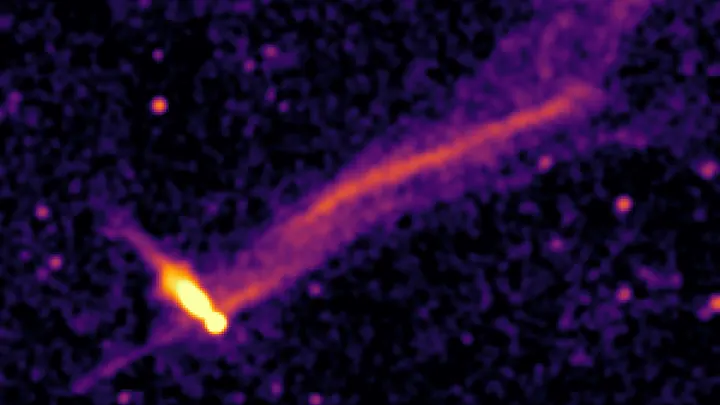
Deep in space, a rapidly spinning neutron star, a pulsar nicknamed the Lighthouse, speeds through tenuous gas. Like a motorboat cutting through water, it leaves a glowing trail of charged particles behind. In X-rays, this trail appears as a bright tail and a thin filament stretching over many light-years.
At the center of the Milky Way lurks something invisible but extremely massive — about four million times heavier than the Sun. It is usually called a black hole and designated Sagittarius A*. But astronomers are not letting their guard down: what if it is not a hole but something more exotic, like a giant ball of ultralight particles — a boson star?
Around small, cool, but extremely restless red dwarfs, planets the size of Earth often orbit. Such a star is like a temperamental stove that intermittently erupts flares: powerful streams of light and particles batter the planet's atmosphere, as if someone splashed fire into a simmering soup pot.
A sunspot, a dark island on the scorching surface, breathes. Every three minutes, a wave spreads from it, runs along an invisible magnetic arch, and makes the plasma above a neighboring spot flare with a radio signal. Radio telescopes caught seven such flares in a row on February 14, 2024.
A solar flare is like a giant rubber band that's been twisted and let go. Magnetic field lines on the Sun tangle, snap, and reconnect — a process called magnetic reconnection. At the break point, energy bursts out: particles accelerate, plasma heats up, and we see bright ribbons on the surface.
Light from thin semiconductor layers can be polarized: its waves oscillate in a single plane. Previously, it was thought that the direction of oscillation was set by how the sample was illuminated.
The black hole GRS 1915+105 usually hides behind a dense gas curtain: its X-ray emission is heavily absorbed on its way to us. But in April 2023, it suddenly flared: the X-ray flux jumped nearly tenfold.
The Sun constantly flares up like a campfire when you toss in more kindling. Big flares are obvious at once, but weak ones easily get lost in the overall glow. The neural network was taught to pick out even barely noticeable bursts from the stream of data that satellites send every second.
From 2018 to August 2025, the algorithm found 111,580 flares.
In 2017, the IceCube detector caught a neutrino from the distant galaxy TXS 0506+056. It was like hearing a phone ring from across the ocean: the signal came from where the most energetic particles in the Universe are born. At the same time as the neutrino, astronomers spotted a gamma-ray flare, and two to three years later, radio waves. Why was the radio late?
Water isn't the only thing life needs. To assemble the first RNA-like chains from simple molecules, you need ultraviolet light, like the sunlight that helps plants, but harsher and with shorter wavelengths. Big stars like the Sun emit plenty of this light. Small, dim stars, however, have almost none: they shine mostly in red and infrared, like a glowing ember.
Light from the Sun is usually unpolarized: its waves oscillate in all directions, like a crowd where everyone waves their arms as they please. But on May 3, 2023, astronomers in Locarno, Switzerland, noticed that during a flare, the light from helium became organized — the waves aligned in one direction, like soldiers on parade.
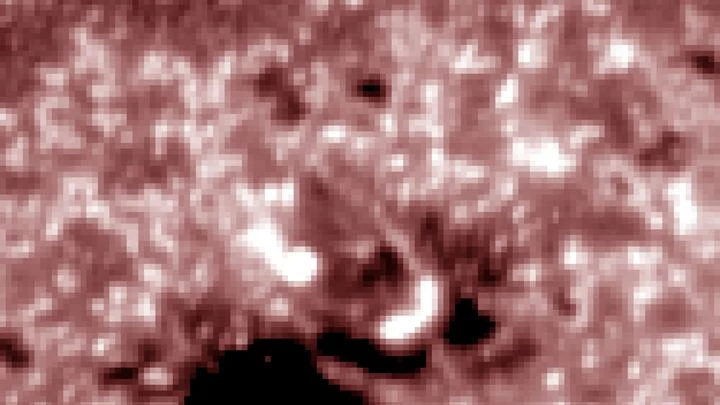
The Sun sometimes produces flares — bright explosions that hurl streams of charged particles into space. On April 22, 2021, one such flare occurred in an active region where a dark sunspot was crossed by a bright "bridge" of hotter gas.
The white dwarf WDJ165335.21-100116.33 is the cooled core of a star, about the size of Earth but with the mass of the Sun. On its surface, there is an unusual hot spot that appears and disappears. Astronomers long puzzled over why the star's brightness changes every 80 hours.
Twenty-eight seconds: that's how long it took for an automated camera to lock onto a flash in a constellation whose light had traveled for more than nine billion years.
A galaxy plunges into a dense cluster like a runner into a crowd. The oncoming gas, known as the intracluster medium, strips away its own gas, stretching it into a long, glowing tail. Astronomers call these galaxies jellyfish: they have a body and flowing tentacles of stripped material. But only in a few do new stars ignite within those tentacles.
A solar flare is like a short circuit in a giant neon sign. Inside the Sun, magnetic fields twist into loops, like rubber bands, and when they reconnect, energy bursts into space. Part of it goes into hard X-rays, produced by particles accelerated to nearly the speed of light.