Bacterial Quantum Secret of Safe Light Harvesting express
Under sunlight, molecules inside bacteria, like the beaters of a kitchen mixer, capture energy and spin electrons in the right direction. But sometimes the spin gets disrupted — 'stuck' triplet particles appear. It's as if the beater momentarily froze and then jerked backward, splashing hot liquid and scalding the walls.
Heliobacteria, which mastered light back in Earth's oxygen-free atmosphere, developed a defense — a quantum filter called CISS. It only lets through electrons with the correct spin, much like a mixer part always snapping into place before turning on. This prevents breakdowns, and the carbon-based cell components stay intact. Cutting-edge spectroscopy confirmed that the mechanism works flawlessly even in warm, humid environments — previously, such effects were thought to require extreme cold.
Now engineers are trying to replicate CISS in solar panels so they don't lose efficiency over time. Nature debugged its quantum mixer for billions of years — all we need to do is adopt this experience.
Original abstract
as written by the authors arXiv:2605.08307
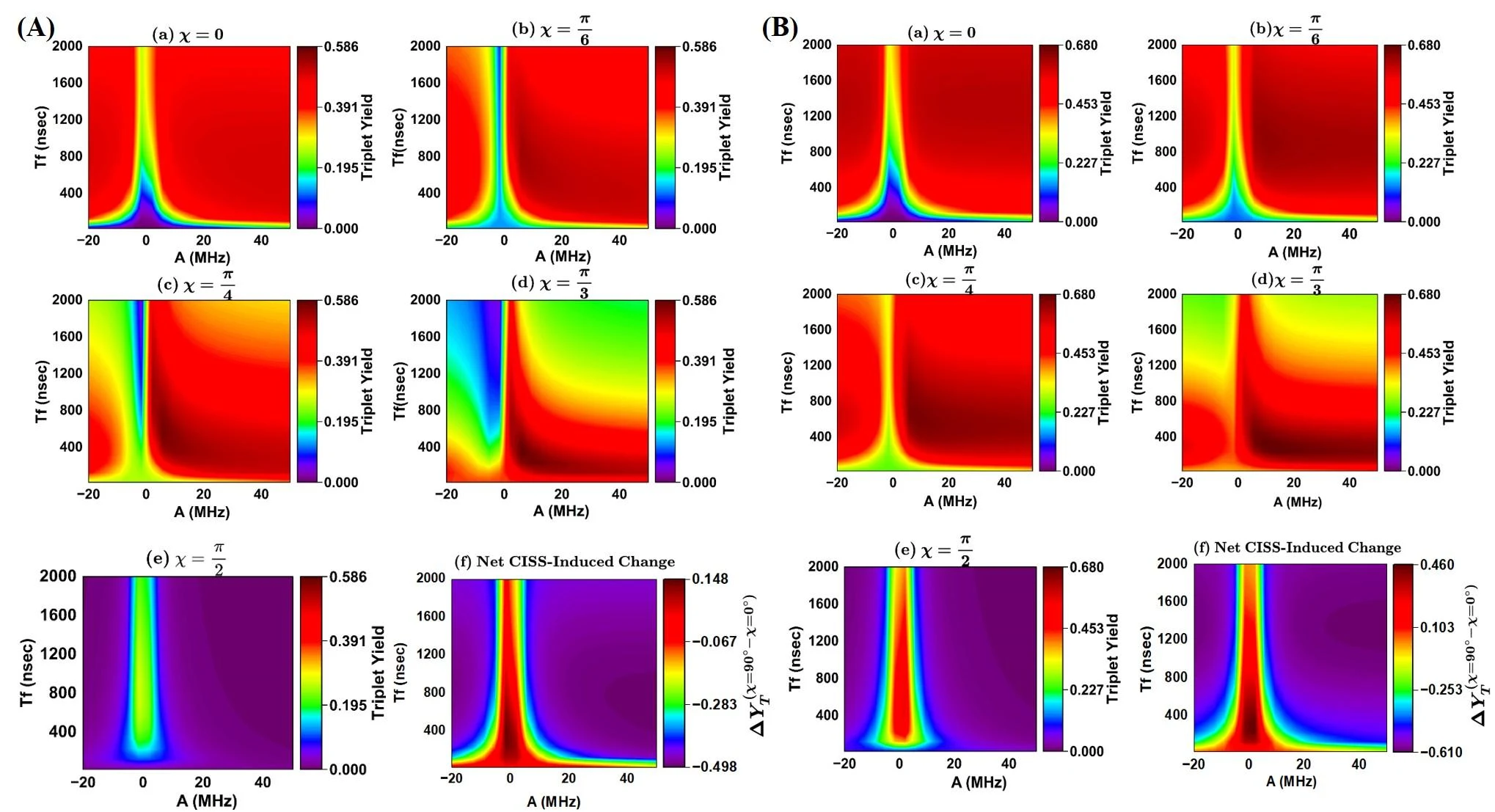
Triplet formation and its regulation have always been of central interest in understanding the photophysical behavior of living systems. In organic systems, excessive triplet formation poses significant challenges, as it can promote photochemical damage and reduce the efficiency of charge separation processes, making its regulation critically important.Here, we present a theoretical investigation of the intrinsic quantum spin dynamics governing triplet formation in the heliobacterial reaction center, a system that operates without any internal magnetic field. Using an open quantum systems approach based on the Lindblad formalism, we simulate the spin-correlated radical pair dynamics occurring during charge separation in the heliobacterial reaction center. The study systematically examines how triplet formation is regulated by variations in two key parameters, hyperfine coupling strengths and recombination rates, and how this regulation is further influenced by the inclusion of chirality-induced spin selectivity (CISS) in conjunction with the radical pair mechanism (RPM). Our results demonstrate that the CISS effect significantly suppresses triplet formation across the parameter space relevant to the heliobacterial molecular environment, revealing an intrinsic quantum protective mechanism operating through spin control in heliobacterial photosynthesis.
Heliobacteria are among the few organisms that can survive in hydrogen sulfide springs, where light is barely perceptible and oxygen is lethal. Their 'quantum mixer' operates in conditions that would kill any highly organized cell.