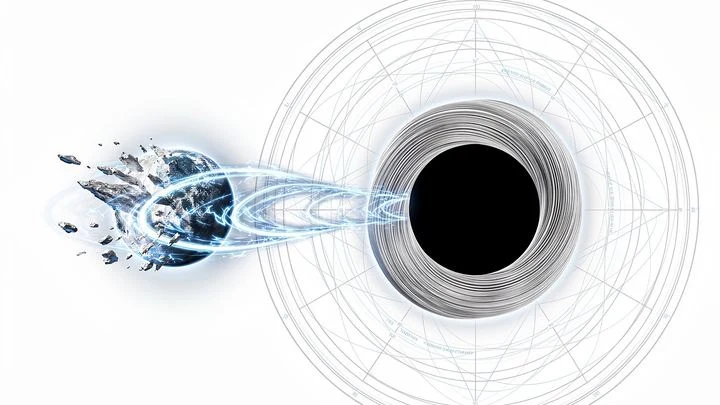
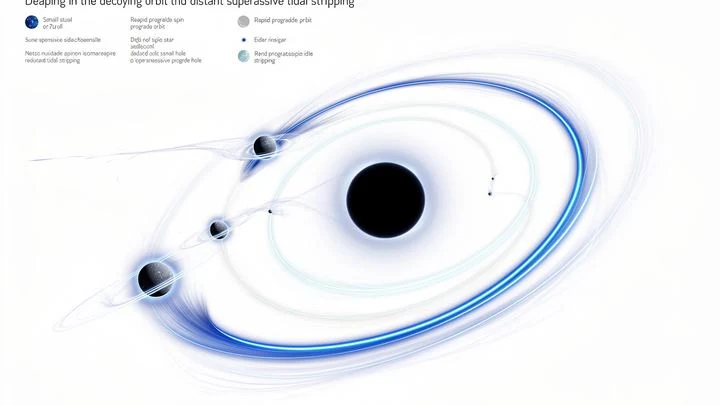
The Hills mechanism describes a dramatic gravitational interaction in which a supermassive black hole tears apart a binary star system that wanders too close. One of the two stars is captured into a tight, often highly eccentric orbit around the black hole, while the other is ejected at extreme velocity — sometimes fast enough to escape the galaxy entirely. This process is a key explanation for the existence of hypervelocity stars, which were first predicted by Jack Hills in 1988 and later observed in our own Milky Way.
History
Proposed by Jack Hills in 1988 in a paper titled 'Hypervelocity stars from the Galactic center'.
How it works
When a binary star system approaches a supermassive black hole, the black hole's tidal gravitational field acts differently on the two stars because they are at slightly different distances. If the binary's orbital energy is less than the tidal energy from the black hole, the binary is disrupted. One star loses energy and falls into a bound orbit around the black hole, while the other gains the excess energy and is flung outward at speeds that can exceed 1,000 kilometers per second.
In practice
The mechanism is used to explain the origin of hypervelocity stars observed in the Milky Way's halo, and it also provides a way to probe the presence and properties of supermassive black holes in other galaxies.
Fun fact
The ejected star can travel so fast that it leaves the galaxy, becoming an intergalactic wanderer.
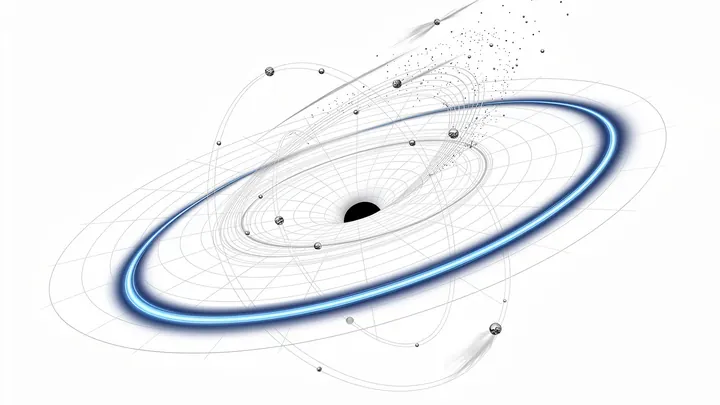
At the center of an ultra-compact dwarf galaxy, a very dense stellar system spanning tens of light-years, there is a vacuum cleaner at work. But instead of dust, it sucks in gas shed by dying stars. This gas does not fly off in all directions; instead, it spirals into a funnel, a rotating disk that gradually settles onto the black hole.
In 2015, the LIGO detectors caught the first ripple of spacetime from a black hole merger. Since then, hundreds of such events have piled up, each carrying the imprint of its ancestry: whether the holes were born together from a single pair of stars or met by chance in a dense cluster. The difference shows in the direction of their spin axes.
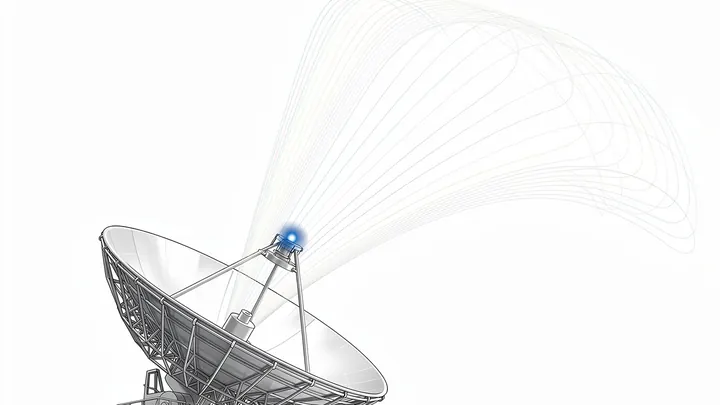
A network of radio telescopes scattered across the planet catches the whisper of a distant black hole. Each antenna records a signal, but how do you combine these recordings if the clocks at the stations tick at different rates and the atmosphere distorts incoming waves?
A black hole pulls in anything that gets too close. But if you toss in not one object but a pair, one of them can fly back out, carrying off some of the hole's rotational energy. This trick, devised by Roger Penrose in 1969, works only because a black hole has a horizon — a boundary beyond which nothing returns. Now it turns out the horizon isn't necessary.
A balloon that lets out air in bursts zips around the room — the jet blasts first one way, then another. A dying star behaves the same way as it sheds its bloated shell. Only instead of air, it's superheated gas, and instead of a balloon, it's a future white dwarf (the dense stellar remnant about the size of Earth).
Somewhere in the center of a galaxy, a black hole is spinning. It doesn't hang in a void — around it swirls an invisible swarm of dark matter particles. Until now, this swarm was described for non-rotating holes, but in reality, holes always rotate.
A black hole is like a perfectly smooth sphere. It has no features — only mass, charge, and spin. This rule is called "no-hair." But nature loves to complicate things: sometimes a cloud of a scalar field (a special field described by a single number at each point) spontaneously appears around a black hole.
In the dark outskirts of our Galaxy, far from bright star clusters, millions of black holes lurk. They are invisible: they don't shine and don't noticeably accrete matter. Conventional search methods, designed for dense stellar fields, are useless here. A different approach is needed.
Astronomers have proposed using the very fabric of space as a detector.
A whirlpool gulps down water, but splashes most of it back out. That's roughly how a black hole behaves when too much matter falls onto it. In a new study, astrophysicists ran 32 computer simulations to understand how a black hole's parameters — mass, spin, and "appetite"—control these cosmic fountains.
At the heart of our Galaxy lives the supermassive black hole Sagittarius A*. If an invisible companion orbits nearby, their dance can be spotted through the light of other stars. The pair's gravity works like a lens: as the black holes pass in front of a background star, its light briefly brightens and splits into two.
A black hole is not a perfect vacuum cleaner. It is surrounded by a swarm of particles and fields, and this swarm alters its fate. In a new study, astrophysicists examined how a massive vector field, a hypothetical form of dark matter, behaves near a rotating black hole.
The most massive stars are like overinflated balloons: their envelope stops stretching and instead begins to furiously vent material. At a certain stage, the mass loss becomes so intense that the star stops growing in size. Astronomers see this moment as a kink in the diagram where stars are sorted by luminosity and temperature.
A galaxy collision is like a slow dance in which two partners gradually draw closer. Hidden at the center of each is a supermassive black hole — an invisible flywheel with a mass of millions or billions of suns.
A gas disk with a mass of four hundred thousand suns encircles the black hole at the center of the Milky Way. Its gravity works like a gravitational rudder: slowly but inexorably turning the orbits of binary stars, driving them into the region where tidal forces tear the pair apart.
Layer by layer, artifact by artifact — an archaeologist reconstructs the history of an ancient settlement. Similarly, astrophysicists sifting through 259 records from LIGO–Virgo–KAGRA saw a clear layered structure among merging black holes.
1799 kilometers per second — that's the speed at which star S5-HVS1 is permanently leaving the galaxy. 4.8 million years ago, it was ejected from the center of the Milky Way during a close encounter with the supermassive black hole Sgr A*.
Two galaxies (our Milky Way and its satellite, the Large Magellanic Cloud) slowly circle each other. Their gravitational pull stirs the distant outskirts of the Milky Way, like a pebble thrown into a pond makes the water ripple.
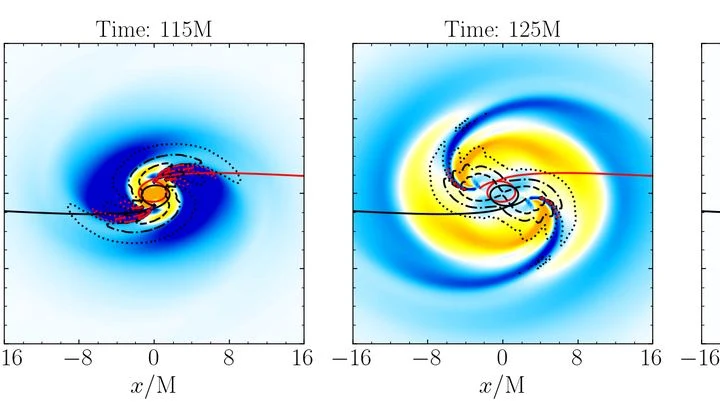
Three milliseconds before the merger. A gargantuan black hole spinning at breakneck speed drags in a neutron star — a ball the size of a city but with 1.5 times the Sun's mass. Tidal forces stretch the star into a thread as thin as a needle and fling its matter outward.
A branch falls into a whirlpool. It gets spun and broken, but sometimes a powerful fountain of water bursts from the center. Similarly, a black hole tears apart a passing star, and occasionally a blinding plasma jet, a jet, shoots into space.
It takes the stellar pair J05+50 nearly two months to complete one orbit around their common center. From Earth, it appears as a faint point in the constellation Hercules — 4625 parsecs away. Photometry of the binary star only captures a steady flicker of brightness, like the pulse of a giant heart.
The event horizon's edge is never calm. Quantum vacuum boils there, and particles sometimes burst out of this foam: that is how Stephen Hawking in 1974 discovered black hole radiation, forever linking gravity with quantum field theory.
At the center of attention is a black hole of unusual shape. Its geometry resembles a spindle: a slight elongation is added to the usual rotation. The parameter B measures this deformation.
The spindle deformation is not just a mathematical toy.
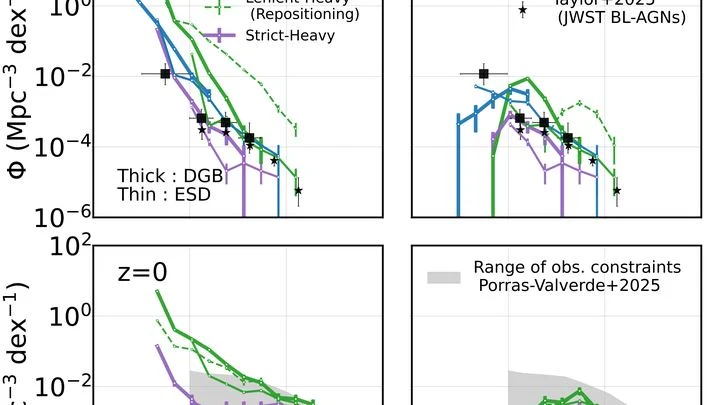
The James Webb Space Telescope peered into an era when the universe was less than a billion years old and spotted strange objects—'little red dots.' These are black holes with masses of millions of suns, but in very compact, chemically pristine galaxies. Standard scenarios can't grow such heavyweights that early.
A detective story unfolded in the GWTC-5 catalog. Hundreds of signals from merging black holes, captured by the detectors of Rainer Weiss and his colleagues, held the secret to the origin of the most massive and rapidly spinning stellar-scale objects.
In a recent study, astrophysicists showed how pre-recombination physics, particularly early dark energy, affects the spectral running $$α_s$$ and, consequently, the viability of scenarios forming primordial black holes from an ultra-slow-roll (USR) phase during inflation.
The cosmos sets its own lenses in the path of gravitational waves. When two black holes merge, the resulting ripple travels through the universe. If it encounters a massive galaxy cluster along the way, its gravity bends the path of the waves — much like glass focuses light.
In 1933, Fritz Zwicky first spoke of an invisible mass holding galaxy clusters together. Decades later, Vera Rubin mapped galactic rotation, revealing the ghostly presence of dark matter. Today we know it pervades the cosmos, but its particle nature remains elusive.
Two black holes race past each other like Formula 1 cars on opposite lanes. In standard general relativity, they remain 'bald'—no extra fields appear around them. But if you add a scalar field to the equations (something like an invisible fog permeating space), the rules change.
Gravitational-wave detectors picked up a strange burst — the signal GW241011. Two black holes merged, but the pair looked unusual: one hole was about three times lighter than the other, and the system as a whole was spinning rapidly. Such a combination is a rare guest in the catalogs.
A black hole with a magnetic field resembles a whirlpool in a river, where water doesn't flow into the vortex but swirls in place. Usually, the hole's rotation picks up waves and amplifies them: this is called superradiance. But add a magnetic field, and everything changes.
Two magnets collide in a dark room, stick together into a clump, and a dull thud echoes. Black holes behave much the same way, except instead of magnets they carry electric charge, and instead of a thud, there's a burst of gravitational waves. But there's a third player in this story — an invisible field that physicists call scalar.
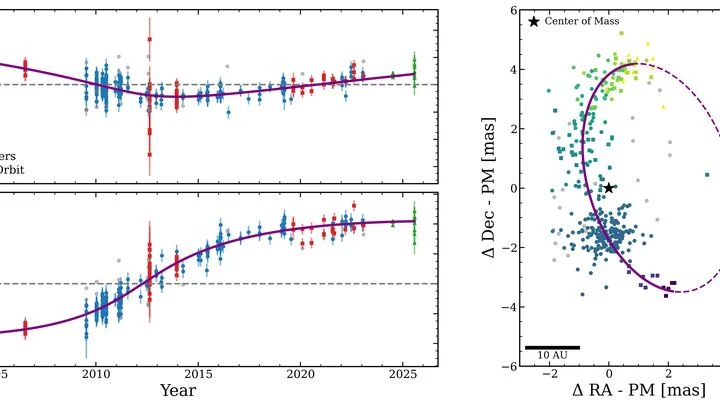
For 23 years, Hubble and James Webb have peered into the heart of Omega Centauri, a globular cluster where millions of stars crowd into a space just 150 light-years across. In this stellar beehive, the motion of the stars betrayed an invisible partner: a main-sequence star (one that has not yet left the main evolutionary branch) seemed to be tugged in a dance with an unseen weight.
A field sown with seeds. Some seeds are large and sprout at the slightest rain; others are finicky, requiring special soil and rare conditions. Which seeds fall into the ground determines what kind of forest will grow years later. Astrophysicists think about the birth of black holes in the early universe in much the same way.
In the accretion disks that gird the nuclei of active galaxies (quasars, discovered by Maarten Schmidt way back in the 1960s) a river of incandescent gas and dust churns. In its backwaters, where turbulent flows subside, against all odds, planets are born.
Picture a tightrope walker balancing over an abyss. Every step changes the rope's tension, and the slightest shift in center of gravity can prove fatal. That's roughly what the dance of an ordinary sun-like star around a black hole of ten solar masses looks like when the orbit is highly elongated.
In the centers of galaxies, where supermassive black holes lie dormant surrounded by stellar swarms, lights of monstrous power sometimes flare up — tidal disruption events. But some of these events behave oddly: they repeat again and again, and each new ignition is dimmer than the last.
In the silent theater of the cosmos, a star’s life plays out over billions of years. But sometimes an invisible director sneaks onto the stage — a primordial black hole.
Drop a handful of sand into calm water — the ripples spread and fade. Drop it into a running blender — the vortices mix everything in an instant. Physics has a similar rule: chaos cannot grow faster than a certain rate.
Pairs of black holes dance in three different styles before merging. The first is a neat waltz: the objects swirl in the same direction, like partners facing the same way. Such pairs are born from binary stars and often have unequal masses. The second is chaotic disco: spins are scattered, masses nearly equal.
Two figure skaters glide on the ice. One is light and cautious, barely rotating. The other is massive and fast, spinning with all its might, and in different directions at that. That's roughly the picture painted by gravitational waves from black hole mergers.