A triplet state is a quantum state of a system with two unpaired electrons whose spins are aligned (both 'up' or both 'down'), resulting in a total spin quantum number S = 1. This gives three possible spin projections (m_s = -1, 0, +1), hence the name 'triplet'. It contrasts with the singlet state, where the spins are antiparallel (S = 0). Triplet states play a crucial role in molecular physics, photochemistry, and quantum information science.
History
The concept of triplet states was developed in the early 20th century with the advent of quantum mechanics. Friedrich Hund and Robert Mulliken contributed to understanding molecular electronic states, and the term 'triplet' was formalized in the 1920s.
How it works
In a triplet state, the two electrons occupy different spatial orbitals, and their spins are parallel. This alignment reduces electron-electron repulsion due to the Pauli exclusion principle, often making triplet states slightly lower in energy than corresponding singlet states in certain molecules. Transitions between singlet and triplet states are 'forbidden' by quantum selection rules, making triplet states long-lived (metastable). This property is exploited in technologies like organic light-emitting diodes (OLEDs) and in quantum sensing.
In practice
Triplet states are central to phosphorescent materials, OLED displays, and nitrogen-vacancy centers in diamond, which are used as quantum sensors and qubits for quantum computing.
Fun fact
In the nitrogen-vacancy center in diamond, the triplet state's spin can be manipulated with microwave pulses and read out with laser light, making it a leading platform for room-temperature quantum technologies.
A lone erbium atom sits on a silver substrate, and its spin, the electron's internal rotation, stores quantum information. Previously, flipping this spin required a magnetic pulse: a blunt tool that disturbs neighbors and works slowly. Now physicists from Germany and Korea have shown that a single electric voltage suffices.
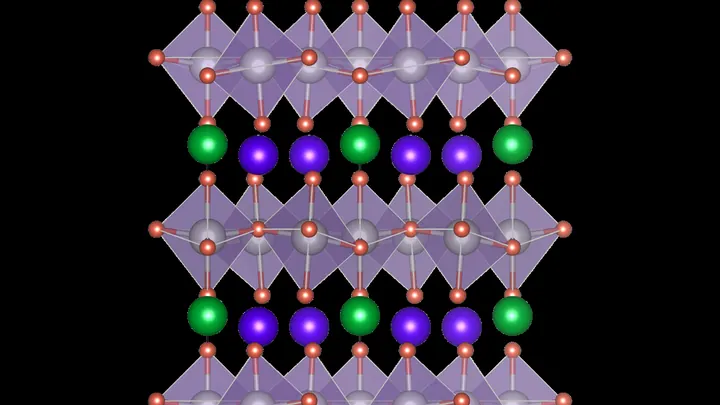
The PbCuTe₂O₆ crystal resembles a three-dimensional web of copper, tellurium, and oxygen. Inside, the magnetic moments, tiny arrows tied to electron spins, are so entangled that they can't settle into an orderly arrangement even near absolute zero.
A thin silver thread nearly as long as a hair's width, and inside it, pristine quantum laws hold sway. Physicists built a conductor where electrons can only move forward or backward, like on a perfectly straight single-lane road with no shoulders. On such a road, any pothole or pebble would normally destroy the fragile quantum state.
Seven dancers step onto the stage. They join hands so that any trio or quartet moves in perfect harmony with the rest — no group falls out of the overall rhythm. In the quantum world, this is called an absolutely maximally entangled state (AME for short). It's a perfect knot where every part knows everything about the whole.
A magnetic field of 42 tesla — about a million times stronger than Earth's field. In such a field, the crystal SrCu₂(BO₃)₂ behaves unusually: its magnetization doesn't increase smoothly but in jumps, pausing at specific values.
An atomic nucleus is not just a ball of protons and neutrons. It has a shape, and that shape can change. The tin-116 nucleus was long considered almost perfectly spherical: it has 50 protons — a 'magic' number that usually gives a nucleus spherical symmetry. But a new ultra-precise measurement showed otherwise.
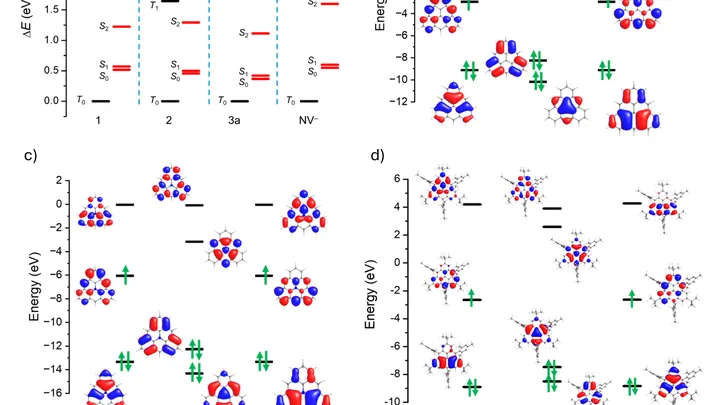
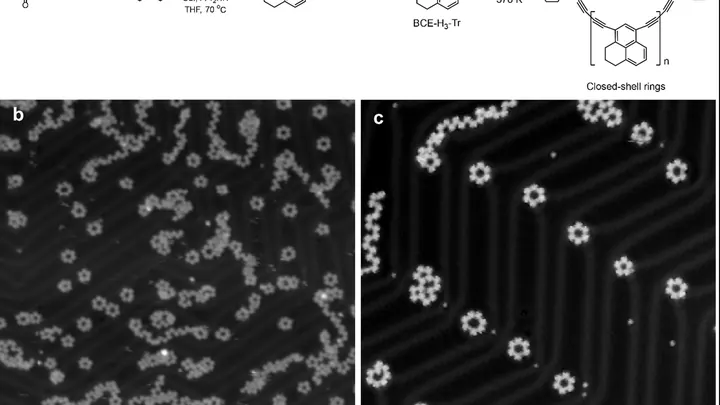
At the heart of a future quantum computer might lie a tiny organic molecule shaped like a triangle. It has two 'extra' electrons that don't pair up. Such molecules are called diradicals, and their electrons can store information in a special, quantum way.
Light hits an organic molecule, and inside, a pair of twin excitations is born. They're called triplet pairs. In single pentacene molecules, such pairs have long been known to share their energy with neighbors: this is the basis of singlet fission, which boosts the efficiency of solar cells.
The carbon nucleus was long imagined as a uniform ball of protons and neutrons, evenly mixed like dough. But physicist George Gamow suspected otherwise: particles inside might group into tiny, sturdy blocks — helium nuclei, or alpha particles.
An electron and its antiparticle — the positron, predicted by Дираком, — upon meeting, momentarily form позитроний: a tiny pair circling each other, like in an atom but without a nucleus. Almost instantly it decays, emitting two photons that turn out to be mysteriously linked.
Neutrinos are the true ghosts of the microcosm. Nearly massless and chargeless, they pass through planets as if through empty space. But inside each neutrino hides not one particle but three — three 'flavors' (electron, muon, and tau) that constantly morph into one another. This dance is called oscillation.
Three dancers move as one: each feels all the others, and the overall harmony cannot be reduced to individual interactions. This is roughly how three particles behave, born from an electron and positron collision at the speed of light. They are a top quark, its antiparticle, and a Z boson.
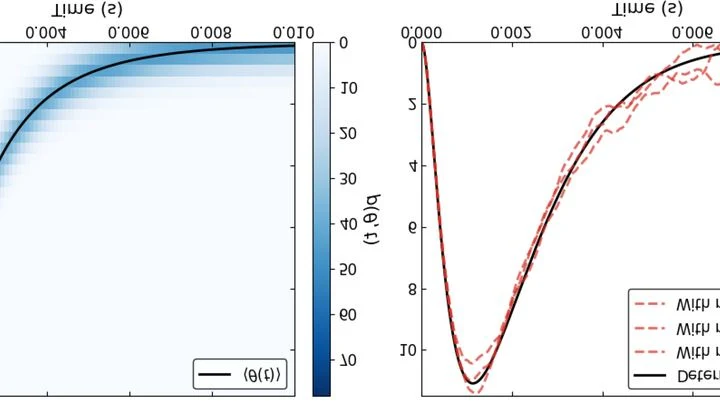
Hot water sometimes freezes before cold: this is the Mpemba effect. In the quantum realm, a similar paradox appears: the more the equilibrium is disrupted, the faster it recovers. It's like fleeing from disorder (entropy) in reverse: the system rushes toward order, and a large initial imbalance only helps.
A long chain of atoms, each a tiny magnet. They talk to each other and to a common field, like musicians in an orchestra who hear both the conductor and their neighbors. When the external field changes, the orchestra either plays out of sync or all instruments come in together: that's a quantum phase transition.
A superconductor carries current without resistance, like water running through a pipe without friction. The secret lies in electron pairs: two electrons stick together as one, even though they normally repel. In an ordinary superconductor, the spins of the electrons in a pair point in opposite directions: this is the singlet state.
Two black holes smash head-on at full speed — while a third one circles nearby. In ordinary life, such a crash would produce a burst of gravitational waves (ripples in space, like the ripples from a stone thrown into a pond). But here, part of the ripple passes by the massive neighbor, and changes, like light in a funhouse mirror.
An orchestra where every musician plays their own part, yet together they weave a complex melody: that's what a cloud of atoms looks like when their spins (intrinsic rotations, like tiny tops) oscillate in sync. Usually, these tops behave independently.
Two entangled photons fly apart in opposite directions but continue to behave as a single whole: measuring one instantly determines the state of the other. That's quantum entanglement. But sometimes it resembles a seasoned spy — leaving no traces detectable by ordinary checks.
Quantum networks need a mediator between storage — spin — and carrier — light. No single molecule had ever pulled off such a feat. But now physicists have found a solution. They placed a carbene molecule into a crystal and cooled it to -269°C.
Under sunlight, molecules inside bacteria, like the beaters of a kitchen mixer, capture energy and spin electrons in the right direction. But sometimes the spin gets disrupted — 'stuck' triplet particles appear. It's as if the beater momentarily froze and then jerked backward, splashing hot liquid and scalding the walls.
In a piece of ordinary magnet, all electron spins, tiny magnetic arrows, point in the same direction. It's a formation of soldiers facing their commander. This order is called a collinear altermagnet.
In the silence of the cosmos, the fabric of spacetime trembles almost imperceptibly: this is the quantum whisper at the scale of 10⁻³⁵ m, which until now was considered fundamentally undetectable. But collisions of black holes can turn it into a deafening scream.
Two quantum dots are like two tiny pockets in a piece of silicon where an electron can sit, like a ball in a cup. When the pockets are far apart, each electron lives on its own, and its energy resembles the levels of a solitary atom.
The quantum world loves order, but reality often brings disorder. In this work, physicists study one-dimensional chains of spins — tiny magnetic arrows that can point up or down. Usually, topological phases (stable states protected by symmetry) are defined for pure states, where each arrow is precisely known.
An electron in an ordinary wire is like a courier carrying both a package and the recipient's signature at once: its charge and spin are always together. But if the wire is made just one atom thick, the courier gets cramped. In such a one-dimensional tube, electrons cannot overtake each other, and their collective behavior changes beyond recognition.
In some materials, atomic magnetic moments: their tiny 'arrows'—refuse to freeze even at ultra-low temperatures. Instead of conventional order, they form a spin liquid: a state where spins constantly flicker but do so coherently, like dancers in an intricate routine.
A quantum dot is like a tiny island where one or a few electrons can settle. In this new work, such an island was connected to two 'seas' of electrons: one flat like a pancake, the other bulky like an ocean. Electrons can hop from the island to the seas and back, and this hop depends on the shape of the electron's wave on the island.
A ring of magnetic atoms resembles a round dance where each participant holds hands with their neighbors. In ordinary magnets, each atom has its own permanent magnetic moment, and they interact like little arrows striving to align opposite to each other.
A drop of water on the table looks calm, but inside it, quantum life is bustling. Protons in hydrogen atoms are like tiny spinning tops that constantly rotate. Each has its own direction of spin.
Magnetic atoms in a solid are like compass needles: usually, when cooled, they align in one direction: that's how magnetism arises. But in TbInO3, the terbium needles sit on a triangular lattice where it's impossible to please all neighbors at once. One needle wants to point north, another south, and in the end none can settle into a stable position.
A quantum computer based on electron spins is like a row of tiny spinning tops. Each top spins either clockwise or counterclockwise: that's a qubit. To find out the result of a computation, you typically stop the top and see which way it fell. But if you have many tops, each one needs its own "eye"—an extra helper qubit.
A tiny diamond hangs in the air, held by an electric field like a speck of dust in a beam of light. Hidden inside are defects — places where a carbon atom is replaced by nitrogen, with a vacancy nearby. These defects behave like little magnets that can be flipped with laser and microwaves.
In two mirrored rooms, set at right angles, lives a cloud of atoms. Each atom is like a singer in a choir: on its own, it may stay silent, but when neighbors start to sing, it joins in. Here, the conductor's role is played by geometry itself: one room helps the atoms emit light together, while the other gently nudges them toward that — not directly, but through a clever detour.
An ordinary superconductor is like a squad of soldiers marching in pairs: electrons pair up, and their spins (internal 'tops') point in opposite directions. A magnetic field easily flips such pairs, destroying superconductivity.
In UTe₂, things are different.
On a silicon chip that resembles a neighborhood, qubits, electrons with spin, live in separate 'houses.' Previously, neighbors could only chat over the fence, but now a road has been laid between them: along it, a qubit can ride to any of the four stops. The road is a bus that carries the electron without losing its quantum state.
A bell doesn't ring with a single note — after being struck, it sounds with several harmonics at once. An atomic nucleus vibrates in much the same way: after a collision, it can oscillate, and these oscillations show up in the emitted gamma rays.
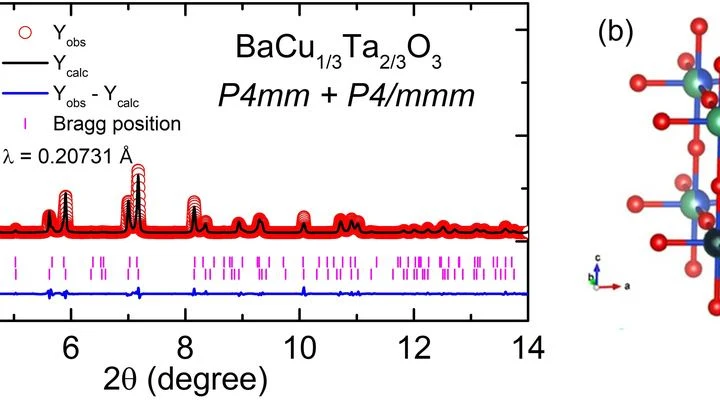
Atoms in a crystal usually sit in their designated spots, like passengers on a plane with assigned seats. But in this material, copper and tantalum have taken their places randomly, as if the tickets got mixed up. Scientists peered into the crystal using X-rays and saw that the disorder is not just on paper but in the actual arrangement of atoms.
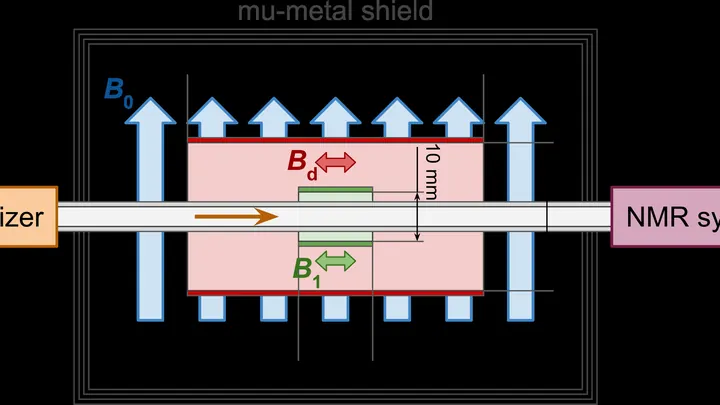
A magnetic compass in a test tube sounds like a magic trick, but it's pure physics. In a solution of fumarate (a salt of malic acid), carbon-13 nuclei behave like tiny spinning tops.
In an accelerator, two Higgs particles collide. For a fleeting moment, their fates intertwine, then separate, carrying away information about the encounter.
A tiny diamond with defects, nitrogen atoms that replaced carbon, hides an unusual feature. Around each defect, an extra electron spins like a top that can be tilted by radio pulses. On its own, this top is too quiet to reach a superconducting qubit — an artificial atom operating at temperatures colder than outer space.