How to Hear Bone Strength: AI Learns from Physics express
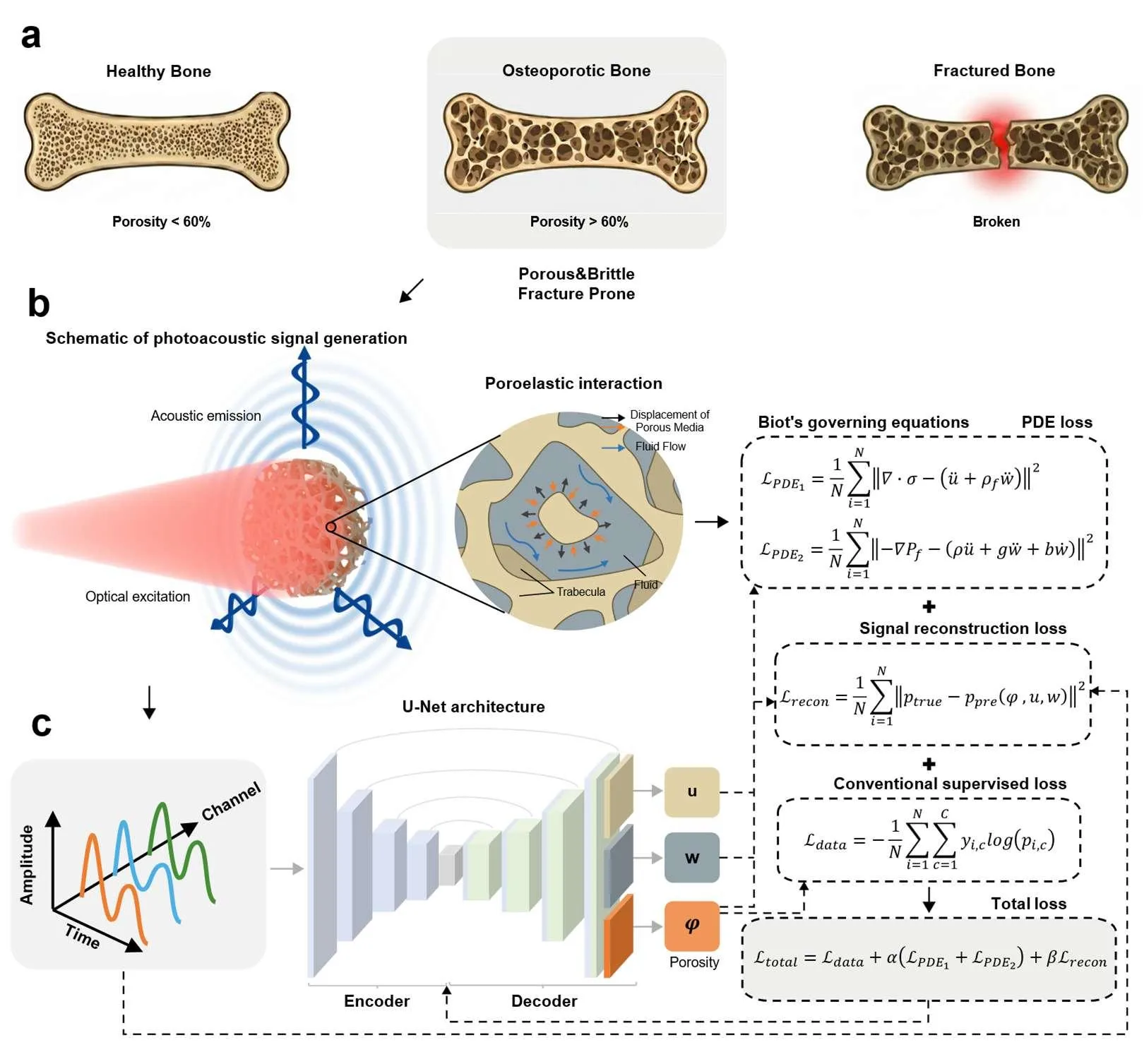
A laser beam strikes bone, and it responds with a nearly inaudible ultrasonic echo. Hidden in that sound is information about every microcrack and every fluid-filled pore. The trouble is that conventional computer programs don't understand this language: they see the signal but don't know the physics that produced it.
The authors took a different approach. They took a neural network and embedded Biot's equations into it — the mathematical description of how sound and deformation travel through a porous medium saturated with fluid. The result is a hybrid: the program doesn't just look for patterns in data; it relies on the laws of physics. This approach is called a physics-informed neural network.
The outcome is automatic sorting of bone samples by microstructure condition. The algorithm, named Biot-PINN, distinguishes healthy from damaged bone in 97% of cases. For comparison, purely "blind" machine analysis of the same signals yields far more modest numbers. The secret is that physics prevents the neural network from inventing false connections: it works like an experienced engineer who hears a familiar mechanical rhythm in the noise.
This is no lab curiosity. Early diagnosis of bone fragility is one of the most pressing challenges of an aging world. Today, osteoporosis is often only noticed after the first fracture. Biot-PINN promises to hear trouble earlier — through subtle changes in how bone transmits sound.
Human bone completely renews itself roughly every 10 years: we quietly "swap skeletons" several times in a lifetime, and the quality of that assembly determines whether old age brings a fracture.