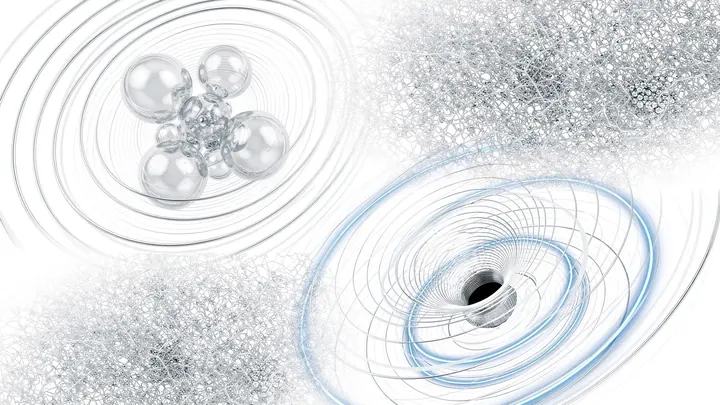
Density fluctuations are the tiny, almost imperceptible variations in the density of matter and energy that existed in the early universe. These variations acted as the initial seeds from which all cosmic structure—galaxies, galaxy clusters, and the large-scale web of the cosmos—eventually grew. Without them, the universe would be a perfectly smooth, featureless expanse of particles, with no stars, planets, or observers to ponder them. The study of these fluctuations is central to cosmology, as their statistical properties encode the physics of the very early universe, including the process of inflation.
History
The concept of density fluctuations as seeds of structure was developed in the late 20th century, with key contributions from physicists like Edward Harrison and Yakov Zeldovich in the 1960s-70s, who predicted the scale-invariant spectrum. The detailed confirmation came with the COBE satellite in 1992, which detected the fluctuations in the CMB.
How it works
In the early universe, quantum mechanical effects during a period of rapid expansion (inflation) created minuscule ripples in the fabric of spacetime. These ripples manifested as density fluctuations—regions slightly denser or sparser than average. Over billions of years, gravity amplified these differences: denser regions attracted more matter, growing into the vast structures we see today. The fluctuations also left an imprint on the cosmic microwave background (CMB) as tiny temperature variations, which we can measure with high precision. The distribution of these fluctuations—how many are large versus small—follows a nearly scale-invariant spectrum, a key prediction of inflationary theory.
In practice
Density fluctuations are used to test cosmological models, particularly inflation, by comparing precise measurements of the CMB (from missions like Planck) and galaxy surveys with theoretical predictions.
Fun fact
The density fluctuations that seeded all cosmic structure originated as quantum jitters on scales smaller than an atom, stretched to astronomical sizes by inflation.
Units by system: SI: kilogram per cubic meter · CGS: gram per cubic centimeter
In the first moments after the Big Bang, the universe underwent a rapid expansion — inflation. Space stretched faster than light, and quantum jitters of the vacuum turned into real particles. This is how dark matter, the invisible substance that holds galaxies together, could have been born.
The early Universe was not just a hot soup of particles. In the first fractions of a second, mirror symmetry could have been broken: the world and its reflection would not be quite identical. If so, the large-scale cosmic web of galaxies would retain a barely noticeable 'curl'—as if all matter were slightly twisted in one direction.
In the first fractions of a second after the Big Bang, the universe was a stage of rapid change. A stretched rubber sheet that cools quickly becomes covered with microscopic cracks. A similar process on a cosmic scale could have given rise to cosmic strings — ultra-thin but super-dense threads of energy stretching across the entire universe.
These strings are not just defects in space.
At the dawn of time, the universe experienced a brief moment of frantic expansion — inflation. Tiny quantum jitters of spacetime stretched to cosmic scales. These jitters, primordial fluctuations, became the seeds from which galaxies and stars later grew.
Imagine a ball in an unfamiliar hall: two guests start from opposite corners. Their movements are not a smooth waltz but chaotic improvisation in search of rare treasures. Contrary to intuition, the outcome hinges not on tempo but on the geometry of the floor.
In the first instants after birth, the universe might have been multidimensional, like a sheet of paper that suddenly gained thickness. This "thickness"—the extra dimensions — began to inflate rapidly. Such superfast growth is called inflation.
Using the James Webb telescope, astronomers peered into an ancient quasar — the dazzling heart of a galaxy where a giant black hole sucks in matter. It turns out it doesn't just destroy, but also creates: its powerful outflows and shock waves act like a true cosmic mill.
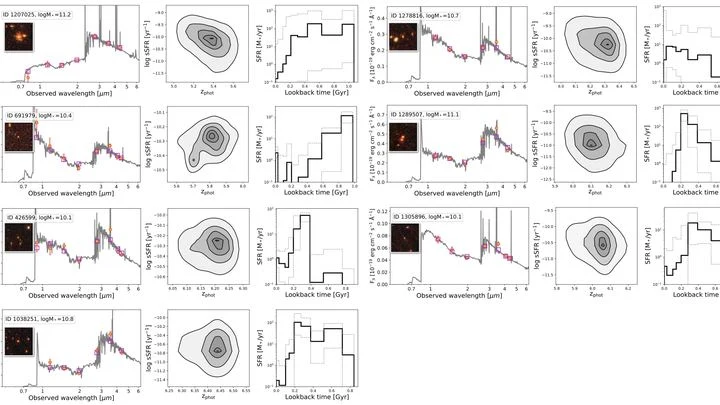
A street where houses have just been built. Some shine with clean windows, others are covered in construction dust. That's roughly what galaxies looked like when the universe was only a few hundred million years old. The new James Webb telescope peered into that era and saw dozens of bright star islands.
Ancient light, traveling 14 billion years, reaches us from all directions. At first glance, it looks perfectly smooth, but if you look closely, tiny fluctuations appear, like ripples on a still pond. Those ripples aren't random noise; they're an encoded history of the universe.
A magnet with only one pole — north, but no south. Split it in half, and instead of two ordinary magnets, you get two more one-pole magnets. In our world, no such particle has been found, although many theories predict their existence. These hypothetical objects are called magnetic monopoles.
The authors of the study noticed a curious connection.
The mystery of dark matter, first glimpsed in the stellar whirlpools by Vera Rubin, has been tormenting physics for nearly a century. One of the boldest hypotheses: primordial black holes, born in the scalding broth of the early universe.
Axions are hypothetical elementary particles introduced in 1977 by Roberto Peccei and Helen Quinn to resolve the so-called strong CP problem in the Standard Model of particle physics.
In the first few hundred million years after the Big Bang, the cosmos was like a noisy teen club: galaxies flared up, collided, and churned out stars by the hundreds.
By analyzing color indices — the ratio of brightness in different spectral bands in images from the James Webb Space Telescope, astronomers have identified galaxies whose light cuts off sharply in the ultraviolet.
In the dense swarm of old stars known as the globular cluster M15, astronomers have spotted not just stars but layers of time. Some stars were born earlier, others later, and their chemical composition reveals their origin with the precision of an archaeologist reading the strata of an ancient settlement.
In laboratories on Earth, Bose-Einstein condensates are created by cooling a cloud of atoms to billionths of a kelvin. The atoms lose their individuality and merge into a single quantum wave that behaves as one entity. But in space, such conditions are not needed: gravity itself creates deep wells where matter compresses and cools into a state of quantum fog.