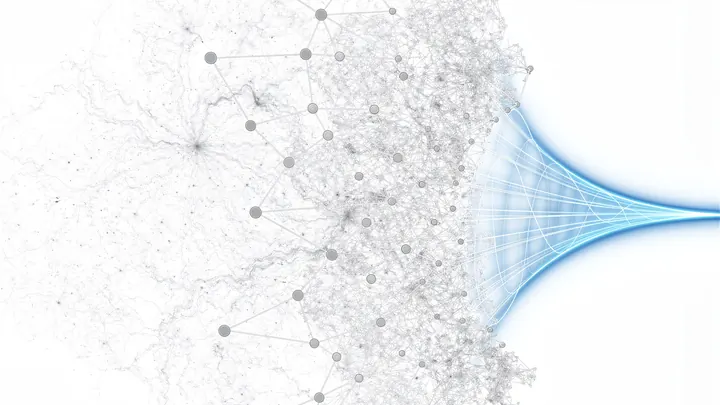
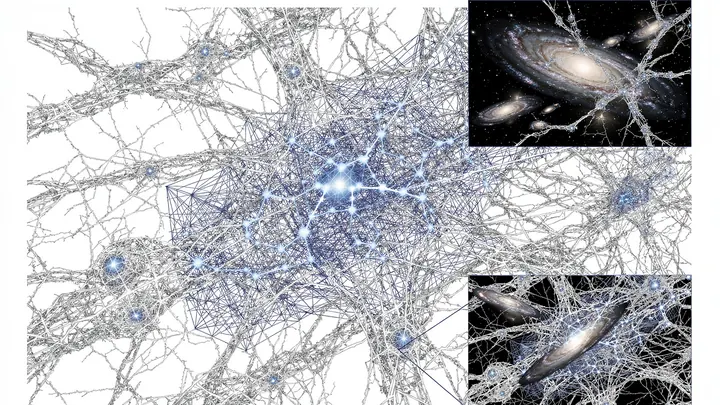
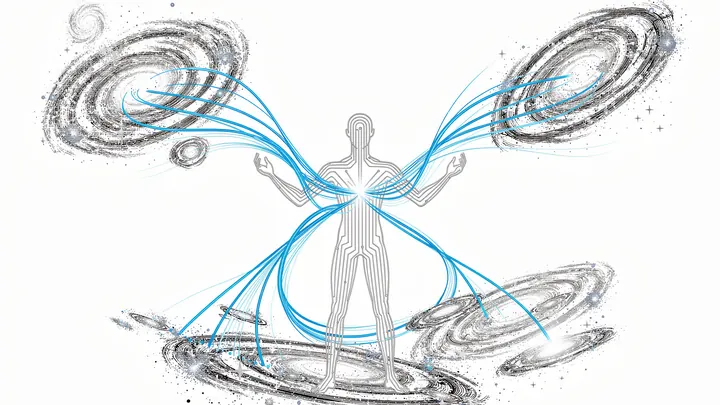
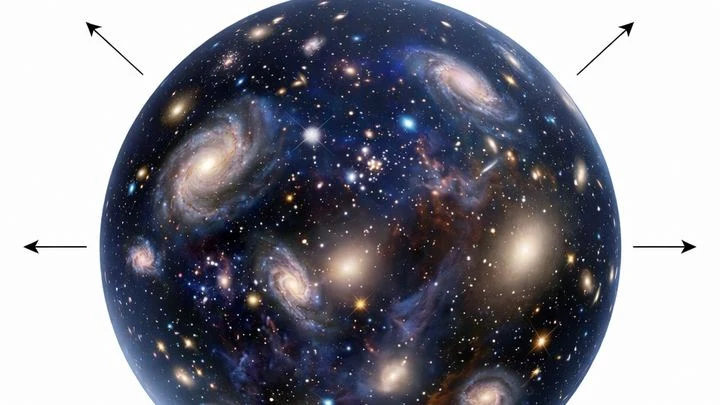
On scales of billions of light-years, the cosmos resembles a cellular network: galaxies, gas, and dark matter are stretched along filaments converging in rich clusters, outlining colossal voids. This 'cosmic web' is the largest known pattern of nature. Its contours are set by the distribution of dark matter, into whose gravitational wells ordinary matter collects. The structure is hierarchical: small halos formed first, then merged into more massive ones. Statistically, it is described by the two-point correlation function and the power spectrum of density fluctuations.
History
Hubble in the 1920s established the extragalactic nature of spiral nebulae and the linear law of redshift. The first redshift surveys (CfA, 2dF) in the 1980s–2000s laid bare the foamy morphology. The COBE satellite (1992) detected the primordial fluctuations—the seeds of the future structure. The Sloan Digital Sky Survey (SDSS) covered millions of galaxies, confirming ΛCDM. The contributions of Vera Rubin (rotation curves) and Fritz Zwicky (hidden mass in clusters) pointed to the dominance of dark matter in shaping the LSS.
How it works
Structure growth is governed by gravitational instability in an expanding background. In the linear approximation, the density contrast δ evolves as δ ∝ a in the matter-dominated era. After recombination, baryons fall into the potential wells of dark matter. The power spectrum bears the imprint of baryon acoustic oscillations—frozen sound waves from the primordial plasma. The nonlinear stage is described by the Vlasov-Poisson equations for collisionless dark matter and hydrodynamics for gas, taking into account feedback from star formation and active nuclei. Numerical models reproduce voids, filaments, and hierarchical clustering, creating virtual universes in the computer.
In practice
A map of the cosmic web is a chronicle of the Universe's growth. It tells of dark matter, dark energy, and the first moments after the Big Bang, and also serves as a compass for finding galaxy clusters.
Fun fact
The KBC void stretches over a billion light-years, and our Milky Way lies near its centre, so we live inside the emptiest region.
A census by body shape: that's one way to describe what astronomers did with 6348 massive galaxies. Instead of height and weight, they measured how concentrated the light is toward the center, how flattened the galaxy is, and how asymmetric its shape is. Then they ran the same measurements on galaxies from three computer models of the universe and compared the results.
A census by body shape: that's one way to describe what astronomers did with 6348 massive galaxies. Instead of height and weight, they measured how concentrated the light is toward the center, how flattened the galaxy is, and how asymmetric its shape is. Then they ran the same measurements on galaxies from three computer models of the universe and compared the results.
A river drawn on a map is always a single line. But stand on the bank, and you will see that within the channel there are faster currents, eddies, and branches that merge and split. The cosmic web is like that river, but made of dark matter, and until recently astronomers drew it as a single line.
Light from a distant galaxy reaches us through its own dust. This dust is not a smooth haze but ragged clouds, like wisps of cotton. Old models treated it as a uniform mist, and then the galaxy didn't add up energetically: too much light disappeared in the ultraviolet and too little came back in the infrared.
Astronomers did what a cook does when they dice a potato instead of tossing it in whole.
A dance floor where couples whirl. At the center, an invisible master of ceremonies sets the rhythm. This is the supermassive black hole at the heart of the Milky Way, and the couples are stars whose orbits astronomers have tracked for years. But what if the master himself is wrapped in a fluffy fur coat of tenuous matter?
The night sky looks like a random scattering of stars. But zoom out to enormous distances, and the chaos disappears. Galaxies gather into long filaments and flat walls, with colossal voids gaping between them — cosmic voids. This structure is called the cosmic web.
A translator gets distracted by every rustle in the hall, and a one-hour meeting stretches into two. A single wrong intonation changes the meaning beyond recognition. That's roughly how a particle with spin 3/2—the gravitino — behaves. It cannot exist in isolation: its "speech" must be perfectly coordinated with its surroundings, or the whole structure falls apart.
A pot of boiling porridge: bubbles burst, steam escapes, and everything gets mixed up. Massive stars in giant gas clouds behave in much the same way. Their radiation and stellar winds blow out enormous cavities, molecular bubbles, scattering material all around.
A weather forecaster draws a thick black line across Europe: north of it, frost; south, a thaw. That boundary, the zero isotherm, won't tell you the temperature in Stockholm or Rome, but it honestly marks where winter ends. In recent cosmology, a map has emerged where a similar frontier can be drawn.
The first moments after the big bang: space expands rapidly — physicists call this period inflation. Inside this swelling fabric, like soap bubbles in a stream of air, regions of new vacuum begin to form — a first-order phase transition. Most bubbles pop or merge as soon as they appear.
In the early universe, as it cooled after the Big Bang, defects could have formed, like cracks in ice. One such defect is a global monopole, a tiny clump of field where energy is trapped in a knot.
The cosmos resembles silk fabric with threads of the dark web showing through. We only glimpse tiny swatches of the real tapestry — through telescopes, in actual galaxy catalogs. To separate the fundamental signal from astrophysical noise in the cosmic pattern, statistical analysis demands thousands of plausible sketches — synthetic sky maps.
In the first moments after the Big Bang, cosmic symmetry breaking divided the hot plasma into regions with different vacuums — the lowest energy states of a field.
A cold, black mirror — that's what the sea of dark energy, the invisible substance driving the expansion of the universe, looked like for billions of years. But the DESI spectrograph has caught a faint ripple.
The optical sky background is a cosmic palimpsest, where light from billions of unresolved galaxies is layered, each layer corresponding to a different epoch. Until now we could only distinguish the brightest "letters"—individual stars and nearby galaxies.
It all starts with a tiny scar — a thin tunnel connecting two universes. In quantum cosmology, there has long been discussion that our closed universe could have been born from "nothing" via tunneling (a process where a system overcomes a barrier that is insurmountable by ordinary standards).
The cosmological debate is like two craftsmen measuring the same wall but getting different lengths. One uses a tape measure, applying it to nearby landmarks — Cepheids (pulsating beacon stars) and Type Ia supernovae (flashes of dying stars). He finds the wall is stretching at 73.5 arbitrary units.
Around some young stars where star formation has recently ended, there swirl not just dust rings but actual planetary battlefields — extreme debris disks.
Dark matter — the invisible foundation of cosmic architecture — makes up 85% of all mass, yet eludes direct observation. In the 1920s, Edwin Hubble discovered the expansion of the universe and the realm of galaxies; by the 1930s, Fritz Zwicky suspected hidden mass in their clusters.
In deep space, 95 parsecs from Earth, nature is assembling a planetary clock. The model HD 114082 is a prototype, only 15 million years old. Two massive pendulums — exoplanets b and c — are already swinging with periods of 225 and 314 days, but the whole mechanism is still covered in the construction dust of a debris disk.
The cosmological principle – the notion that the Universe is homogeneous and isotropic on large scales – has guarded our understanding of the world since the time of Edwin Hubble and Georges Lemaître, whose ideas formed the basis of the Big Bang model.
Light from distant galaxies travels to us for billions of years, but along the way it gets bent and twisted by the invisible web of dark matter. This effect, predicted by Albert Einstein within general relativity, is called gravitational lensing.
Imagine a philharmonic orchestra playing, but the microphone picks up only a blended roar — a tutti where double basses, flutes, and timpani all merge. Physicists have grappled with a similar task for decades, staring at fields of density, temperature, or magnetic induction.
A sub-Neptune is a planet that falls between Earth and Neptune in size. These worlds are abundant in our galaxy, but their internal structure has been hotly debated. New research shows that in their youth, these planets behave like a sponge soaked with water.
A cosmological map is like a snapshot of ripples on water: from it you can reconstruct what stone was thrown. The stone is the properties of the universe — how much ordinary matter it contains, how much dark matter, how fast it is expanding. The ripples are the pattern of galaxies that telescopes measure.
The story began with a missing mass. In the 1930s, Fritz Zwicky, measuring velocities in galaxy clusters, first suspected the presence of invisible matter. Later, Vera Rubin showed that the outskirts of spiral galaxies rotate too fast for the visible matter.
Magnetic vortices just tens of nanometers across are like tiny tornadoes frozen in metal. Called skyrmions, they are remarkably stable: hard to destroy but easy to move. That's why engineers see them as ideal 'bits' for future memory — fast, energy-efficient, and resilient.
But until now, no one knew how such a vortex is structured within the material's depth.
Galaxy clusters are the greatest gravitational ensembles in the Universe. In X-ray glow from hot plasma, the story of cosmic expansion, hidden dark matter, and enigmatic dark energy is encoded.
Lenticular galaxies are the cosmic quiet types: they have a disk but no bright spiral arms. For a long time, their origin remained a mystery. A team of scientists ran the Hydrangea computer simulation and traced the fate of each galaxy from its youth to the present day.
On the mass–size diagram, these galaxies line up in a V shape.
The early Universe is often imagined as a nursery: most galaxies there are amorphous blobs, rowdy and irregular, choking on gas and bursts of star formation.
In the first instants after birth, the universe might have been multidimensional, like a sheet of paper that suddenly gained thickness. This "thickness"—the extra dimensions — began to inflate rapidly. Such superfast growth is called inflation.
The Universe behaves like a soap bubble swelling in a multidimensional foam. The dark bubble model explains why it's expanding ever faster: the spacetime bubble grows, and its membrane gains a tiny thickness — about a micron, like a bacterium. At such distances, gravity 'blurs' across this thickness and weakens.
Our universe is expanding, and its future, according to cosmologists, is empty, cold de Sitter space. Understanding its quantum nature is like trying to read a book by looking only at its cover. The holographic principle suggests that all information about what happens inside a volume can be encoded on its boundary, like a picture on a film.
The galaxy NGC 1277 is like an old book that no one has opened for billions of years. It formed quickly at the dawn of the Universe and has barely changed since — no collisions with neighbors, no new layers added.
The Universe is singing. Not in the usual sense: its symphony is recorded in tiny density variations from which galaxies and ourselves grew. After the Big Bang, space was almost uniform, but quantum fluctuations during inflation left a faint pattern — slightly more matter here, slightly less there.
The Universe resembles a dense forest: up close, individual galaxy-trees are visible, gathered into groves, but from a distance everything merges into a solid green canopy. The boundary beyond which the cosmos becomes homogeneous is called the angular scale of homogeneity: it's the size of a patch of sky from which galaxies are distributed evenly.
In the 1930s, Fritz Zwicky first noticed that galaxies in clusters were moving too fast — something invisible was holding them. Later, Vera Rubin measured the rotation of spiral galaxies, confirming that space is permeated by dark matter.
Through the ripples on the water, pebbles at the bottom of a pool look shifted and warped. In a similar way, the gravity of invisible dark matter bends the light of distant galaxies — a phenomenon known as weak lensing.
Spacetime is often pictured as a smooth fabric. But at the very microscopic level, this fabric might not be continuous; instead, it could consist of individual 'atoms'—events linked by causality. This picture of the world is called causal set theory.