A space telescope is an observatory placed beyond Earth's atmosphere to capture astronomical images and spectra without the distortions and absorption caused by air. The atmosphere blocks most ultraviolet and infrared light, and it causes visible light to twinkle and blur. By operating in space, telescopes like Hubble and James Webb achieve diffraction-limited resolution and access wavelengths that never reach the ground. This has enabled discoveries from exoplanet atmospheres to the most distant galaxies, fundamentally changing our view of the cosmos.
History
The concept was proposed by Lyman Spitzer in 1946, leading to the launch of the Hubble Space Telescope in 1990. Earlier, the Orbiting Astronomical Observatory (1968) and the International Ultraviolet Explorer (1978) pioneered space-based astronomy.
How it works
Space telescopes use mirrors and detectors similar to ground-based ones, but they are launched into orbit or at Lagrange points. They maintain precise pointing using reaction wheels and star trackers, and they often include cryogenic cooling to reduce thermal noise for infrared observations. Data is transmitted to Earth via radio links, where it is processed and analyzed. The absence of atmospheric turbulence allows the telescope to reach its theoretical resolution limit.
In practice
Space telescopes are used for cosmology, exoplanet characterization, and monitoring space weather. They also serve as testbeds for technologies like adaptive optics and precision pointing systems.
Fun fact
The Hubble Space Telescope has observed the same patch of sky for over 20 years, creating the Hubble Ultra-Deep Field, which contains thousands of galaxies from when the universe was less than a billion years old.
The orchestra plays, but the musicians can't hear each other. The conductor keeps stopping the music and walking over to each player to tune the instrument. That's roughly how space telescopes with segmented mirrors work.
Buried in Antarctic ice, there's a detector the size of a cubic kilometer. It doesn't catch light but ghostly particles — neutrinos. Yet sometimes, a different beast might flash through: a pair of muons born together and flying apart in a wide fan. No known particle of ordinary matter can paint that pattern.
Measuring distances in the universe is no easy task. Almost all methods rely on light, which can be absorbed by dust, scattered, or distorted along the way. It's like trying to spot a distant lighthouse through fog and haze. Neutrinos are a different story. These ghostly particles pass through anything without noticing obstacles.
In the silent ocean of the Galaxy, mature civilizations have likely long chosen an unexpected strategy: instead of loud beacons, they scatter quiet fireflies — autonomous interstellar laser beacons, drifting in the void and dropping microsecond flashes. These 'seeds of contact' are not tied to their home stars and do not drown in their glow.
The cosmological debate is like two craftsmen measuring the same wall but getting different lengths. One uses a tape measure, applying it to nearby landmarks — Cepheids (pulsating beacon stars) and Type Ia supernovae (flashes of dying stars). He finds the wall is stretching at 73.5 arbitrary units.
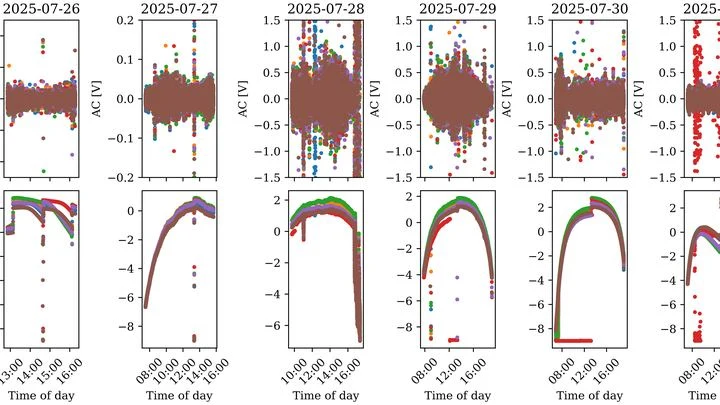
By day in Chile's Atacama Desert, the air shimmers with heat like the haze above a hot skillet. Sunlight passing through this shimmer begins to dance and flicker. Astronomers call this airy trembling "seeing" — and it keeps telescopes from getting a sharp view of the stars.
To fight this nuisance, engineers have built a special instrument — a solar seeing monitor.
If you look at a map of distant galaxies, it is not perfectly uniform: on one side of the sky there are slightly more, on the other — slightly fewer. This lopsidedness has been noticed in several sky surveys, and it does not look like a random fluke. Usually, it is explained by the fact that our Galaxy itself is flying somewhere, making distant objects appear shifted.
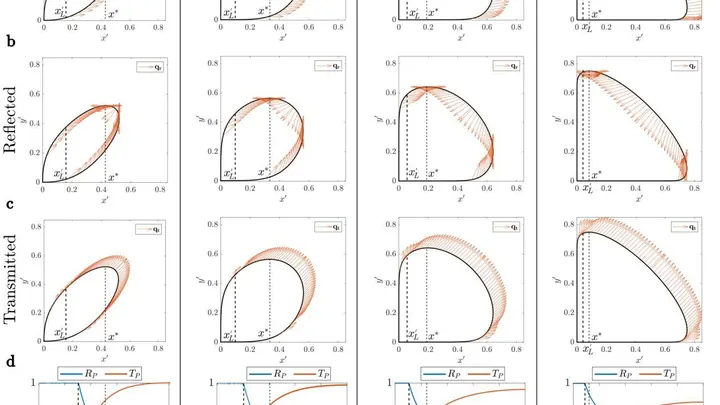
A river flows in one direction, but a wave on its surface travels in the opposite direction. The same splitting happens in hyperbolic materials: the energy of a light wave and its fronts diverge, preventing a sharp lens from being created.
Since Vera Rubin first convincingly showed that galaxies are surrounded by invisible matter, the quest to understand the nature of dark matter has remained one of physics' greatest challenges.
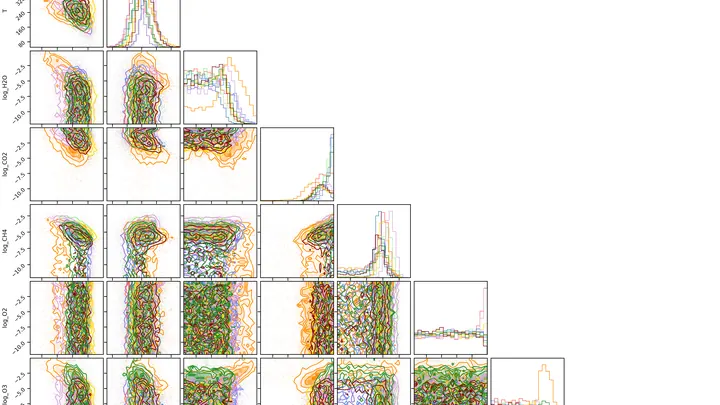
Eavesdropping on a distant planet's atmosphere is hampered by the star's noise. In the TRAPPIST-1 system, astronomers used a planet-"bug": TRAPPIST-1 b — an airless neighbor that records only the interference.