The Fifth Dimension as a Trap for Particles express
The fifth coordinate, curled into a tiny loop, could be hiding right under our noses. In such a universe, everything we see would be stuck to a four-dimensional film, the brane, like water droplets on a window pane. But why doesn't matter slip into the fifth dimension? The answer may lie in the twisting of spacetime itself.
Physicists calculated the behavior of fermionic fields, the building blocks of matter, in a five-dimensional world. Here, gravity obeys not Einstein's geometry but its teleparallel version, where space is not curved but twisted, like a rubber band. This twisting is described by quantities that depend on the function f(T,$T_G$). To grasp the difference, imagine an ant on a sphere: with curvature, it returns to its starting point after making a loop, but with torsion, it returns with its legs rotated. The addition of the teleparallel Gauss-Bonnet term ($T_G$) acts like an extra spring in the mechanism, changing the shape of the trap for particles.
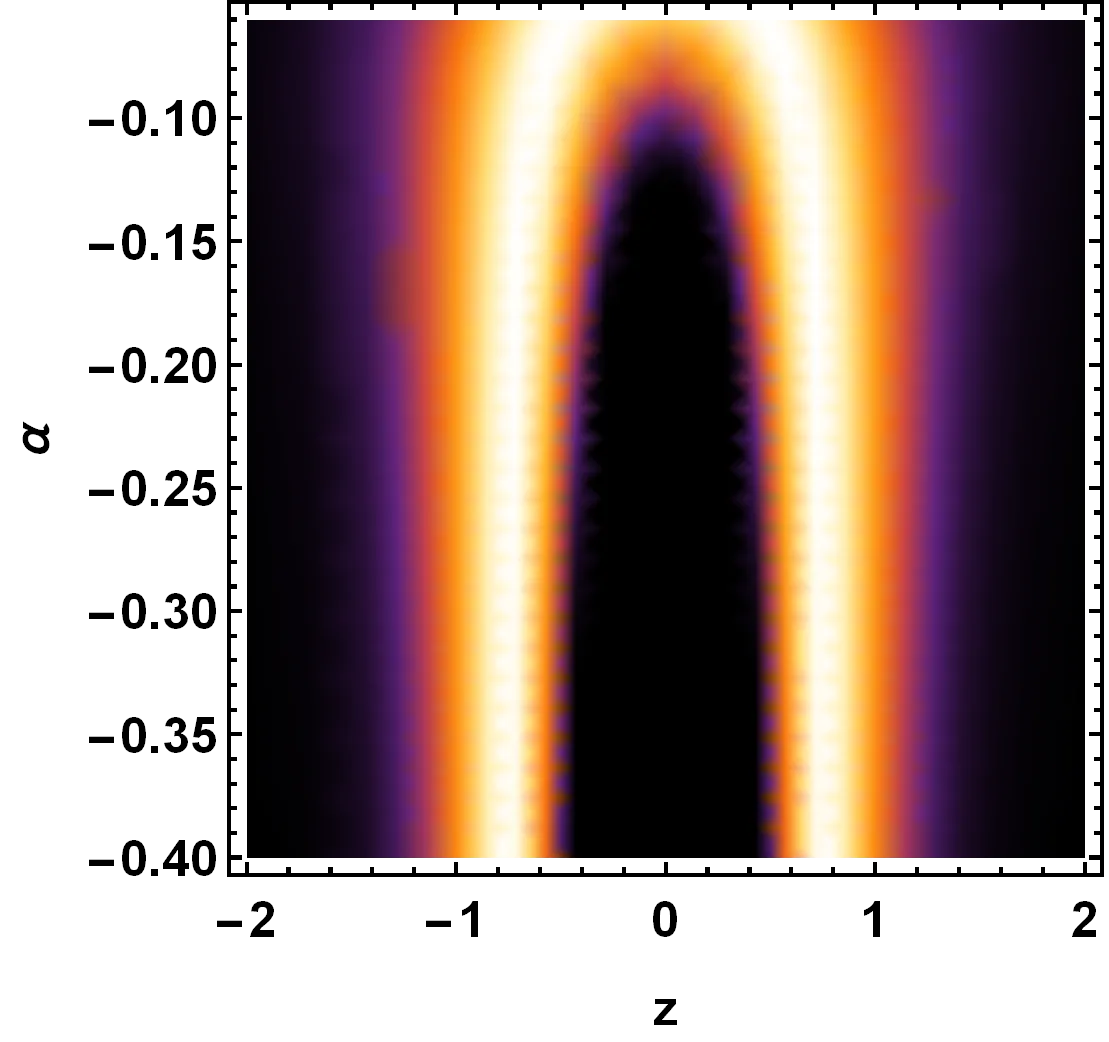
The Schrödinger equations for Kaluza-Klein modes showed that only one chiral component of the field can be localized on the brane — roughly speaking, the 'left-handed' particle. The 'right-handed' one escapes into the fifth dimension. It's as if, from a pair of Velcro gloves, only the left one sticks, while the right one slips off. In the massive sector, the spectrum is continuous, but the potential creates resonant states: particles with certain masses hover near the brane for a long time. Like a pendulum that takes a long time to dampen at a certain frequency.
To measure the degree of localization, the authors used an information-theoretic approach: they computed the Shannon entropy and relative probability. Entropy here works like a roulette wheel: the smaller the spread of possible particle positions, the lower the entropy and the more confident we are that it is on the brane. It turned out that as torsion increases, entropy decreases — information about the particle concentrates near the brane, as if a spot of light narrowed to a point. Thus, higher-order torsion corrections become not just decoration but a real mechanism that holds matter in our layer of reality. Like drops on glass that don't fall into the void because the glass itself is slightly twisted.
Original abstract
as written by the authors arXiv:2605.21838
We investigate the localization of fermionic fields in a five-dimensional braneworld scenario within the framework of modified teleparallel gravity described by a general $$f(T,T_G)$$ function. Considering a non-minimal coupling between a Dirac spinor and the torsional invariants, we derive the effective Schr\"odinger-like equations governing the Kaluza-Klein modes. We showed that the contribution of the teleparallel Gauss-Bonnet term significantly modifies the effective potentials and, consequently, the localization properties. The zero-mode analysis reveals that only one chiral component can be localized on the brane, with the degree of confinement depending on the chosen model. In the massive sector, the spectrum is continuous, but resonant states arise due to the internal structure of the potentials. Additionally, we employ information-theoretic measures, such as Shannon entropy and relative probability, to quantify the localization mechanism. Our results show that the torsional modifications induce a nontrivial redistribution of information, exhibiting stronger localization. These findings highlight the role of higher-order torsional terms in shaping fermionic localization and resonance structures in braneworld scenarios.
The Shannon entropy used to assess localization was originally devised to calculate the capacity of telephone lines, and now it helps search for hidden dimensions.
The idea of a brane holding an entire universe is echoed in Terry Pratchett's novel 'Discworld', where the world rests on the backs of four elephants, except here, instead of elephants, it's the torsion of spacetime.