How Heavy Electrons Ignite an Artificial Sun ⚡ экспресс
Original: "Muon-Catalyzed Nuclear Fusion: Physical Mechanism, Bottleneck Breakthroughs, and an Engineering Pathway"
Muons help hydrogen atoms fuse at room temperature, but efficiency is still limited.
Links in the knowledge graph 1
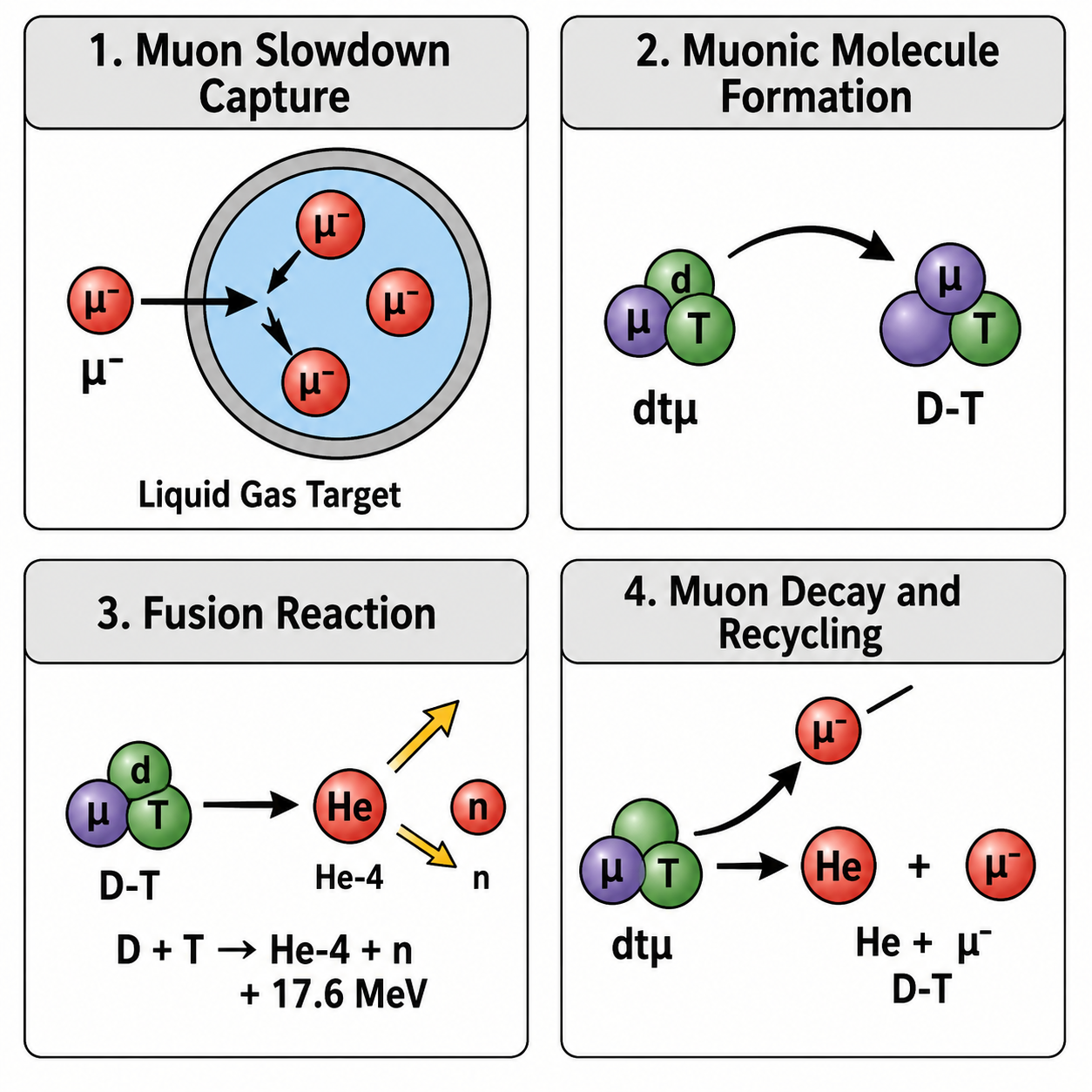
Conventional thermonuclear fusion demands stellar temperatures. But muons—the heavy cousins of electrons—squeeze atoms so tightly that nuclei fuse on their own, almost without heating. One such 'chunky' particle triggers hundreds of reactions, and a clever trick with fields boosts that number to 500, giving back more energy than put in. These setups could produce nuclear fuel for ordinary nuclear power plants.
🎯 The natural muon background is used to scan pyramids and find hidden chambers in structures.
Q = \frac{E_{\text{out}}}{E_{\text{in}}}
The ratio of energy output to input. If Q>1, more energy is produced than consumed. The work shows the potential to reach Q>2.