How Heavy Electrons Ignite an Artificial Sun express
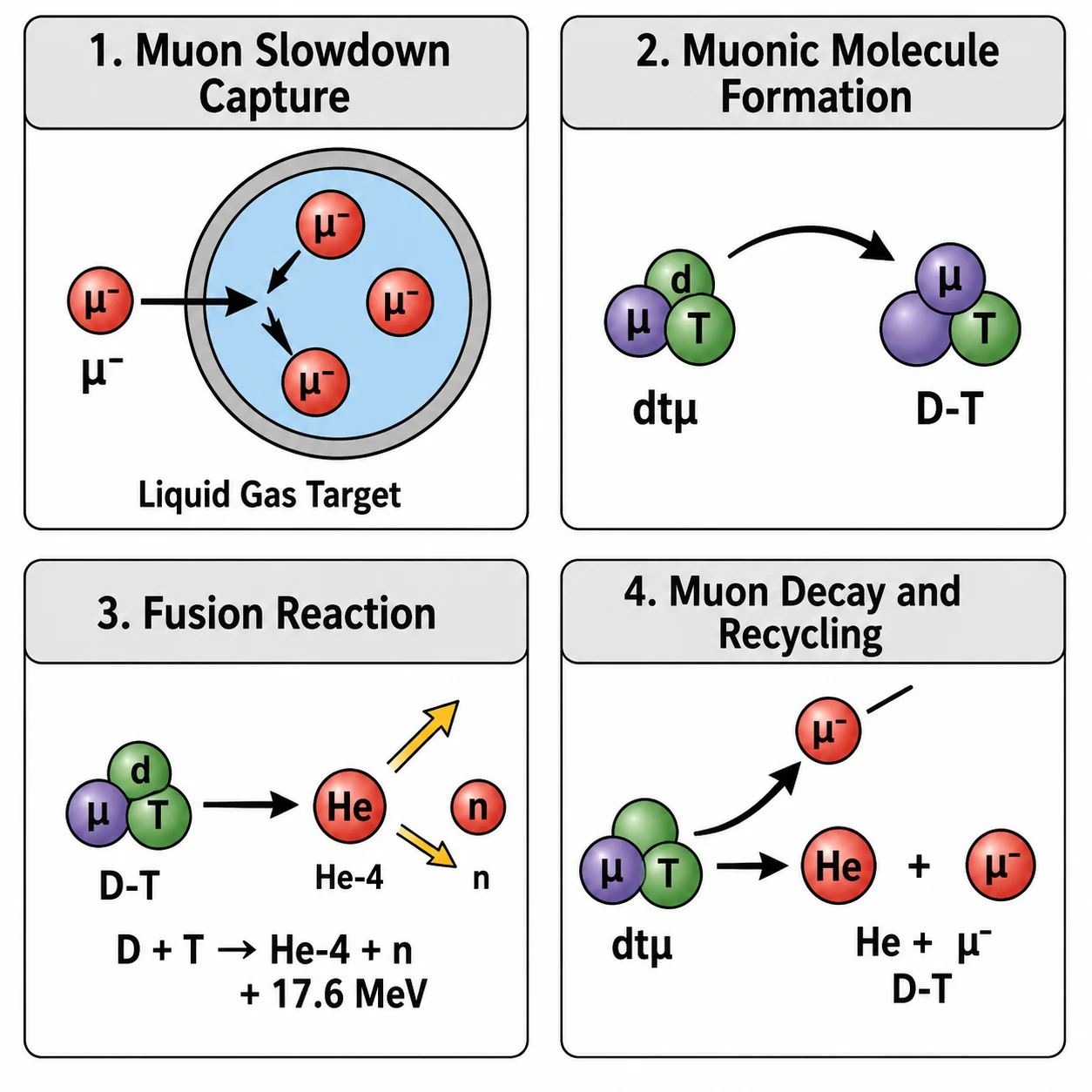
Atomic nuclei are wrapped in fluffy electron coats — in such attire, they can't get close enough to embrace. But swap the light coat for a heavy one: a muon, a particle from the standard model, shrinks the cloud by nearly 200 times. Then hydrogen nuclei (deuterium and tritium) fuse on their own at room temperature, giving birth to helium and a burst of energy.
Trouble is, after fusion, the heavy coat sometimes sticks stubbornly to the helium, and the muon is out of the game. Currently, one muon triggers only 150 reactions. But electric fields and special conditions make it slip off, extending the chain to 500 fusions. This yields more energy than what was spent creating the muon.
Such setups could become hybrid reactors: a neutron flux from micro-thermonuclear fusion converts ordinary uranium-238 into plutonium-239, fuel for classic nuclear power plants.
Original abstract
as written by the authors arXiv:2605.26432
Muon-catalyzed nuclear fusion (\mucf) replaces atomic electrons with negative muons, compressing atomic orbitals by about two orders of magnitude and enabling deuterium--tritium (D--T) fusion under near-room-temperature conditions. This paper reviews the physical principles of \mucf{} and formulates its essential dynamics as a four-step cycle: muonic-atom formation, muon transfer, resonant \dtmu{} molecular formation, and D--T fusion with muon release and recycling. A kinetic model is used to quantify the number of catalysis cycles per muon and the corresponding energy gain. We focus on the central limitation of catalytic efficiency, namely the alpha-sticking effect, and discuss possible breakthrough routes including nuclear-spin and muon dual polarization, in-flight muon-catalyzed fusion, and heavy-ion-driven magneto-inertial fusion. Within the idealized assumptions of the present model, a four-dimensional synergistic scheme combining dual polarization, high-density confinement, electric-field-assisted muon recovery, and resonant enhancement may increase the number of catalysis cycles per muon from the present experimental record of about 150 to more than 500, potentially enabling an energy gain \(Q>2\). On this basis, we propose a conceptual fusion--fission fuel-breeding hybrid reactor, denoted as \mucf-FBR, which exploits the 14.1-MeV neutron yield of \mucf{} to breed \({}^{239}\mathrm{Pu}\) from a \({}^{238}\mathrm{U}\) blanket in a decoupled fusion--fission operating mode. This concept may offer advantages in engineering robustness, radiation-damage tolerance, and natural-uranium utilization.
The natural muon background is used to scan pyramids and find hidden chambers in structures.