How Heavy Electrons Ignite an Artificial Sun express
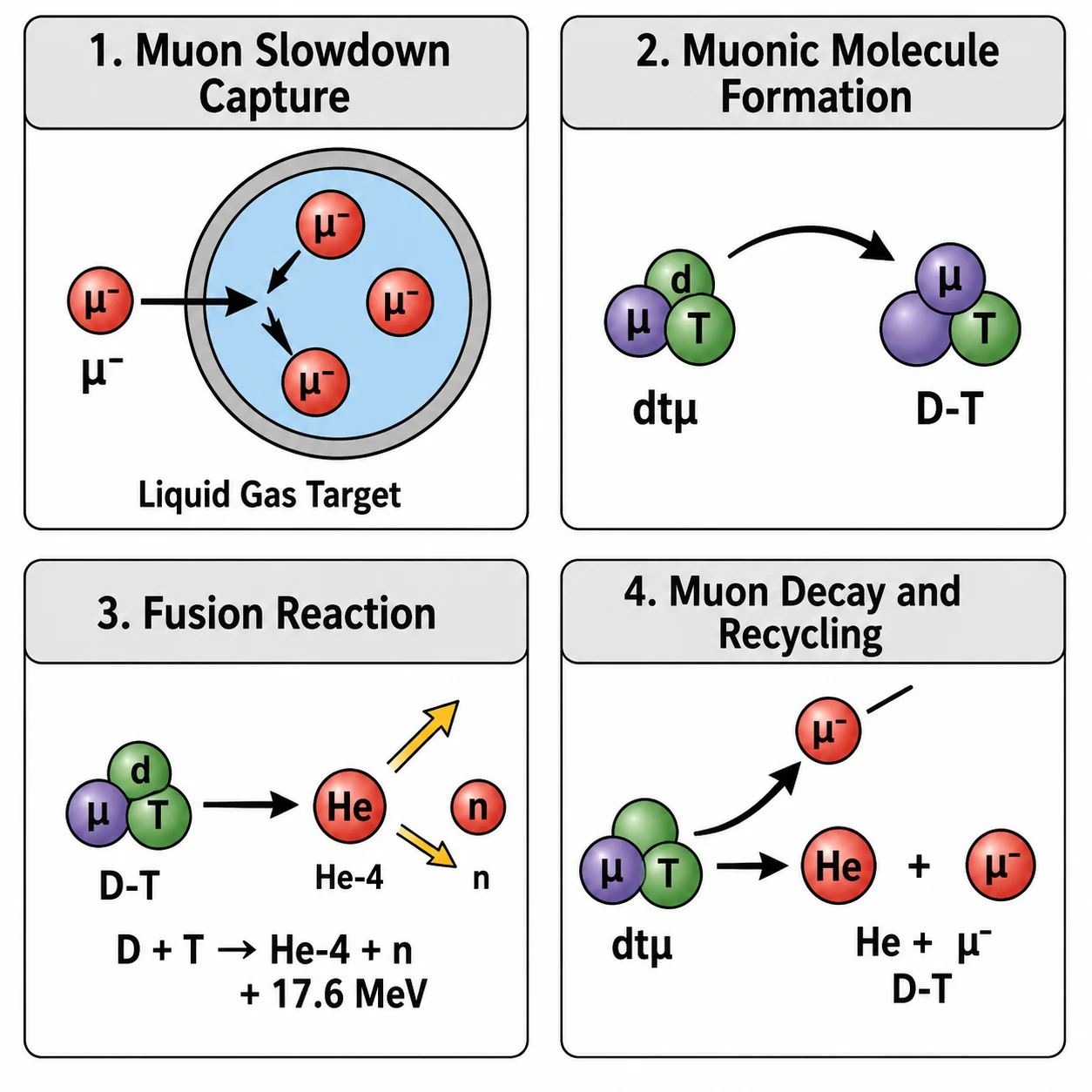
Atomic nuclei are wrapped in fluffy electron coats — in such attire, they can't get close enough to embrace. But swap the light coat for a heavy one: a muon, a particle from the standard model, shrinks the cloud by nearly 200 times. Then hydrogen nuclei (deuterium and tritium) fuse on their own at room temperature, giving birth to helium and a burst of energy.
Trouble is, after fusion, the heavy coat sometimes sticks stubbornly to the helium, and the muon is out of the game. Currently, one muon triggers only 150 reactions. But electric fields and special conditions make it slip off, extending the chain to 500 fusions. This yields more energy than what was spent creating the muon.
Such setups could become hybrid reactors: a neutron flux from micro-thermonuclear fusion converts ordinary uranium-238 into plutonium-239, fuel for classic nuclear power plants.
The natural muon background is used to scan pyramids and find hidden chambers in structures.