Popular

How Heavy Electrons Ignite an Artificial Sun ⚡ экспресс

Original: "Muon-Catalyzed Nuclear Fusion: Physical Mechanism, Bottleneck Breakthroughs, and an Engineering Pathway"
· Xiong Yin, Wei Kou, Xurong Chen
Muons help hydrogen atoms fuse at room temperature, but efficiency is still limited.
Abstract

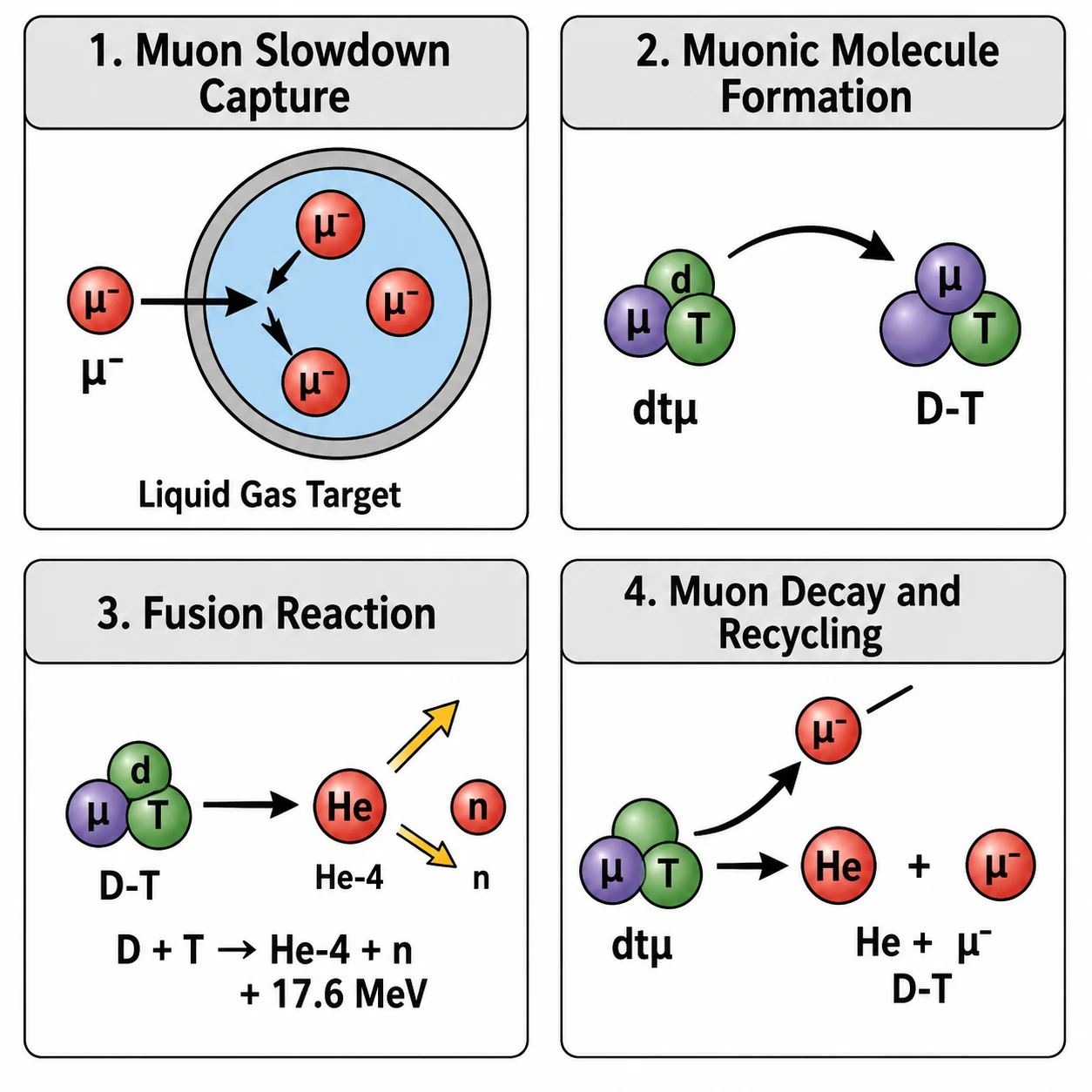
Muon catalysis makes it possible to spark a deuterium-tritium fusion reaction with virtually no heating: muons, the heavier analogues of electrons, squeeze atoms and act as catalysts. The authors formalized it as a four-step cycle and determined that the main limitation (muon sticking) can be overcome by combining polarization, confinement, and muon extraction — raising the number of reactions from ~150 to over 500 and giving Q>2. A hybrid reactor design is proposed, in which fusion neutrons breed plutonium from uranium-238.

Links in the knowledge graph 1

📄 Showing the "Simple" version — "Popular" is not ready yet. Add it to favorites to help prioritize it.

Atomic nuclei are wrapped in fluffy electron coats—in such attire, they can't get close enough to embrace. But swap the light coat for a heavy one: a muon, a particle from the standard model, shrinks the cloud by nearly 200 times. Then hydrogen nuclei (deuterium and tritium) fuse on their own at room temperature, giving birth to helium and a burst of energy.

Trouble is, after fusion, the heavy coat sometimes sticks stubbornly to the helium, and the muon is out of the game. Currently, one muon triggers only 150 reactions. But electric fields and special conditions make it slip off, extending the chain to 500 fusions. This yields more energy than what was spent creating the muon.

Muons aren't exotic: every minute, thousands of these particles—born from cosmic rays in the atmosphere—zip through your body.

Such setups could become hybrid reactors: a neutron flux from micro-thermonuclear fusion converts ordinary uranium-238 into plutonium-239, fuel for classic nuclear power plants.

🎯 The natural muon background is used to scan pyramids and find hidden chambers in structures.

Q = \frac{E_{\text{out}}}{E_{\text{in}}}
The ratio of energy output to input. If Q>1, more energy is produced than consumed. The work shows the potential to reach Q>2.
Scientists
Emmy NoetherCharles-Augustin de CoulombJames Clerk MaxwellJohannes RydbergTheodore LymanWolfgang Pauli
Tags
hydrogen helium Standard Model
Laws
Noether's theoremCoulomb's lawRydberg formulaspin–statistics theoremFermi's golden ruleCPT theorem
Original: arXiv:2605.26432 · CC BY 4.0 · bridge42worlds