A Protein Builder with a Memory for Winning Moves express
Improving a complex recipe is a delicate task, especially if you can only taste a few versions a day. Changing ingredients at random is risky: remove the salt or the baking powder, and you ruin the base. The same goes for proteins: random mutations often break vital parts, and each lab test costs time and money.
A new approach called SILO does it differently. It splits each change into two steps: first, it picks a position in the protein chain, then it decides which amino acid to place there. This is like repairing an engine: a mechanic doesn't replace all parts in a row but looks for the specific component that's failing and finds the right spare part. SILO also uses a clever trick — the "alanine test": it temporarily swaps the position with the simplest building block (alanine) to gauge how important that spot is for the protein's function. This way, the algorithm avoids touching critical regions.
During the search, SILO accumulates experience. Each round, it generates several variants, tests them in a computer model, and remembers the most successful ones. Then it learns to imitate those winning moves, without trying to predict the exact "score" of each change — such scores are often noisy and misleading. This approach is like a chef learning: instead of calculating the perfect oven temperature with formulas, he simply copies the head chef's moves when preparing the best version of the dish.
The takeaway is simple: to create an ideal protein, you don't need to try everything. Just remember your best moves and carefully avoid fragile spots — like a skilled craftsman who knows his tools and doesn't ruin the workpiece.
Original abstract
as written by the authors arXiv:2605.26690
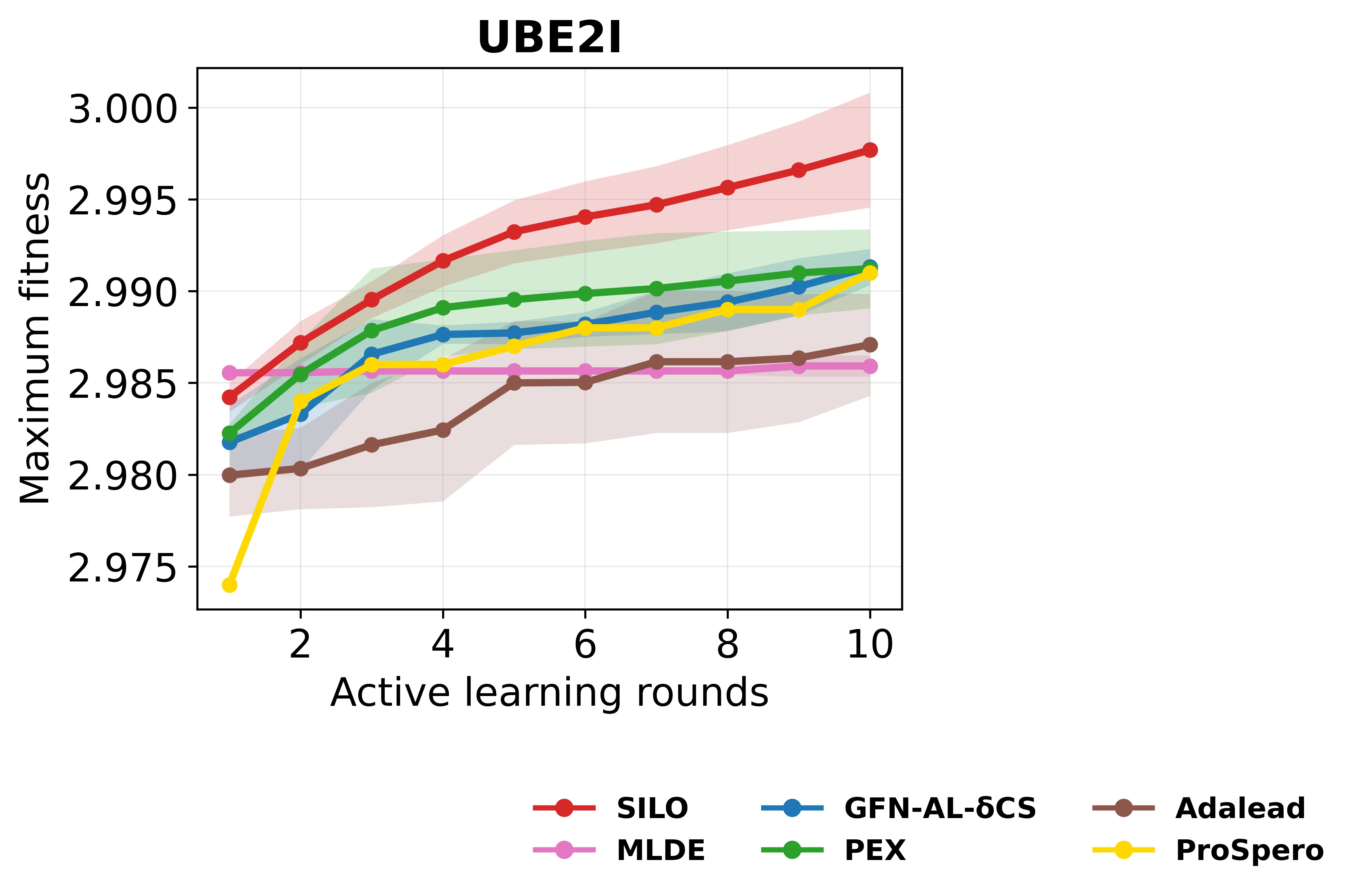
Protein sequence optimization under tight oracle budgets requires methods that explore vast combinatorial spaces while making each evaluation informative. Existing reinforcement learning and off-policy generative approaches often degrade under surrogate noise, and position-agnostic mutation proposals risk disrupting functionally critical residues. We introduce SILO, a trajectory-level self-improvement imitation framework for oracle-budgeted protein design. SILO uses a hierarchical edit policy that decomposes each mutation into a position choice followed by a residue choice. In each active-learning round, the policy samples candidate trajectories via incremental stochastic beam search without replacement (SBS), and a UCB-based proxy ensemble, combined with an alanine-scan fitness score (AFS), selects candidates with functionally relevant edits for in silico oracle evaluation. The policy is then updated by next-action cross-entropy imitation on the round's best oracle-labeled trajectories, avoiding value-function estimation. Across eight reproduced protein fitness landscapes and five strong baselines from prior work, SILO achieves the highest maximum and top-100 mean fitness on 8 of 8 landscapes within our evaluations, often exhibiting faster early-stage improvement. In low-data and noisy-proxy stress tests on two landscapes per setting, SILO remains competitive or best when several baselines degrade. Ablations show that SBS with AFS account for much of the gains, with iterative imitation providing additional improvement. Code is available at: https://github.com/grimmlab/SILO.git
The alanine test used in SILO was invented back in the 1980s: biologists replaced amino acids with alanine one by one to find "hot spots" important for protein function. It's like checking which button in an elevator is broken by pressing them one at a time.