Stochasticgene expression is the variability of mRNA and protein levels in genetically identical cells under the same conditions, caused by random molecular events. The main sources of noise: intrinsic (biochemical fluctuations during transcription and translation) and extrinsic (differences in the number of ribosomes, polymerases, growth factors between cells). This phenomenon underlies cellular heterogeneity and has evolutionarysignificance, allowing populations to survive in a changing environment.
History
Classical observations of phenotypic heterogeneity in isogenic populations (e.g., fluctuations of β-galactosidase in E. coli, Novick and Weiner, 1957) were long considered an artifact. In the 1990s, with the development of single-cell fluorescence microscopy (e.g., the work of Elowitz and Leibler, 2000), it became possible to quantitatively study noise. Theoretical foundations were laid by Delbrück (1940), and later by Berg (1978), McAdams, Arkin (1997). Modern high-throughput methods (single-cell sequencing) confirm the ubiquity of stochastic expression.
How it works
Transcription is initiated by the binding of RNA polymerase and transcription factors to the promoter, a stochastic process due to the low probability of molecular collisions in the cell volume. After initiation, mRNA synthesis occurs in bursts, and degradation of mRNA and proteins is exponential, creating Poisson noise. Negative and positive feedback loops in regulatory networks can suppress or amplify noise. Evolutionarily selected circuits—for example, bistable switches—use noise for random cell fate decisions.
In practice
Understanding stochastic expression helps explain the resistance of cancercells to therapy and develop more reliable genetic engineering constructs for biotechnology.
Fun fact
In the same pancreatic tissue, different cells can produce insulin with a hundredfold difference, even with identical glucose stimulation.
Picture a wind map over a mountain range. The wind mostly blows downhill, following elevation changes. But if you look closely, in some valleys the air swirls into little eddies that keep the wind from simply flowing down. That is exactly what the mutation field in human DNA looks like.
The orchestra starts playing, but each musician has their own tempo. If everyone plays at roughly the same speed, the music flows in a continuous stream. But if one group of instruments plays noticeably slower than the rest, the sound gathers into a dense clump that slowly moves forward.
Every day, the brain sounds a little different. Yesterday, the thought of moving your left hand produced one pattern of electrical waves; today, it's slightly different. For a brain-computer interface (a device that turns mental commands into actions), this is a big problem: yesterday's settings don't work today.
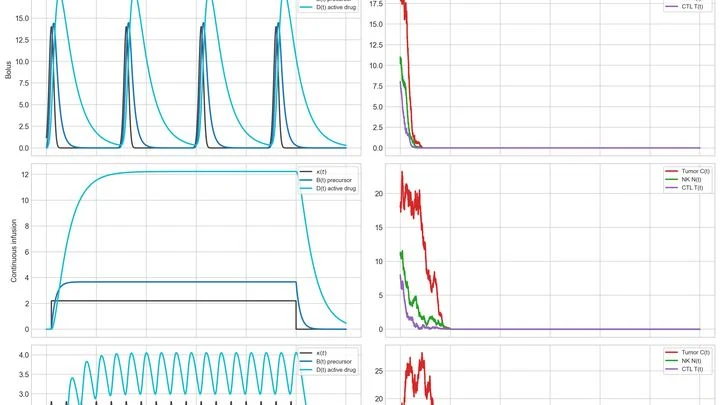
Chemotherapy hits cancer like a powerful spray on a dirty plate: the stream washes away almost everything, but crumbs remain in the cracks. Old models said that if you make the pressure strong enough, the plate becomes perfectly clean. New work shows this isn't so.
Every winter, hospitals fill up, and by summer they seem to empty. Epidemics breathe like the tide. But why do waves of disease keep rolling in, even without new mutations? Mathematicians found an answer in a tug-of-war between two strains.
Within a single epidemic, two virus variants often coexist.
Two daughter cells receiving equal shares from the mother: that's the familiar picture of division. But what if one gets almost everything and the other just crumbs? Stochastic modeling shows that sometimes unequal division is more advantageous.
Each cell stores a protective reserve that helps it weather hardships. During division, this reserve is distributed between daughters.
Two daughter cells receiving equal shares from the mother: that's the familiar picture of division. But what if one gets almost everything and the other just crumbs? Stochastic modeling shows that sometimes unequal division is more advantageous.
Each cell stores a protective reserve that helps it weather hardships. During division, this reserve is distributed between daughters.
As you slowly turn the tuning knob of an old radio, the sound doesn't fade in gradually from the static: it bursts forth in a sudden jump, the moment the antenna hits resonance with the wave. Genes in a living cell behave much the same way.
When an antibody meets a virus, it doesn't latch on with a single death grip. Rather, it's like two bunches of grapes tumbling in water, catching each other with dozens of short tendrils. Each tendril is weak on its own, easily torn by the thermal jitter of water molecules, but together they hold tight.
If a smell seeps into a room through a slightly open door, you could stand in the middle and sniff. But the most accurate way to catch the moment the smell arrives is to stand right at the threshold. A cell behaves much the same way when it needs to measure the concentration of a substance around it.
As you slowly turn the tuning knob of an old radio, the sound doesn't fade in gradually from the static: it bursts forth in a sudden jump, the moment the antenna hits resonance with the wave. Genes in a living cell behave much the same way.
In an ultracold cloud of atoms cooled to near absolute zero, regions with different spin orientations emerge, like patches with different magnetization. The boundaries between them are called domain walls. Usually they are stationary, but in this experiment the walls started moving on their own.
A lone erbium atom sits on a silver substrate, and its spin, the electron's internal rotation, stores quantum information. Previously, flipping this spin required a magnetic pulse: a blunt tool that disturbs neighbors and works slowly. Now physicists from Germany and Korea have shown that a single electric voltage suffices.
Toss a handful of sand onto a table — the grains scatter equally in all directions. But if a magnet is hidden under the table and the sand is iron, the trajectories get trickier: an invisible structure overlays the chaos. That's roughly how molecular motion works inside a living cell.
Hot water sometimes freezes faster than warm water: this odd fact is known as the Mpemba effect. Now something similar has been found in the quantum world: a state with weak entanglement (a special quantum connection between particles) can beat a more entangled one to the finish line.
A courtroom interpreter is distracted by every rustle: the creak of a chair, a cough in the back row, the rustle of papers. By the end of the day, they are translating not what the witness said, but what they heard through the noise. Rare translation errors are not the result of a single loud shout, but of the accumulation of many small disturbances.
A huge orchestra without a conductor. Each musician is a gene, and the melody is the cell's complex work. Previously, looking at a tissue photo, a computer tried to guess each instrument's part individually. It didn't know that violins usually play with violas, and trumpets with trombones. The program just output a list of notes, without sensing the harmony.
A kitchen mixer runs at a single speed, but start jabbing the button and the mixture whips up differently. Chemical reactions behave much the same way when the rates of their individual steps are not constant but pulse over time.
Imagine a cookbook that gets rewritten from generation to generation. One day, the borscht recipe receives a secret ingredient from a pastry chef, and from that moment, the taste remembers not only ancestors but also a neighbor. In the Standard Model of evolution, genes behave the same way.
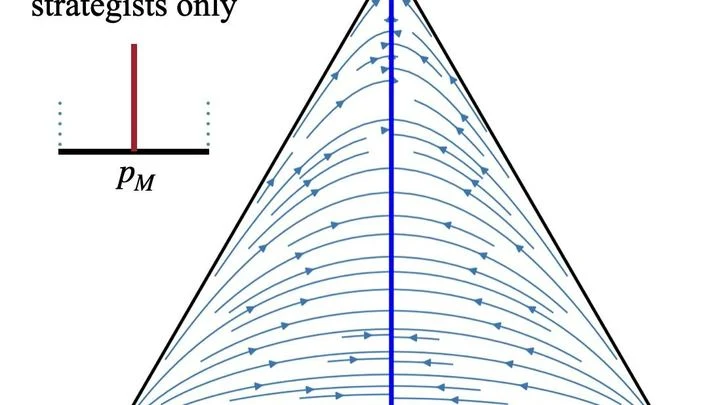
For a long time, biologists argued: if a herd of animals stably maintains a mix of aggressive and peaceful individuals, does each one alternately change behavior, or do some always fight while others always yield? In classical equations, these options are indistinguishable.
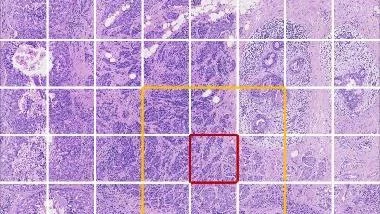
Genes are like houses in a city: in some, life bustles; in others, silence reigns. This 'urban' genetic landscape was analyzed in a thousand women with breast cancer.
Data on gene activity usually looks like a long string of numbers, like a rainbow stripe (spectrum) with no visible connections. In the scVision model, these numbers are turned into a meaningful picture — not a list of ingredients, but a photo of a finished dish.
The cells of an organism are like twin chefs sharing a kitchen. They have the same cookbook (DNA), but when copying the recipe to a cheat sheet and assembling the dish, random errors occur. This unpredictability, entropy, means that in identical cells, protein levels are sometimes high, sometimes low.
When biologists measure the activity of thousands of genes, they usually just see a list of coincidences, like two ingredients in a soup that often end up together. The standard method looks for such pairwise connections but doesn't show who influences whom.
A new approach, like a detector of dark matter, uncovers hidden threads of causation.
In the depths of the Universe, when a massive star collapses into a black hole or a magnetar is born, a gamma-ray burst flares up — for an instant, it outshines all the stars in the observable Universe.
Every tumor writes its own cosmology. Its cells are galaxies, and mutations are stellar flares marking the branches of a genealogical tree. The key to its history is the rhythm of accumulating genetic typos.
Evolution flows like water. In a wide river, changes are smooth and slow, while a mountain stream churns with every stone. Population size and mutation rate set the channel: broad and calm, or narrow and rapid-filled.
In embryonic development, a cell resembles a musician in a vast orchestra: it must play its part, following a conductor — the gradient of signaling molecules. But the conductor is unreliable: morphogen concentrations constantly fluctuate. How then does a cellist not veer into a violin melody?
60 mice, 1,980 samples, 234 lung cancer patients. Behind each number lie thousands of genes. Their activity is measured to understand the disease. But the data aren’t uniform: for one patient, you assess a protein level (a continuous number), make a diagnosis (yes/no), and determine the tumor subtype (a category).
The crumpled DNA thread in the cell nucleus is not a chaotic knot, but an intricate melody played on a polymer string. Modern experiments Hi-C, like highly sensitive microphones, capture the echo of contacts between distant genome regions, turning spatial organization into a two-dimensional probability matrix.
Imagine a book being simultaneously copied by trillions of scribes. As long as most of them check against the original, the narrative remains meaningful. But once control weakens, the text accumulates typos, which multiply until the manuscript turns into gibberish.
Inside every cell, a complex network of genes determines what it will become — a nerve cell, a muscle cell, or part of the skin. This choice often resembles flipping a toggle switch: two stable positions, and the cell decides which way to tip. But cells have a feature rarely considered in such models: they divide.
Inside every cell, construction never stops: molecules constantly cluster together and drift apart. Sometimes they form dense droplets, like oil in water, but without a membrane. These droplets act as temporary storage: they hold proteins, gene copies, or DNA repair tools.
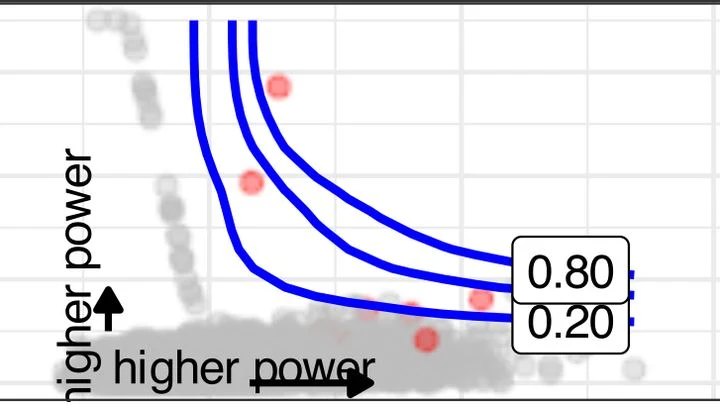
When you're planning a renovation, you don't buy paint by eye: you measure the wall area. In science, deciding how many samples to collect is a similar guess, but the stakes are higher. Skimp on samples, and your study becomes a lottery: you might miss a real effect, or you might mistake noise for a discovery. Overshoot, and you're wasting tubes, months, and, in animal experiments, lives.
Population growth from a distance looks like a train picking up speed: it crawls at first, then gains momentum. But look closely at the data, and the picture blurs. One measurement shows a dozen individuals, another a hundred. Classical models wipe away this scatter like annoying smudges on a lens. They assume the noise is uniform and simply ignore it.
When the canary in the coal mine falls silent, the miners know: the gas is already here, time to get out. Tumor DNA floating in the blood behaves much the same way. The drug bears down on the cancer, and the level of this DNA drops to nearly zero. The test stops seeing it. The doctor sees 'clean' and breathes easy.
But silence can be deceptive.
When the conductor leaves the orchestra, the musicians keep playing from memory for a while. But without a unified rhythm, each one starts to speed up or slow down on their own, and the harmonious symphony turns into disjointed noise. According to new research, the brain and heart behave much the same way in the last hours of a person's life.
Two road crews are paving a street from opposite ends. They move toward each other, and how well they coordinate determines when the street is finished.
A torn telephone wire is a nuisance, but a torn DNA is a catastrophe. A double-strand break, when both strands of the helix snap at the same spot, threatens the cell with death or transformation into cancer. Fortunately, the cell has its own 'glue': special proteins that gather into a droplet right at the accident site.
On one side of the scale are the genes you inherited from your parents. On the other is how many hours you actually sleep. For a long time, it seemed genetics pulled harder. But a new study covering more than 200,000 people shows that real sleep can tip the balance, especially when it comes to excess weight and diabetes.