Protein design is the engineering of new protein sequences that fold into specific, predetermined three-dimensional structures and perform desired functions. Unlike natural proteins, which evolved over billions of years, designed proteins are created from scratch using computational methods. This field aims to create novel tools for medicine, industry, and basic research, such as new enzymes, biosensors, and therapeuticagents.
History
The field was pioneered by David Baker and colleagues at the University of Washington, who developed the Rosetta software in the late 1990s. A major milestone was the 2003 computational design of a novel protein fold, Top7, which had no natural counterpart.
How it works
The process typically involves computational algorithms that search the vast space of possible amino acid sequences for those that are likely to fold into a target structure. These algorithms use physical models of atomic interactions and statistical knowledge from known protein structures. The best candidates are then synthesized in the lab and tested experimentally, with iterative refinement to improve stability and function.
In practice
Designed proteins are used to create new vaccines, such as the RSV vaccine, and are being developed for targeted drug delivery, biosensors, and industrial enzymes that can break down plastics or other pollutants.
Fun fact
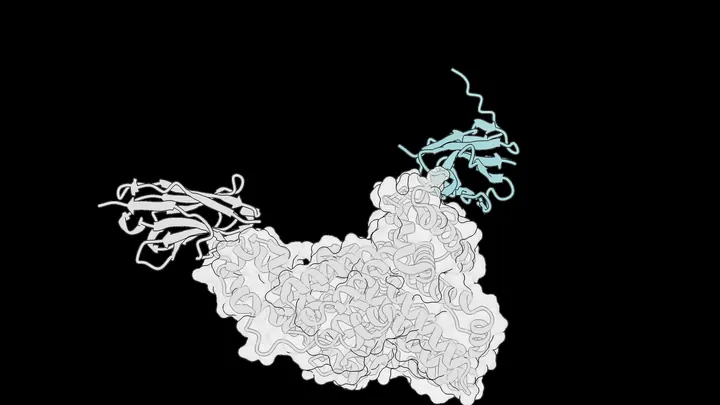
In 2020, a team used protein design to create a novel protein that could bind the spike protein of SARS-CoV-2, potentially blocking the virus from entering cells.
Four old maps were lying in different desk drawers. Each one marked genes linked to cellular aging, but the maps did not match: different names, different scales, different legends. A scientist hunting for a gene to test had to cross-check them by hand, at the risk of missing an important mark.
SenSASP stitched those maps into one.
A drop of blood on filter paper preserves not only cells but also a record of what has been happening to the body over the past few months. That record is not in the genes but on them: the chemical marks cells attach to DNA change with food, stress, illness and age. Scientists have learned to read this archive tape to reconstruct a picture of health without repeated trips to the lab.
A protein engineer is like a chef trying to make a dish that is tasty, healthy, and cheap all at once. Change one ingredient, and you risk ruining another. In the past, computer assistants could only evaluate protein properties one at a time, missing how they are connected.
Under an electron microscope, a protein looks like a series of blurry shadows — hundreds of thousands of images of the same molecule, but from different angles and with heavy noise. Previously, from these shadows, one first assembled a volumetric 'haze'—a map of how electric charge is distributed inside the protein.
A protein in a cell is not a rigid part but rather a soft glove that can grasp different objects. Until now, protein designers worked like sculptors, crafting a key for a single lock: one target, one shape. But life is more complex: sometimes a protein needs to recognize two different viruses at once or change its contours depending on its neighbors.
Blood stem cells are like spare keys to a house: they open the door to any room, but over time they wear down and start to stick. In an elderly person, such keys handle the locks worse, and the blood renews itself more slowly. Scientists have long been searching for a way to make a duplicate that stays new even after heavy use.
In any city project, residents' behavior is a invisible force that determines success. One skeptical neighbor can slow down solar panel installation across an entire block: their caution triggers a rise in disorder.
The data from a single CT scan is comparable to several feature-length films. TCAM-Diff bypasses this bottleneck: the program compresses the 3D scene into three shadow projections — like a sculptor reconstructing a solid statue from silhouettes on three walls.
Building a light chip is like a game where you have to guide a beam through a maze of tiny mirrors and beam splitters. Each element acts like a railroad switch: it either lets light pass straight through or directs it to an adjacent track. The goal is to produce a specific light pattern at the output while using as few 'switches' as possible.
Usually, engineers spend years finding the shortest route for each task.
A protein in a cell is not a frozen sculpture. It is constantly in motion: bending, breathing, jittering. This motion, its dynamics, determines how the protein works. But peering directly into the dance is hard, and computer simulations often demand enormous computing power.
A new approach, named DynaMode, views protein motion as a musical piece.
Think of a massive cookbook: each recipe is a protein, and the finished dish is its job in the cell. To whip up a complex treat, you often need to mix several ingredients and let them 'set' into the right shape. Until now, scientist-chefs could only guess how someone else's recipes would fold.
Imagine an audition for a symphony orchestra, where out of hundreds of hopefuls, only those whose instruments sound pure and withstand the furious crescendo remain. In the world of materials, computers have learned to generate 'atomic scores'—thousands of virtual crystals that promise to become the foundation for quantum chips or superconductors.
Ordinary neural networks learn from examples, like a person memorizing tunes by ear. But networks with physical laws embedded from the start resemble a musician who knows notes and harmony: they can play a new piece from just a few chords. Instead of mindless memorization, they use equations like energy conservation or motion.
An engineer tunes an antenna: pull one segment, the frequency drifts; change the angle, the gain drops. Developing therapeutic peptides (short protein chains) works much the same way.
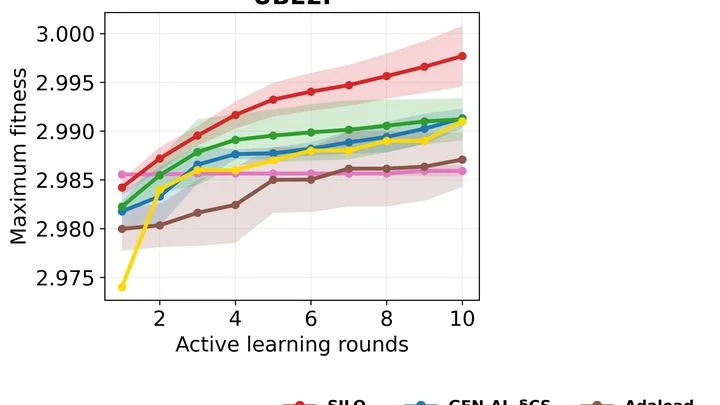
Improving a complex recipe is a delicate task, especially if you can only taste a few versions a day. Changing ingredients at random is risky: remove the salt or the baking powder, and you ruin the base. The same goes for proteins: random mutations often break vital parts, and each lab test costs time and money.
A new approach called SILO does it differently.
A torn telephone wire is a nuisance, but a torn DNA is a catastrophe. A double-strand break, when both strands of the helix snap at the same spot, threatens the cell with death or transformation into cancer. Fortunately, the cell has its own 'glue': special proteins that gather into a droplet right at the accident site.
A translator doesn't learn a language from a textbook but by listening to live speech and immediately seeing what people do in response to words. That's exactly how the new method C3P reads bacterial DNA. Standard genomic models try to learn the rules by simply "rereading" billions of letters of the genetic code, and often get confused.
Imagine a huge garage with hundreds of parking spots. You're driving a tiny car, a future drug molecule, and you want to find the one free bay where it fits perfectly. But these bays aren't concrete; they're woven from DNA or RNA chains, and no one has posted the parking rules.
At a party, guests don't just chat in pairs; they gather in circles of shared interests: three discussing movies, four debating sports. The usual acquaintance map, like a phone's contact list, can't capture that: it only sees one-on-one links.
Inside every cell, life is bustling: tiny protein machines tirelessly haul cargo, read genes, and fix errors. But their work is far from perfect: they often 'spin their wheels,' take backward steps, or get stuck in futile cycles. It's like a city traffic jam where cars dart around aimlessly, burning fuel.
A protein in a cell is like a tiny machine: each has its own precise blueprint and its own task. Some proteins cut molecules, others carry oxygen, and still others capture light. To build such a mechanism from scratch, you need to solve two problems at once: decide what job it will do and how it will fold into the right knot. If the knot goes wrong, the machine jams or breaks.
Proteins, like people, have family trees. Two proteins performing the same job in different organisms descend from a common ancestor. By comparing their sequences, you can reconstruct that history. But when proteins diverged long ago, standard methods lose the trail: so many differences pile up that the signal fades, like old photographs yellowing.
A protein is like a chain of amino-acid beads that folds into a precise shape, and that shape dictates how the protein works in a cell. Protein designers swap beads to achieve the desired form, but the number of possibilities is enormous.
Imagine trying to examine a snowflake without letting it melt or get damaged. That's roughly the challenge facing scientists who want to study individual proteins — the tiny molecular machines of life. In solution, a protein constantly jiggles and clumps with its neighbors, and in an electron microscope, the beam destroys it.
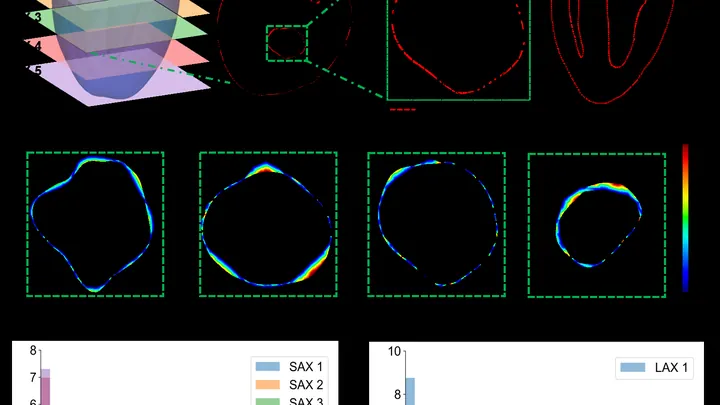
The heart is not a perfect sphere; its shape changes with every beat. To build an accurate 3D copy for a computer model, doctors typically take dozens of MRI slices. But that's like assembling a watermelon from thin slices: the fewer slices, the more guesswork.
A new approach teaches a neural network to understand the heart's shape from sparse contours.
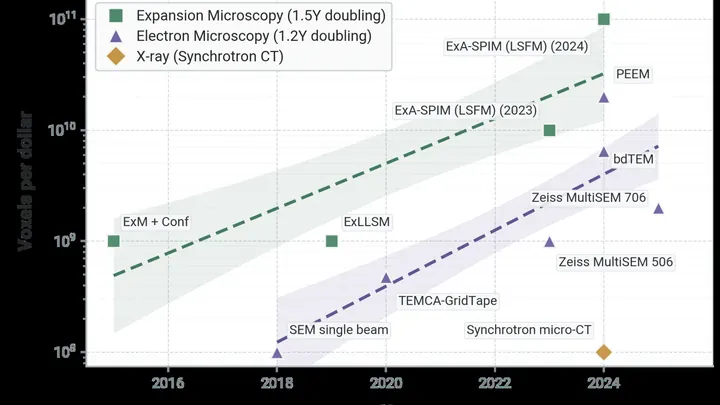
Modern microscopes see the brain in exquisite detail: not just the synapses themselves, the contact points between neurons, but also the molecules they are made of. Such images are becoming more common and cheaper to produce.
Alzheimer's disease begins quietly: deep in the brain, two proteins, tau and amyloid-beta, start to accumulate. They behave like weed seeds: one clump that appears causes neighboring cells to produce similar clumps. Gradually, the proteins spread along nerve fibers, like water through the capillaries of a paper towel, and invade new areas.
Capsids are protein boxes that viruses use to carry their genetic material. In gene therapy, these boxes serve as couriers: you put a desired gene inside, and the outside retains the ability to enter cells.
A scanning tunneling microscope probes a molecule with an ultra-fine tip and maps its relief. But the image is flat, while the molecule is three-dimensional. How do you guess a person's pose from their shadow on a wall?
An octopus tentacle bends, grabs, and stretches — all without a single bone. The secret is that inside it, sections that contract alternate with sections that remain passive. Scientists have long tried to replicate this trick in artificial materials, but until now they couldn't precisely dictate how a material would change shape.
Now researchers have proposed 3D-printing elastic threads from two materials at once.
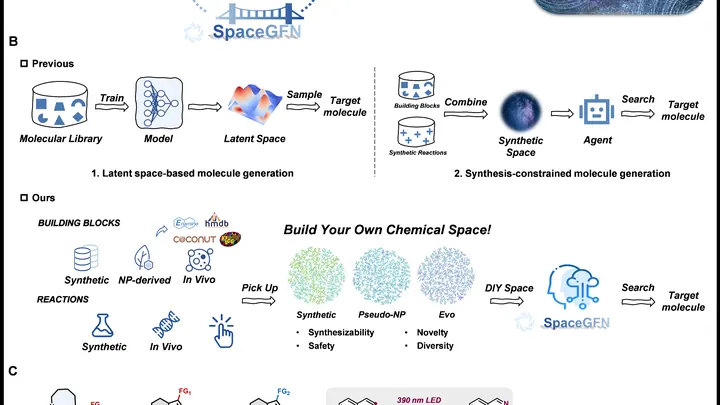
Previously, generative models for drug discovery worked like an artist painting without choosing a canvas. They learned from existing molecules and simply produced similar ones, without considering how the space of possible compounds is organized. SpaceGFN changes the approach: now chemical space is a construction set where the user specifies the parts and the assembly rules.
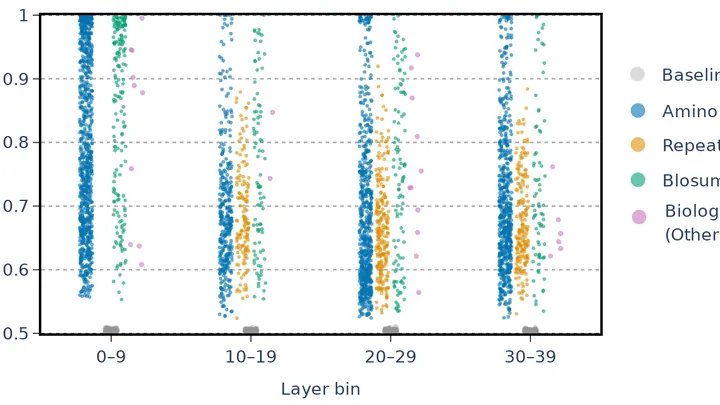
Proteins are chains of amino acids, and they often contain repeated chunks. Sometimes the repeats are exact, like the same phrase said twice. Sometimes they come with typos: a couple of letters swapped, but the meaning is the same. These repeats matter: they help the protein fold into the right shape and do its job.
A drop of ink in a glass of water spreads out on its own. But if the ink were made of tiny motors, they wouldn't just spread: they'd crawl, jostle, and cluster into swarms. Such self-propelled particles are called active. You can assemble them into molecules like beads on a bracelet. And here's the surprise: the order of beads on the bracelet changes everything.
Inside a fuel cell, protons must race through a solid material like commuters through turnstiles at rush hour. If the turnstiles are sparse and narrow, the current is weak. In the past, to find a material with good proton conductivity, chemists had to screen compounds almost blindly, one by one.
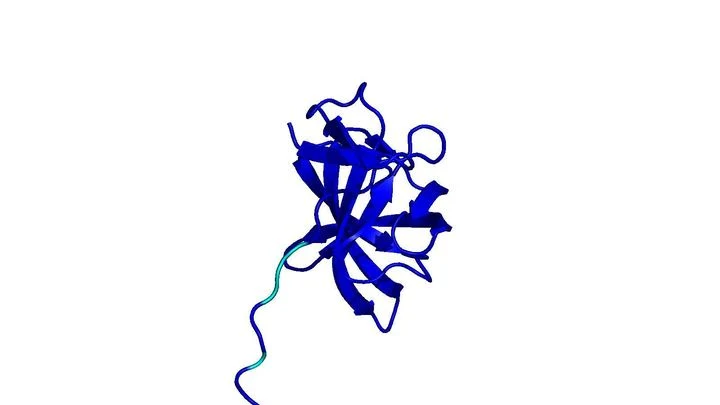
Proteins are the molecular machines of life. They fold into complex three-dimensional shapes, like a sheet of paper into origami. But if you fold the paper a bit differently, you get a different figure. Likewise, a protein can take on several forms, and that determines how it works.
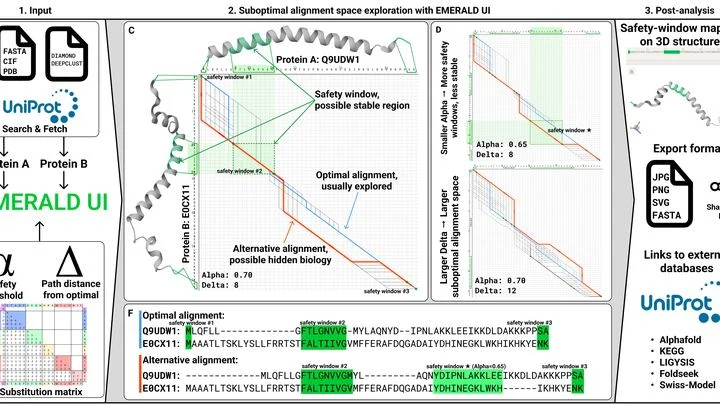
Usually, scientists compare proteins by their sequences — chains of amino acids.
A protein language model is like a chef who learned from thousands of recipes and now invents new dishes. Sometimes he gets carried away and salts every dish because one good cookbook used a lot of salt. In proteins, such repetition isn't just ugly: identical stretches in the chain make the protein fragile, it can't fold into the right shape, and it doesn't work.
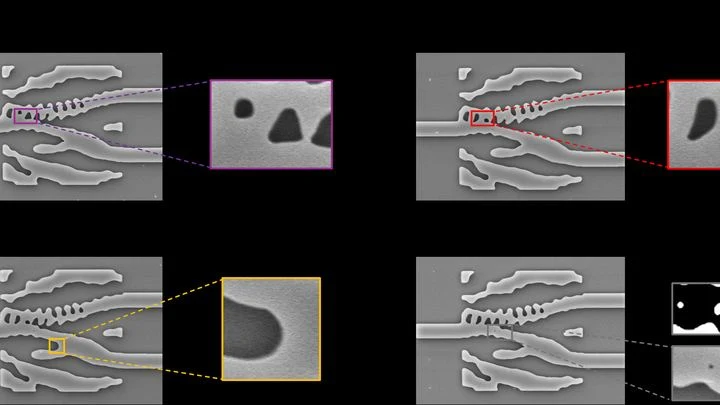
Modern computer algorithms design photonic integrated circuits — light chips capable of separating signals by frequency (color) for spectroscopy. Unlike traditional engineering, light paths in these chips are not straight waveguides but chaotic, almost organic mazes.