Teaching Neural Networks to Read Molecules at a Glance express
Finding the right molecule among billions of options is like finding a single grain in a sack of rice. To avoid sifting through everything by hand, chemists increasingly turn to neural networks. But large models require powerful computers, while small ones often lack the big picture.
GLACIER tackles this problem like a bright student learning from several mentors at once. First, the model's three 'eyes' look at the molecule from different angles: one sees it as a graph (a scheme of atoms as vertices and bonds as edges), another reads it as a SMILES string (a kind of molecular barcode), and the third evaluates physicochemical parameters — size, charge, solubility. These three views then merge into a unified portrait of the molecule using a mathematical framework inspired by Finsler geometry (which is like measuring distances not along a straight line but along a winding mountain trail).
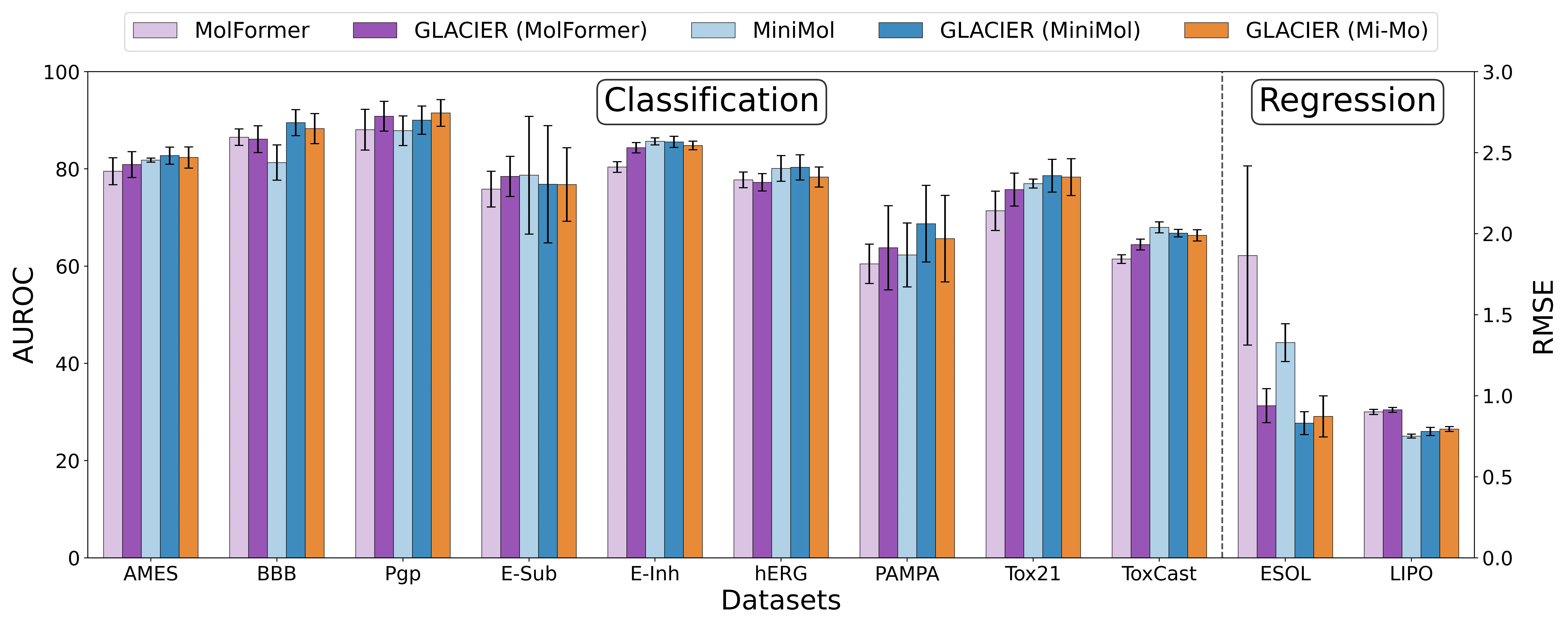
In the final stage, the teachers step in — large models MiniMol and MolFormer, already trained on vast datasets. The GLACIER student doesn't just copy their answers; through contrastive learning, it learns to bring molecules that are similar in essence closer together in its internal space and push apart those that are different. This yields a compact yet highly accurate model capable of predicting substance properties without heavy computation.
In the end, one lightweight tool replaces a cumbersome set of programs, speeding up the search for new materials and drugs. The grain in the sack of rice can now be found not by touch but by precise description.
Original abstract
as written by the authors arXiv:2606.11382
Deep learning models facilitate the discovery of molecules with tailored properties among billions of candidate compounds. However, the computational burden to develop and deploy state-of-the-art models continuously increases, limiting their scalability. Most large-scale models are unimodal in nature and overlook the potential to leverage complementary molecular data modalities. To address these shortcomings, this paper introduces the Graph-Language Alignment for Chemical Inference and Exploration using Representations (GLACIER) model, a student-teacher framework that integrates molecular graphs, SMILES strings, and physicochemical descriptors to learn rich molecular embeddings. Our framework consists of three stages: (1) we pretrain three student encoders on 100,000 drug-like molecules: a message-passing neural network for molecular graphs, a transformer-based encoder for SMILES strings, and a multilayer perceptron for physicochemical descriptors, (2) we fuse these student modalities using a novel Finsler geometry-aware module, and (3) distill complementary knowledge from large teacher models, including MiniMol and MolFormer, into a single lightweight model via contrastive learning. We demonstrate that GLACIER is a robust framework that delivers high predictive performance and computational efficiency in complex molecular property prediction tasks. Our code is publicly available at https://github.com/eemokey/glacier.
The SMILES string for plain water is simply 'O', and for aspirin it's 'CC(=O)OC1=CC=CC=C1C(=O)O'. Essentially, it's a molecule written in letters and numbers, like a word in the chemical language.