Teaching Neural Networks to Read Molecules at a Glance express
Finding the right molecule among billions of options is like finding a single grain in a sack of rice. To avoid sifting through everything by hand, chemists increasingly turn to neural networks. But large models require powerful computers, while small ones often lack the big picture.
GLACIER tackles this problem like a bright student learning from several mentors at once. First, the model's three 'eyes' look at the molecule from different angles: one sees it as a graph (a scheme of atoms as vertices and bonds as edges), another reads it as a SMILES string (a kind of molecular barcode), and the third evaluates physicochemical parameters — size, charge, solubility. These three views then merge into a unified portrait of the molecule using a mathematical framework inspired by Finsler geometry (which is like measuring distances not along a straight line but along a winding mountain trail).
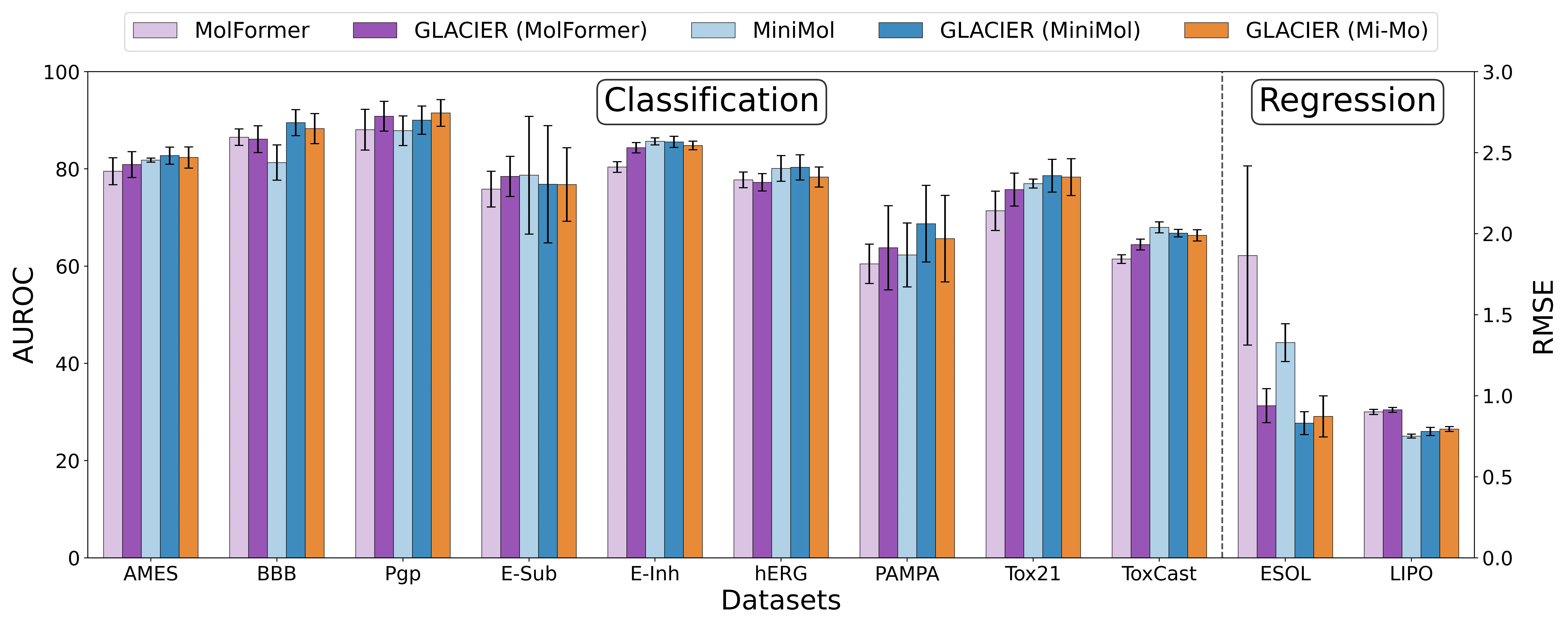
In the final stage, the teachers step in — large models MiniMol and MolFormer, already trained on vast datasets. The GLACIER student doesn't just copy their answers; through contrastive learning, it learns to bring molecules that are similar in essence closer together in its internal space and push apart those that are different. This yields a compact yet highly accurate model capable of predicting substance properties without heavy computation.
In the end, one lightweight tool replaces a cumbersome set of programs, speeding up the search for new materials and drugs. The grain in the sack of rice can now be found not by touch but by precise description.
The SMILES string for plain water is simply 'O', and for aspirin it's 'CC(=O)OC1=CC=CC=C1C(=O)O'. Essentially, it's a molecule written in letters and numbers, like a word in the chemical language.