Quantum-like models transfer the mathematical apparatus of quantum mechanics (e.g., Hilbert spaces—abstract vector spaces for states, operators—ways of measurement, probability amplitudes—quantities whose squared modulus gives probability) to the description of cognitive processes, social interactions, or biological systems. They do not claim that the brain is literally quantum but use a convenient formalism to account for contextuality, inconsistency, and question order.
History
Pioneering work in this area was done by mathematicians and cognitive psychologists such as D. Aerts and A. Khrennikov starting in the 1990s. They showed that many 'irrational' human decisions are well described by quantum-likeprobabilities. Later, the field was taken up by quantum information specialists. David Deutsch contributed to quantum computing, providing tools; John Archibald Wheeler reflected on the participation of the observer, which resonates with quantum-like approaches.
How it works
The state of an agent is described by a vector in Hilbert space (a complex vector space with an inner product). Choices are represented by projection operators. The probability of an outcome is given by the squared modulus of the projection (Born rule). Context influences like a change of basis. This allows quantum-like effects: interference (when the sum of probabilities does not reduce to the classical sum) and violation of distributivity. The principle of superposition and interference of states is applied.
In practice
Helps create more flexible AI algorithms that can handle contradictory data.
Fun fact
These models have explained decision-making paradoxes, such as violations of classical probability laws in surveys.
Dancers on a stage with moving walls: particles in a finite quantum system collide with each other and reflect off the edges, but the walls can move according to a prescribed scenario. Physicists have long been able to describe such dances only with fixed walls or in an infinite hall. Now there is a way to account for both the motion of the walls and the reflections from them.
An interpreter in a crowded room tries to make out one person's speech but hears the murmur of hundreds of voices. A molecule storing quantum information in its spin finds itself in a similar situation: its spin is surrounded by the thermal jitter of atoms, and it is this jitter that gradually erases memory.
A laser pulse slams into a gas cloud and knocks electrons out of it, leaving behind a bubble: a cavity almost devoid of particles. This bubble races through the plasma at nearly the speed of light, and its walls drag along the electrons trapped inside, much like a speedboat tows a water skier.
Quantum systems made of many particles are the basis of future computers and secure networks. But the more particles there are, the harder it is to understand how they are arranged: the number of possible states grows like an avalanche. The usual approach, measuring everything, takes an incredibly long time.
In 1996, physicists asked: how much noise can a quantum channel withstand before it stops transmitting information? A phone call where every third word is replaced by random noise is still understandable. Up to what level of interference can the listener still grasp the meaning?
A quantum computer is like an orchestra where each instrument is a qubit and the conductor is the control processor. The conductor must not only set the tempo but also change the score on the fly if a soloist plays something unexpected.
A quantum computer isn't just a bunch of qubits: it's a whole city, where each resident is one of the machine's possible states. Residents get to know each other through weak interactions between qubits: if one state can transition to another, a thread of acquaintance is drawn between them.
When a fluid flows around an obstacle, it spawns vortices and shock waves. Describing their behavior means solving a nonlinear equation in which the flow velocity depends on itself. Classical supercomputers spend days on this, while quantum computers have barely been used: their native language is linear operations, but fluids are inherently nonlinear.
Quantum computers make mistakes. Each qubit is like a ball balanced on the tip of a pencil: a slight tremor in the hand and it rolls off. To keep the balls from falling, you need someone to notice the wobble and correct it in time.
A drop of ink in a glass of water spreads in intricate swirls. Similarly, a quantum particle exchanging energy with its environment changes its state in a complex and entangled manner. Describing this dance between particle and environment has long baffled scientists.
Imagine a huge puzzle where each piece is a quantum particle. To complete the picture, you don't just fit the pieces together: you need to entangle them in a special way. Usually, this is done by carefully applying operations one after another, like assembling the puzzle strictly by the instructions, row by row.
Coffee beans alone don't make a drink, but take two, and the cup fills. In the quantum world, there are similar states: from one copy, you can't extract pure entanglement, but from several, sometimes you can. For a long time, it wasn't known if such a thing existed at all.
Scientists took a family of states specifically designed as a testing ground for this question.
A water pipe: the wider it is, the more water flows through. In superconducting contacts — Josephson junctions (bridges through which current flows without resistance)—it's usually the same: the better the material conducts in its normal state, the larger the superconducting current that flows through it.
A stone thrown at a wall bounces off. In the quantum world, a particle can pass right through, as if the wall were woven from mist. This is quantum tunneling: it lights up stars, works in microchips, and even operates in the cells of our bodies. But most particles have spin — an intrinsic rotation, like a spinning top.
A quantum particle moves in a circle, passing through several stations. At each station, something happens to it — for example, its properties change slightly. After completing a full circle, the particle returns, but its state is no longer exactly what it was at the start.
In the quantum world, particles fall into two irreconcilable camps: bosons love to pile into the same state (like light in a laser), while fermions are individualists that never occupy the same spot. You'd think one neural network couldn't learn both personalities at once.
The quantum world does not forgive forgetfulness. Throw a stone into a pond — the ripples spread and vanish, the information about the impact dissipates without a trace. In quantum mechanics, everything is different: the evolution of a system is reversible, and the past is never completely erased.
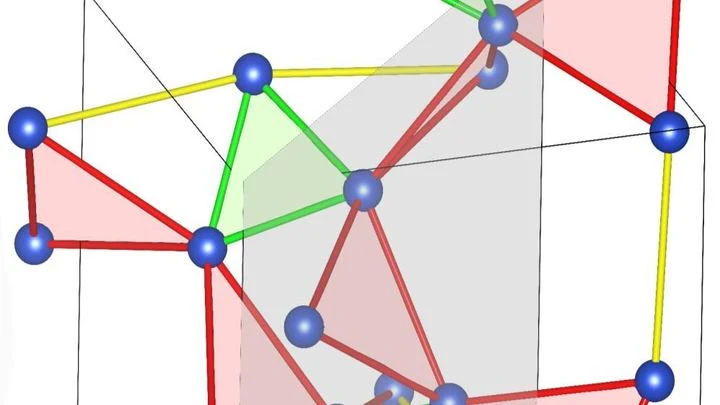
The PbCuTe₂O₆ crystal resembles a three-dimensional web of copper, tellurium, and oxygen. Inside, the magnetic moments, tiny arrows tied to electron spins, are so entangled that they can't settle into an orderly arrangement even near absolute zero.
The quantum world never stands still. Even in the most perfect resonator, a trap for particles of light, energy gradually leaks away, and information is erased. Physicists call this process decay, and it has its own rhythm: some 'notes' fade quickly, while others linger.
In the world of quantum particles, there are introverts — anyons. They are unlike familiar electrons or protons. If you swap two such introverts, they remember the maneuver, as if leaving an invisible trace.
The quantum world is a constant buzz of activity. Particles exchange energy, become entangled, and influence one another. You'd think that the more players in this game, the harder it is to predict the outcome. But sometimes, order emerges from chaos.
Physicists took a close look at the SYK model — a mathematical playground for studying quantum chaos.
A quantum computer is usually like an assembly line: operations proceed one after another, and each error accumulates. In the new work, physicists tried a different path — an architecture where the computation grows out of the measurement process itself. They took 56 ions in a trap and wove them into a three-dimensional cloud of entangled particles.
A thin silver thread nearly as long as a hair's width, and inside it, pristine quantum laws hold sway. Physicists built a conductor where electrons can only move forward or backward, like on a perfectly straight single-lane road with no shoulders. On such a road, any pothole or pebble would normally destroy the fragile quantum state.
Seven dancers step onto the stage. They join hands so that any trio or quartet moves in perfect harmony with the rest — no group falls out of the overall rhythm. In the quantum world, this is called an absolutely maximally entangled state (AME for short). It's a perfect knot where every part knows everything about the whole.
The brain doesn't just react to the world: it's constantly guessing what will happen next. This principle is called predictive coding: neurons compare expectations with reality and update their internal picture when an error occurs. But how such a complex system could be wired into the living tissue of the cortex remained unclear.
In a noisy hall, an interpreter tries to catch every word, but rustles and echoes muddle the meaning. That's roughly how conventional computer methods handle complex quantum systems: the more particles and the stronger their correlations, the faster calculations drown in interference.
Predicting the yield of a chemical reaction is a bit like trying to guess the harvest knowing only the soil composition. Traditionally, chemists have relied on long columns of numbers, quantum descriptors, that describe electron energies but say nothing about molecular shape.
The quantum networks of the future resemble the Tower of Babel: each node speaks its own dialect. Some store information in the polarization of a photon — the direction of oscillation of the light wave. Others use time bins: that is, when exactly the pulse arrives.
A polar molecule is like a tiny dumbbell with opposite charges at its ends. Normally, such particles quickly stick together or fly apart when they meet — electric forces are too strong. But the authors of the work found a way to turn this aggressiveness into a controlled game.
An interpreter gets distracted by every rustle in the hall, and a one-hour meeting stretches into two. That's roughly how scientists have spent years searching for special states in tiny electrical chains: they watched the total current but missed how the signal was corrupted by noise.
A pale green crystal was placed in a magnetic field and cooled below one kelvin — almost to absolute zero. Inside it hide chains of copper atoms that behave like tiny magnetic needles. Usually their orientation is chaotic, but the strong field and cold make the needles align in a unified impulse, like soldiers on a parade ground.
The quantum world is tricky: sometimes particles confined to a flat layer and pierced by a strong magnetic field start behaving like a liquid made not of whole electrons but of their fractions — fractional charges. This is the fractional quantum Hall effect.
An optical trap holds an atom almost motionless, like a ball on a soft spring. But as soon as acceleration appears, say gravity, the equilibrium shifts. The atom moves within the standing light wave, and this changes the rate at which it exchanges energy with the field. The frequency of this exchange becomes a direct indicator of acceleration.
The early universe grew at a terrifying speed — inflating to gigantic proportions in a tiny fraction of a second. Physicists describe this burst with a single number: the exponent in a formula that resembles the steepness of a hill. The steeper the hill, the faster the ball rolls down: that is, the more rapidly space expanded.
Three laser beams intertwine into a triangle. Each is linked to the other two: this is the structure of the new scheme that physicists call "fully connected three-mode squeezed vacuum." This is not just three independent light sources: inside a special crystal, triples of entangled photons are born, and the connection between them resembles a complete graph of…
Inflate a balloon, and the dots on its surface move apart from each other. Our universe expands in much the same way. The mathematical model of this process is called de Sitter space — where scientists study how the tiniest 'building blocks' of matter, elementary particles, behave.
But in a curved, constantly expanding space, the usual description of particles breaks down.
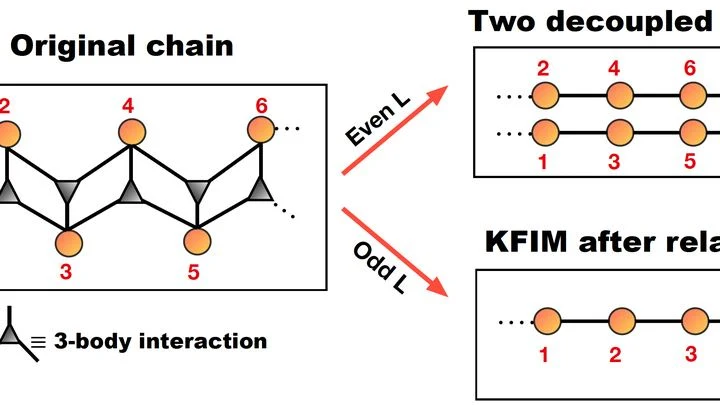
A chain of a hundred tiny magnets lies on a table. Each one can point up or down, like a coin landing heads or tails. But these are not ordinary magnets: they sense each other not just individually but in threes. Three neighboring particles seem to negotiate which way to turn. Once a second, the experimenter shakes the table, and the whole system gets a short kick.
If you accelerate an observer to near-light speed, the emptiness around them stops being cold. A thermal glow emerges — an effect predicted in 1976 and named after William Unruh. For earthly accelerations, this glow is vanishingly faint, like a whisper at a rock concert.
A cloud of atoms cooled to near absolute zero suddenly starts behaving like a brain. One excited atom triggers a chain reaction — neighbors light up in turn, and an avalanche of activity sweeps through the gas. Physicists call this Rydberg facilitation: atoms are easier to excite when an excited one is nearby.
The meditating brain is an orchestra, and attention is the conductor. When you're focused on your breath, all instruments play in harmony. But suddenly, a thought-cello plays a false note: that's mind wandering. An experienced conductor doesn't panic: they instantly catch the dissonance and gently guide the orchestra back to the main melody — the breath.