A Charged Black Hole and Its Evaporating Memory express
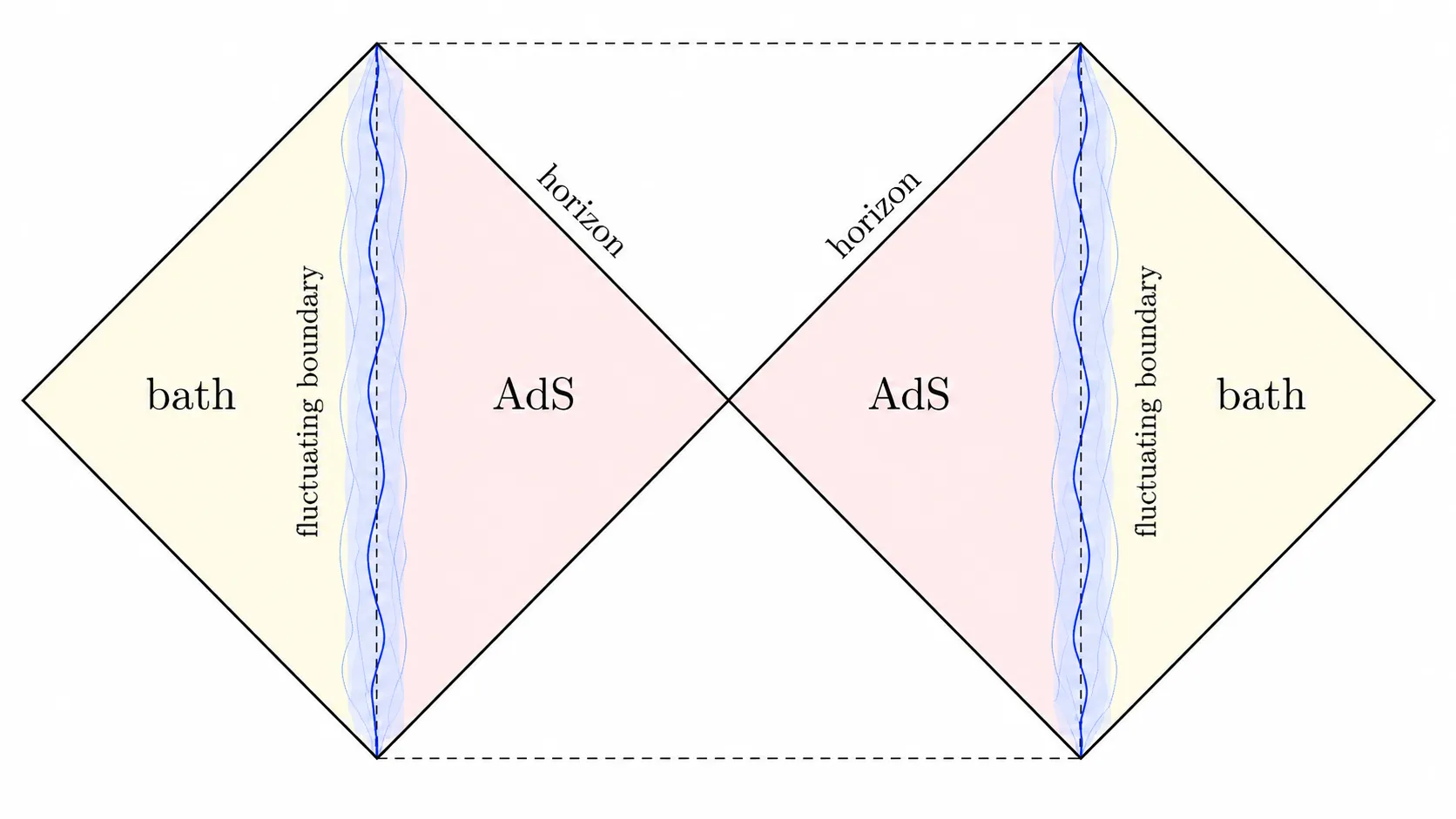
A black hole is not an eternal vacuum cleaner. It slowly evaporates, radiating energy, and along with it, as physicists believe, it should return the swallowed information. But when exactly does that start happening? The answer is given by the so-called Page curve — a graph that shows how much information the hole has already released and how much it still holds inside. A sharp kink in this graph marks the "Page time"—the moment when the hole turns from a vault into an open book.
In the new work, the scientists considered not a simple black hole but a charged and nearly two-dimensional one — whose space resembles a crumpled sheet of paper near the horizon. The key idea: the hole's behavior is influenced by two "soft modes"—barely noticeable collective motions. One is associated with the reshuffling of time labels at the horizon (the Schwarzschild mode), the other with oscillations of the electric phase (the U(1) mode). These modes act like two conductors who shift the radiation orchestra — one slows the tempo, the other speeds it up.
The authors averaged the energy and charge fluxes over these modes and found: the U(1) mode delays the Page time, while the Schwarzschild mode brings it closer. The net shift is the result of their confrontation. In the low-temperature regime, where quantum gravity effects are not yet dominant, this struggle becomes decisive. Thus, the evaporation of a charged hole turns out to be not a monotonic process but a delicate game of two invisible forces.
Original abstract
as written by the authors arXiv:2606.15562
We study the evaporation and Page curve of charged near-AdS$$_2$$ black holes coupled to a non-gravitating bath at fixed temperature and chemical potential. The low-energy dynamics is governed by the Schwarzian reparametrization mode together with a $$U(1)$$ phase mode. We average the boundary energy and the outgoing flux over these two soft modes and obtain corrected balance equations for the temperature and chemical potential. We then use the corrected background to calculate the no-island and island entropies and the Page time shifts. We find that the two soft sectors affect the Page transition in our low-temperature semiclassical regime. The $$U(1)$$ phase mode correction delays the Page transition, while the Schwarzian correction tends to move it earlier. The total Page time shift is therefore determined by the competition between the Schwarzian and $$U(1)$$ sectors.
The Page time is named after physicist Don Page, who in 1993 proposed this curve as a way to resolve the dispute between Stephen Hawking and Leonard Susskind over whether information is lost in a black hole.
In Dan Simmons' novel "Hyperion," the Time Tombs are surrounded by anti-entropic fields that make time flow backward — an echo of the idea that black holes may return information.