A charged black hole is a black hole that carries an electric charge, in addition to its mass and angular momentum. In classical general relativity, such objects are described by the Reissner-Nordström solution (for non-rotating) or the Kerr-Newman solution (for rotating). The charge fundamentally alters the black hole's thermodynamic properties: it changes the temperature, entropy, and the way the black hole radiates. For instance, a charged black hole can cool to zero temperature at a finite mass, a state known as an extremal black hole, where the Hawking radiation ceases.
History
The Reissner-Nordström solution was derived independently by Hans Reissner (1916) and Gunnar Nordström (1918), shortly after Einstein's general relativity. The thermodynamic interpretation of black holes, including charged ones, was developed by Jacob Bekenstein and Stephen Hawking in the 1970s.
How it works
The electric charge creates an electrostatic field that extends outside the event horizon. This field stores energy, which modifies the black hole's mass-energy balance. In thermodynamics, the charge acts as a thermodynamic variable analogous to volume in a gas: changing the charge changes the black hole's temperature and entropy. The presence of charge also introduces a second horizon (the inner Cauchy horizon) and can lead to instabilities or the possibility of extracting energy via processes like superradiance.
In practice
Charged black holes are primarily theoretical tools used to test quantum gravity and black hole thermodynamics, such as in the study of Hawking radiation and the information paradox. They also appear in gauge/gravity duality (AdS/CFT) as models for strongly coupled quantum systems.
Fun fact
A charged black hole can act as a refrigerator: by carefully adjusting its charge, it can extract heat from its surroundings and cool down, a process studied in the context of black hole thermodynamics.
A black hole is not an eternal vacuum cleaner. It slowly loses mass by emitting particles, much like a heated stone cooling as it radiates heat. This process, discovered by Stephen Hawking, is barely noticeable for large holes, but for tiny ones, with masses comparable to a mountain, it becomes a violent evaporation.
A black hole is not silent. When perturbed, it rings like a bell, and that ring is its quasinormal modes — damped oscillations. Physicists delved into the world of charged black holes in anti-de Sitter space (a universe with negative curvature, like a saddle).
Electric charge is a slippery thing. You can measure how much there is in the entire universe or in a single particle, but try to point your finger and say, 'Right here, in this cubic centimeter, there is exactly this much charge right now,' and you hit a fundamental wall.
The issue is that total charge, which physicists denote by the letter Q, is nonlocal.
10⁻¹²⁰. That's not just a small number: it's a chasm. That's the ratio of dark energy density to the Planck density, the natural scale of quantum gravity. The colossal difference of 120 orders of magnitude has long seemed an unsolvable puzzle. But the answer might lie in a drama played out at the dawn of time.
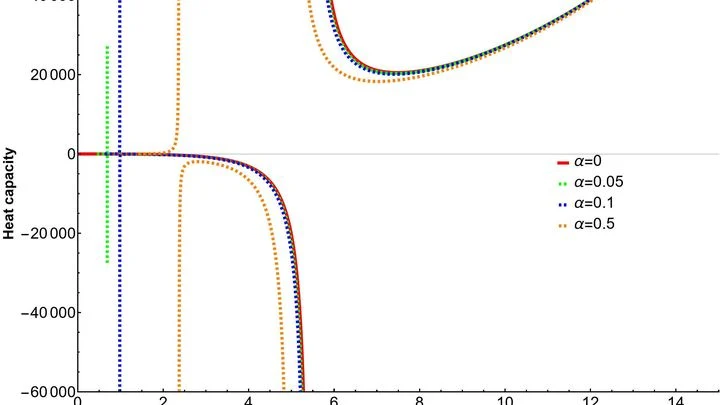
Gas passing through a narrow valve can heat up or cool down: this is the Joule–Thomson effect, which powers refrigerators and air liquefiers. It turns out black holes can do the same.
A black hole with an electric charge is like a vacuum cleaner that not only sucks in everything around it but can also hold light particles in orbit. These particles form a kind of fuzzy cloud around the hole — physicists call it a quasi-bound state.
A classical black hole has a temperature and other thermodynamic properties. When physicists began accounting for changes in the cosmological constant, the energy of empty space, a strange coupling emerged in the equations.
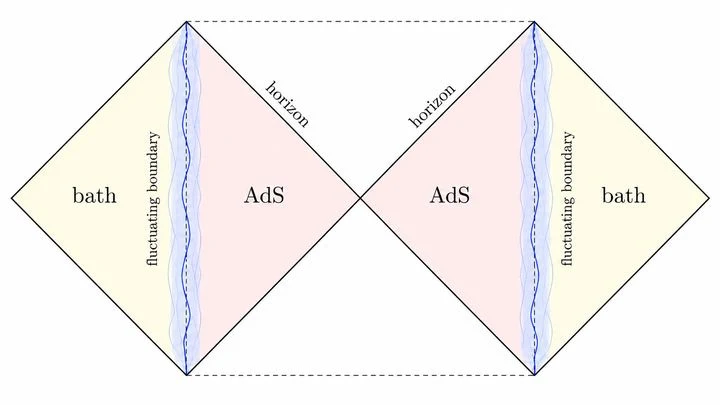
A black hole is not an eternal vacuum cleaner. It slowly evaporates, radiating energy, and along with it, as physicists believe, it should return the swallowed information. But when exactly does that start happening? The answer is given by the so-called Page curve — a graph that shows how much information the hole has already released and how much it still holds inside.
An ordinary black hole is like a stove that heats up more as its mass shrinks. A tiny hole should glow at unimaginable temperatures and evaporate in an instant. But that scenario ignores quantum corrections — what happens when the very fabric of spacetime begins to tremble.
When a massive star runs out of fuel, its core collapses under its own weight. A black hole forms — a region where gravity is so strong that even light can't escape. For a long time, it was thought that a point of infinite density, a singularity, lurks at the very center.
An inflating balloon starts out slowly, then suddenly expands faster and faster, as if someone is pumping it up from inside. That's roughly how our universe behaves: galaxies are receding with acceleration. The culprit behind this acceleration is called dark energy.
A magnetic field can hold a star against complete collapse: that's the idea behind a new kind of black hole. Instead of the usual point of infinite density, inside there is a field that prevents space from crunching down to zero. It's like a spring: the harder you squeeze, the more it pushes back.
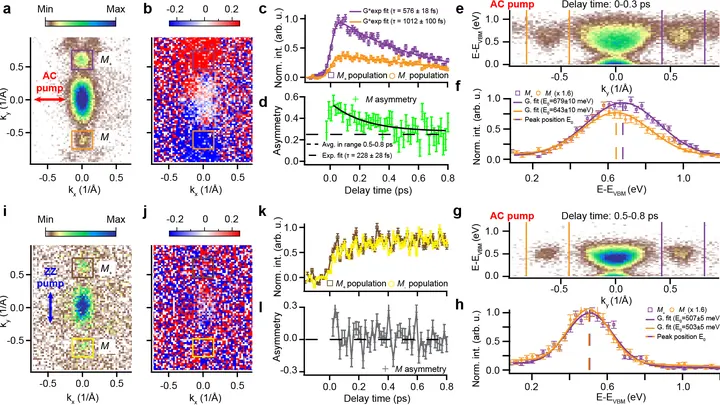
An ordinary sheet of black phosphorus looks like a layered cake of atoms. If you shine a regular lamp on it, nothing special happens: the electrons sit still, like spectators in a dark theater. But a short laser flash lasting millionths of a billionth of a second shakes up that theater.
At the center of a black hole lies a singularity — a point where spacetime is crushed infinitely. Black holes can change state, much like water freezing or boiling. Usually, these transitions are noticed by observing the hole's surroundings.
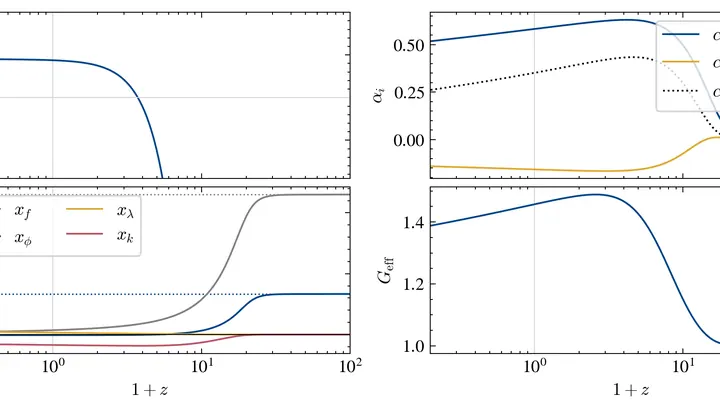
Dark energy is usually seen as an innate property of the cosmos, at work from the very first moments. But a new model suggests it behaved like water on the verge of boiling: long unnoticed, then suddenly kicking in at a critical moment. This scenario is called 'late activation': around 5–7 billion years ago, a shift occurred, and the universe’s expansion began to accelerate.
According to ordinary mechanics, an electron in an atom should spiral into the nucleus and crash into it, like a surfer losing speed and falling off the board. But atoms live for billions of years. Because space isn’t empty. Even in absolute vacuum, an invisible electromagnetic sea ripples — the zero-point field. Its waves continuously nudge the electron.
A hot chain of atoms lined up in a row behaves like a tiny black hole. Such a chain is a series of particles, each resembling a tiny magnet. At normal temperatures, the little magnets flip randomly, but when cooled, they align in a uniform order. Physicists have discovered that when heated, this simple system reproduces the strange properties of black holes.
Picture a black hole as a funnel in a taut sheet — the classic analogy for spacetime curvature caused by a massive body. But if a fifth dimension exists, this simple picture gets complicated: the sheet gains hidden springs.
Scientists applied an unusual mathematical approach in the equations of искривления пространства-времени and obtained a new type of charged чёрных дыр. Their behavior turned out to be surprisingly familiar: this is how вода in a pot behaves when it starts to boil.
A black hole is not a bottomless funnel but a cosmic cooking pot. Inside it, matter obeys laws familiar to us from the behavior of water: under some conditions it resembles boiling steam, under others — a cooling liquid.
The Event Horizon Telescope looks at M87* and sees more than just a ring of light around a dark void. That light is twisted, like a corkscrew. The wavefront carries a helical structure that physicists call orbital angular momentum.
Two telescopes look at the same Universe and see different expansion rates. Local measurements from supernovae give 73.04 ± 1.04 km/s/Mpc, while cosmic microwave background data within the standard model predict 67.36 ± 0.54.