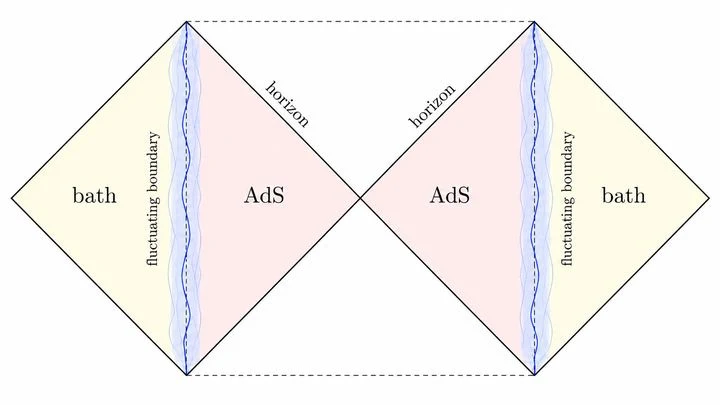
Black hole evaporation is the quantum mechanical process by which a black hole loses mass and energy over time, eventually disappearing entirely. This process is driven by Hawking radiation, a form of thermal radiation predicted to be emitted from the event horizon due to quantum effects. The smaller the black hole, the hotter it radiates and the faster it evaporates, leading to a runaway process in the final moments. This concept is central to the intersection of general relativity and quantum mechanics, and it raises deep questions about information loss and the nature of spacetime.
History
The process was predicted by Stephen Hawking in 1974, building on earlier work by Jacob Bekenstein on black hole thermodynamics. Hawking's calculation showed that black holes are not truly black but emit radiation, a result that transformed theoretical physics.
How it works
In quantum field theory, the vacuum is not empty but filled with virtual particle-antiparticle pairs that constantly appear and annihilate. Near a black hole's event horizon, the intense gravitational field can separate such a pair before they annihilate: one particle falls into the black hole (with negative energy) while the other escapes as real radiation. The infalling negative-energy particle reduces the black hole's mass, while the escaping particle carries away energy. Over time, this leakage causes the black hole to shrink, and as it shrinks, its temperature rises, accelerating the process until the black hole ends in a final burst of radiation.
In practice
While no black hole has been observed to evaporate (stellar-mass black holes are too cold), primordial black holes—if they exist—could be small enough to evaporate within the universe's lifetime, and their final explosions might be detectable as gamma-ray bursts or gravitational wave signals.
Fun fact
A black hole with the mass of Mount Everest would evaporate in about a second, releasing energy equivalent to a large nuclear bomb.
Think of a merry-go-round: the farther you sit from the center, the faster you're carried around. For a long time, astronomers assumed galaxies work the same way — stars at the edges should orbit more slowly than those near the center. But back in the 1970s, it turned out that in many spiral galaxies, the speed of stars barely drops with distance from the center.
A black hole pulls in anything that gets too close. But if you toss in not one object but a pair, one of them can fly back out, carrying off some of the hole's rotational energy. This trick, devised by Roger Penrose in 1969, works only because a black hole has a horizon — a boundary beyond which nothing returns. Now it turns out the horizon isn't necessary.
A boiling kettle on the stove eventually boils dry — and so, according to the classical picture, a black hole should gradually vanish in a hiss of radiation. But what if you add a special ingredient to the kettle?
Alice prepares a quantum particle in one of several states and sends it to Bob. The channel the particle travels through isn't perfect: it's noisy, scatters, interacts with the environment. Bob receives the signal and tries to figure out what Alice actually sent. This is the classic "prepare-send-measure" scheme, and there's always a risk of losing something along the way.
A black hole is not an eternal vacuum cleaner. It slowly loses mass by emitting particles, much like a heated stone cooling as it radiates heat. This process, discovered by Stephen Hawking, is barely noticeable for large holes, but for tiny ones, with masses comparable to a mountain, it becomes a violent evaporation.
A black hole that swallows matter might not just evaporate over billions of years: it could pop like a soap bubble and turn into its opposite: a white hole. This scenario emerged from numerical experiments in semiclassical gravity.
A black hole is not an absolutely black bag. In 1974, Stephen Hawking showed that it glows — faintly, but continuously. This radiation is born not inside, but outside, right at the boundary from which even light cannot escape.
A new study sharpens the picture.
Water turns to ice at zero degrees — sharply, with no intermediate states. Something similar happens to complexity when we take a random quantum state of an entire system and look only at a part of it. As long as that part occupies less than half the system, its complexity grows smoothly. But as soon as the fraction crosses 50%, a jump occurs.
A black hole is not eternal. Even in a perfect vacuum, it slowly loses energy — a process known as Hawking radiation. Quantum effects near the event horizon create pairs of particles, one of which escapes, carrying away some of the black hole's mass.
The agony of a solitary black hole lasts forever. But in its final moments, as its mass evaporates according to the law discovered by Hawking, it manages to send a radio farewell signal. Not a quantum whisper, but a classical hum — if only there's a magnetic field nearby.
The cosmological horizon — the edge of the observable Universe, which is expanding at an accelerating rate — is like a safe with a timer. Information about what crosses this boundary doesn’t vanish but returns, albeit with a delay. Physicists have figured out how long this pause lasts.
Dark matter is the invisible scaffold that holds galaxies together. But how did it come to be? The standard answer: particles of dark matter once stopped colliding and "froze out" in the amount we see today. However, there's a trickier path — UFO, or ultra-fast freeze-out.
Here, everything is like coffee that cools down and then heats up again as you carry it through a cold corridor.
A black hole resembles a safe that slowly gives up its contents, energy and information, through a faint glow known as Hawking radiation. But if the safe opens too quickly, a 'firewall' may flare up at its boundary — a region where the familiar laws of physics break down.
In the new work, physicists complicated the model of this safe.
A black hole is not an eternal vacuum cleaner. It slowly evaporates, radiating energy, and along with it, as physicists believe, it should return the swallowed information. But when exactly does that start happening? The answer is given by the so-called Page curve — a graph that shows how much information the hole has already released and how much it still holds inside.
A bonfire doesn't burn out all at once. If you glance at the flames at a random moment, all you see is a jumble of fire tongues, and you can never tell what exactly burned: a wet branch, an old magazine, or an armful of dry grass. But if you watch the fire hour after hour, rhythms emerge in its dance: a burst of heat, a lull, a change in color. These rhythms tell the story of what was thrown into the flames.
A black hole is not an eternal vacuum cleaner. Left alone in the void, it slowly disappears, radiating energy like a puddle drying on asphalt. This process, predicted by Stephen Hawking, is called evaporation.
A light ray skims along the horizon of a black hole: that invisible boundary from which nothing can escape. The closer the ray gets to the horizon, the slower its own 'time' stretches — a special measure of path called the affine parameter.
A black hole is a cosmic pocket into which everything, even light, falls. But the pioneering work of John Wheeler, Stephen Hawking, and Roger Penrose showed: sometimes, due to the colossal spacetime curvature, the pocket turns inside out.
In the early Universe, primordial black holes emerged — objects no larger than an atom but with the mass of a mountain. They gradually evaporate and, before disappearing, should produce gravitational waves — ripples in spacetime. If they were all identical, they would pop simultaneously, like popcorn kernels: the roar would be deafening.
A tiny black hole, no larger than an atomic nucleus, hovers in a cloud of hydrogen. It doesn't swallow everything around it; instead, it slowly radiates away, losing mass with every moment.
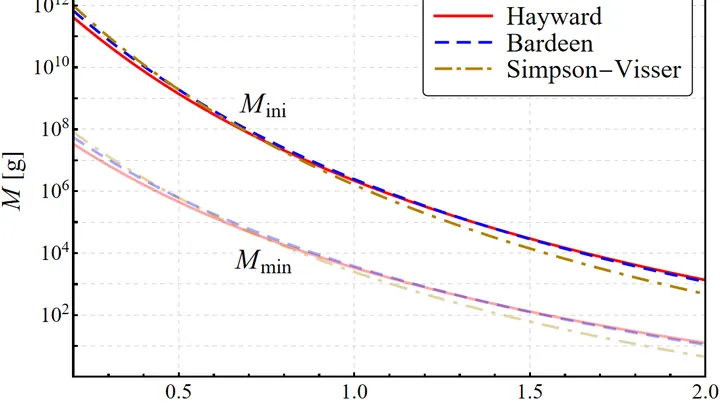
A sugar cube weighs about a gram. But a black hole that could hide inside such a cube would weigh as much as a small mountain — billions of tons. Yet even such tiny things, born in the first instants after the Big Bang, should have vanished long ago.
When a balloon with a painted pattern deflates, the pattern ripples and distorts. Something similar happens to a black hole that slowly evaporates, losing energy through the radiation discovered by Stephen Hawking.
Black holes are not eternal: they slowly lose energy, emitting entropy — a measure of hidden information — as heat. This process was predicted by Stephen Hawking. But until now, it remained a mystery what happens at the very end, when the hole has almost disappeared and must return the captured data.
Water boils in a pot, and bubbles rise from the bottom. They grow, float up, and pop, and the water remains water. Something similar, physicists have found, can happen to space itself — if it contains dark energy (the mysterious force accelerating the expansion of the universe).
In such an eternally inflating universe, black holes are sometimes born.
The standard picture of black hole evaporation, painted by Hawking, long seemed reassuring: quantum fluctuations near the horizon produce thermal radiation, the hole slowly melts away, and the spacetime behind it remains smooth.
A boiling cauldron with the occasional bubble of steam popping: that's what the early universe resembled. All of space was filled with a field in a false vacuum state, like water superheated above its boiling point.
Water flowing through a pipe can become a trap for sound. If the flow speed exceeds the speed of sound in water, then sound waves trying to go against the current can no longer escape: they are swept away, like light beyond a black hole's horizon.
A pebble dropped in a pond creates curved ripples, but from far away they appear as straight lines. Gamma-ray flashes from an evaporating black hole behave the same: a distant burst sends flat waves, while a nearby one arrives curved.
A diary loses pages, yet the story migrates to the rest. Black holes act similarly: as they shrink (shown by Stephen Hawking), swallowed information shouldn't vanish; it eventually resurfaces. Theory predicts a specific rise-and-fall curve for this escape.
A layer of electrons trapped between two semiconductor plates lines up into a neat lattice at low temperatures, like beads on a string stretched between your fingers. As the temperature rises, order collapses: the crystal melts. But exactly how it melts has long been a puzzle.
A black hole is a place from which even light cannot escape. But quantum theory says it still glows faintly. This glow is called Hawking radiation. In space, it's impossible to spot: it's too faint. So physicists build models of black holes from ordinary materials.
Around a young star spins a flat pancake of gas and dust — the future building blocks of planets. The star heats it with ultraviolet radiation, and gas from the disk's surface escapes into space, like water from a puddle under the sun.
The 'double copy' method in physics is a culinary trick: a chef takes a cold soup recipe, doubles the ingredients, and gets a recipe for a hot roast. Likewise, particle interactions via electric forces (the basis of the Standard Model) morph into gravity, which describes spacetime curvature.
A black hole is not just the universe's trash can; it is more like a safe with a secret code. For decades, it was thought that any signal sent toward the event horizon would be partially reflected back: curved spacetime acts like a funhouse mirror, and some energy always escapes.