Phase transitions are transformations between states of matter, like solid to liquid or liquid to gas. The same thermodynamic principles govern these transitions across vastly different physical systems, from black holes to quark-gluon plasma to liquid metals. This universality allows physicists to use familiar concepts like boiling or freezing to understand exotic phenomena, such as the behavior of matter near a black hole's event horizon or the state of the early universe.
History
The analogy between black hole mechanics and thermodynamics was established in the 1970s by Jacob Bekenstein and Stephen Hawking, who showed that black holes have entropy and temperature. The idea of universal phase transitions has roots in the 19th-century work of van der Waals and Gibbs, but its application to black holes is a modern development.
How it works
The key is that phase transitions are driven by competition between energy and entropy. At a critical temperature, the free energy of two phases becomes equal, and the system can switch between them. In black holes, for example, the Hawking temperature plays the role of thermal energy, and the area of the event horizon acts like entropy. This analogy lets researchers apply tools from classical thermodynamics to quantum gravity, revealing possible phase transitions between different black hole geometries.
In practice
In materials science, understanding universal phase transitions helps design alloys with desired properties, such as shape-memory metals. In astrophysics, it guides the interpretation of observations of neutron stars and black hole mergers.
Fun fact
Liquid helium-3 undergoes a phase transition to a superfluid at temperatures below 0.003 Kelvin, a quantum effect that has no classical analog.
Plasma is a gas in which electrons are stripped from atoms and roam freely. Sometimes, regions where electrons are almost absent spontaneously appear in such a gas; they are called holes. It is like a whirlpool forming in a stream, pulling everything around it in. But exactly how such a whirlpool is born has long remained a mystery.
Graphene, a sheet of carbon just one atom thick, can change its magnetic properties the way water changes shape: sometimes flowing, sometimes freezing into ice. In a new study, physicists peered inside this process for the first time using a sensor the size of a needle tip.
A black hole is not silent. When perturbed, it rings like a bell, and that ring is its quasinormal modes — damped oscillations. Physicists delved into the world of charged black holes in anti-de Sitter space (a universe with negative curvature, like a saddle).
In a vast hall, billiard balls are scattered about. At first they lie sparsely, each on its own. Then someone adds more, and suddenly the balls compress into dense clusters. This is a phase transition — the moment when matter abruptly changes its state.
Physicists have long described such a picture with the hard-sphere model: particles are identical balls that cannot overlap.
Water turns to ice at zero degrees — sharply, with no intermediate states. Something similar happens to complexity when we take a random quantum state of an entire system and look only at a part of it. As long as that part occupies less than half the system, its complexity grows smoothly. But as soon as the fraction crosses 50%, a jump occurs.
Boiling water in a pot is a good place to start. Bubbles of steam rise, pop, and the surface settles down. Something similar might have happened in the first moments of the universe's life with a special field filling space: bubbles of a new phase inflated and collided, like islands of steam in liquid.
A black hole is not a dead object. After a disturbance, such as merging with another hole, it rings like a bell. This ring is not just a sound but a complex set of damped oscillations called quasinormal modes. Their frequency and damping rate depend on the hole itself: its mass, charge, and spin.
A black hole is not an eternal vacuum cleaner. It slowly evaporates, radiating energy, and along with it, as physicists believe, it should return the swallowed information. But when exactly does that start happening? The answer is given by the so-called Page curve — a graph that shows how much information the hole has already released and how much it still holds inside.
When a massive star runs out of fuel, its core collapses under its own weight. A black hole forms — a region where gravity is so strong that even light can't escape. For a long time, it was thought that a point of infinite density, a singularity, lurks at the very center.
In the seething cauldron of the early universe, the vacuum, like a supercooled liquid, could boil with bubbles of a new phase. For a long time, physicists pinned their hopes on these bubbles as a source of primordial black holes (PBHs)—ideal candidates for dark matter.
Water in a kettle, as it boils, clearly separates into liquid and steam. But under enormous pressure, the boundary vanishes: the substance enters a supercritical state — neither one nor the other, but something in between.
Black holes can do this too.
At the center of a black hole lies a singularity — a point where spacetime is crushed infinitely. Black holes can change state, much like water freezing or boiling. Usually, these transitions are noticed by observing the hole's surroundings.
A black hole isn't completely black. From its horizon, a faint thermal glow constantly seeps out, like steam rising from a cooling cup of tea. The temperature of this glow depends on the strength of gravity at the surface.
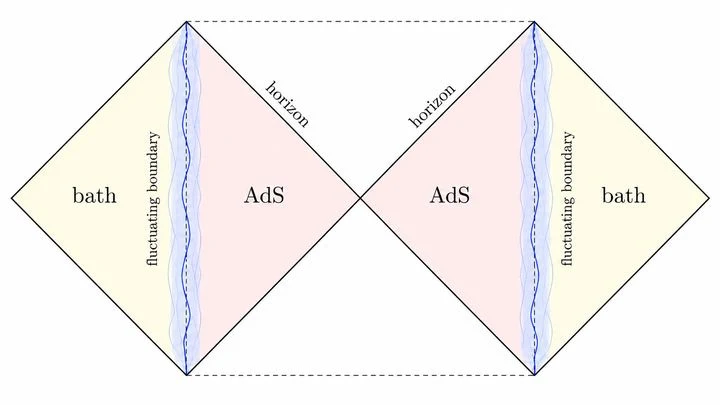
A black hole that has almost stopped consuming matter is like a kettle coming to a boil: calm on the outside, but seething with invisible processes within. Physicists have peered into this boundary world, where space and time no longer follow the familiar rules.
They have described everything that happens right at the horizon: that invisible boundary beyond which even light cannot return.
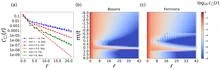
Two actors on the same stage. One is a fermion, finicky and demanding, hard to make follow the rules of a quantum simulator. The other is a boson, easygoing and undemanding, ready to take any role. The director hopes the audience won't notice the substitution.