Quantum black hole thermodynamics extends classical black hole thermodynamics by incorporating quantum field theory effects. It describes black holes as thermodynamic systems with temperature (Hawking radiation), entropy (proportional to horizon area), and other state variables, while also addressing puzzles like the information paradox and the microscopic origin of entropy. This framework connects gravity, quantum mechanics, and thermodynamics, offering insights into the nature of spacetime at the quantum level.
History
The foundations were laid by Jacob Bekenstein in the 1970s, who proposed black hole entropy, and Stephen Hawking, who derived black hole temperature in 1974. Subsequent developments include the holographic principle and string theory calculations of microstates.
How it works
Near a black hole's horizon, quantum vacuum fluctuations become polarized, leading to the emission of thermal radiation (Hawking radiation) with a temperature inversely proportional to the black hole's mass. The entropy, given by the Bekenstein-Hawking formula, counts the microscopic quantum states of the horizon. Quantum corrections modify these relations, for example by adding logarithmic terms, and can affect how black holes evaporate or interact with surrounding fields.
In practice
These concepts guide research in quantum gravity, including attempts to resolve the information paradox, and are used to model black hole evaporation and its potential observational signatures in gravitational wave data.
Fun fact
A black hole with the mass of the Moon would have a temperature of about 0.001 kelvin, colder than the cosmic microwave background, so it would absorb more radiation than it emits.
A black hole is a maze with no way out. But what happens to the information inside? To test this, physicists didn't fly to the nearest hole; instead, they built a tiny replica on a quantum processor. The maze was played by a chain of 32 superconducting qubits, where each step leads only forward, like a one-way corridor.
Drop a pebble into a pond, and ripples spread across the water. Something similar happens when a black hole merges with another: it emits gravitational waves that resemble the fading ring of a bell.
A black hole is not silent. When perturbed, it rings like a bell, and that ring is its quasinormal modes — damped oscillations. Physicists delved into the world of charged black holes in anti-de Sitter space (a universe with negative curvature, like a saddle).
A black hole is not just an abyss where everything falls. Right at its horizon, in the so-called quantum atmosphere, a faint glow is born — Hawking radiation. This is not calm light but a churning stream of particles that can influence the most delicate quantum connections.
For a long time, the event horizon behaved like a cosmic dictator: everything that crossed its boundary vanished irretrievably from our Universe. But quantum mechanics, like a dissident's voice, whispered: information cannot simply disappear.
A black hole is like a perfectly dark room: from outside, you can't see what's inside, and anyone crossing the threshold seems to vanish from the outside world. But what does the falling observer feel? In classical physics, nothing special: the event horizon isn't marked by any signpost.
A black hole is not a dead object. After a disturbance, such as merging with another hole, it rings like a bell. This ring is not just a sound but a complex set of damped oscillations called quasinormal modes. Their frequency and damping rate depend on the hole itself: its mass, charge, and spin.
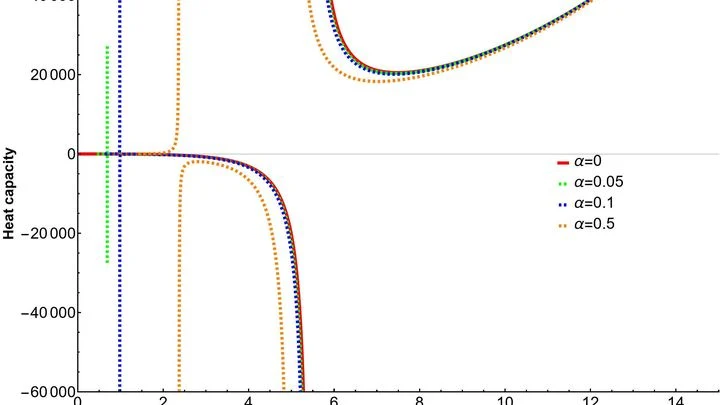
A classical black hole has a temperature and other thermodynamic properties. When physicists began accounting for changes in the cosmological constant, the energy of empty space, a strange coupling emerged in the equations.
Black holes can emit heat. They have a temperature, entropy (a measure of disorder), and other thermodynamic properties. Usually, to compute these, you first have to construct the black hole itself — solve the complicated equations of curved spacetime.
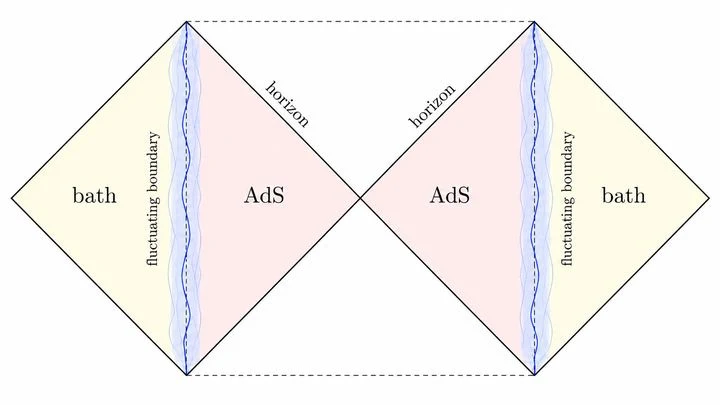
A black hole is not an eternal vacuum cleaner. It slowly evaporates, radiating energy, and along with it, as physicists believe, it should return the swallowed information. But when exactly does that start happening? The answer is given by the so-called Page curve — a graph that shows how much information the hole has already released and how much it still holds inside.
A black hole is not just a cosmic vacuum cleaner. It is a region with such strong gravity that even light cannot escape it. But place it in a perfect fluid of dark matter and add a cloud of strings, thin filaments stretched across all of space, and the picture gets more complicated.
An ordinary black hole is like a stove that heats up more as its mass shrinks. A tiny hole should glow at unimaginable temperatures and evaporate in an instant. But that scenario ignores quantum corrections — what happens when the very fabric of spacetime begins to tremble.
When a massive star runs out of fuel, its core collapses under its own weight. A black hole forms — a region where gravity is so strong that even light can't escape. For a long time, it was thought that a point of infinite density, a singularity, lurks at the very center.
A black hole, perturbed by a merger, vibrates at characteristic resonant frequencies — much like a bell ringing after being struck. Each hole has its own spectrum of these oscillations, allowing astronomers to reconstruct its parameters.
A hot chain of atoms lined up in a row behaves like a tiny black hole. Such a chain is a series of particles, each resembling a tiny magnet. At normal temperatures, the little magnets flip randomly, but when cooled, they align in a uniform order. Physicists have discovered that when heated, this simple system reproduces the strange properties of black holes.
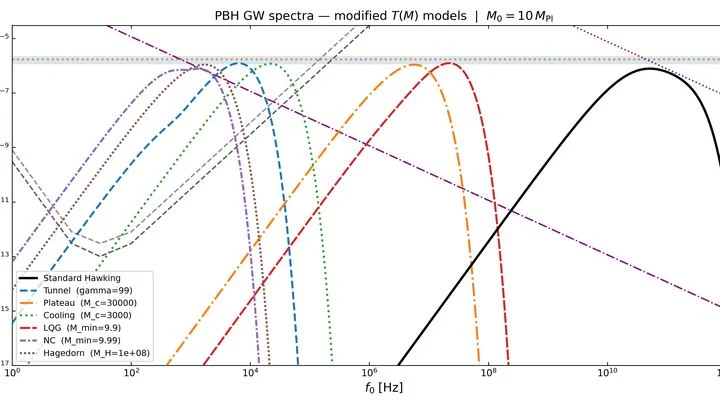
Primordial black holes behave like boiling kettles: as they evaporate, they whistle gravitational waves. The character of the whistle, its spectrum, depends on how the hole's temperature relates to its mass.
A black hole isn't completely black. From its horizon, a faint thermal glow constantly seeps out, like steam rising from a cooling cup of tea. The temperature of this glow depends on the strength of gravity at the surface.