Energyflux measures how much energy passes through a unit area per unit time. In physics, it is a way to quantify the intensity of energy transfer—whether carried by light, sound, particles, or electromagnetic fields. The concept is essential for comparing the power of different sources, such as particle beams, radiation from celestial objects, or ultrasound waves, because it normalizes energy flow to a standard area.
History
The concept has roots in the 19th-century development of the Poynting vector for electromagnetic energy flow, but the general term 'flux' was formalized in continuum mechanics and field theory in the early 20th century.
How it works
Energyflux is calculated as the energy passing through a surface divided by the area of that surface and the time interval. For a beam of particles, it depends on the number of particles per second, their individual energy, and the cross-sectional area of the beam. For waves, it relates to the amplitude and frequency. In practice, measuring flux involves placing a detector of known area and counting the energy it absorbs over time.
In practice
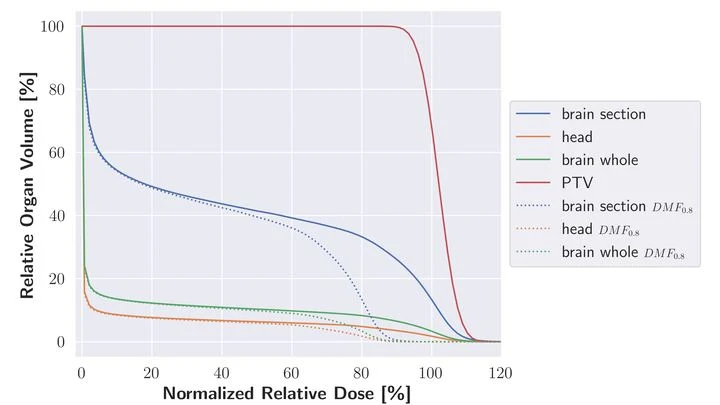
It is used to compare the power of particle accelerators, to calibrate radiation therapy doses (as in the article about electron beams against brain tumors), and to analyze energy transport in plasma physics and astrophysics.
Fun fact
The energyflux of sunlight at Earth's orbit is about 1,361 watts per square meter, a value known as the solar constant.
Units by system: SI: wm2 · CGS: ergs1cm2 · natural: gev2
A vacuum cleaner sucks in dust even if there is more of it near the nozzle. The same happens in a tokamak: plasma particles are drawn toward the center, even though their density is higher at the edge. This phenomenon is called particle pinch, and it contradicts the usual rule that everything tends to move from dense regions to sparse ones.
An assembly line spits out parts one by one per cycle. If the cycle is short and defects are few, the line runs fast. In quantum optics, a single-photon source plays the role of such a line: it must emit exactly one quantum of light per cycle, and the more cycles per second, the more photons go into the fiber.
A sponge slowly watered from a watering can gets soaked all the way through. But if you dump the same bucket of water on it all at once, the middle gets wet while the edges stay almost dry. That's roughly how a material with nonlinear absorption behaves: the more intense the flux, the more it gets stuck at the point of impact.
In the quantum world, particles sometimes behave like acrobats on invisible tightropes. An instanton field is a brief vortex that appears and vanishes in an instant. When a fermion (a particle like an electron) enters such a vortex, its energy does not stay put. Instead, it smoothly slides from one level to another, like a ball rolling down a hill.
A garden hose shoots a thin, powerful jet. If you sweep it across the yard, you can water the whole bed without flooding the path. That's roughly how the new approach to treating deep tumors works: instead of a broad radiation field, you take a narrow beam of electrons accelerated to nearly the speed of light and scan it across the tumor like a jet of water.
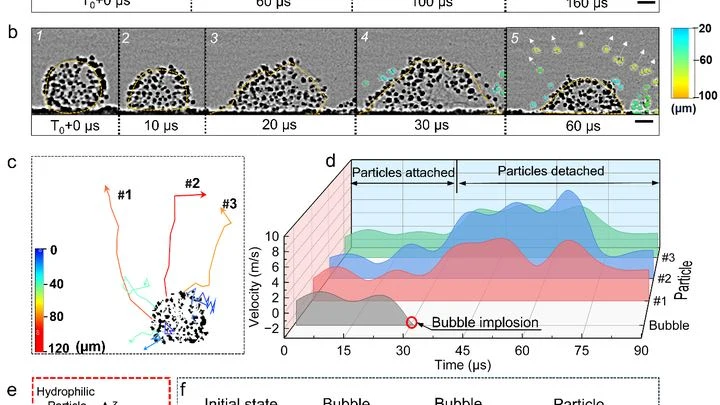
In a glass of water, ultrasound creates tiny bubbles. They grow and shrink, and sometimes they collapse sharply, like a popping soap bubble, but thousands of times faster. Near these bubbles float small particles — for example, nickel spheres the size of dust motes.