How Every Cell Ages: A Journey Through the Methylation Landscape express
DNA methylation consists of tiny chemical marks on our genes. Over the years, they change on a fairly strict schedule. Standard epigenetic clocks look at these marks and output a single number: biological age. But a number can't tell you how the pattern of marks rearranged day by day, year by year. The authors of this work decided to turn a static photograph into a continuous film.
To do this, they collected methylation data from thousands of people of different ages — from infants to centenarians. Then they built a mathematical landscape. Each point in it corresponds to a specific pattern of marks, and age sets the direction of movement. First, a special autoencoder (an algorithm that compresses complex data into a simple map) turned the varied pattern into a compact scheme while preserving the ability to decode it back. Then, an optimal transport model calculated the most natural aging path through this landscape. It accounted for both random walks and the inevitable loss of cells with age.
The most striking result appeared after age 60–70. The rate of random changes jumps sharply. The aging landscape seems to become more 'loose,' and the trajectories of different people diverge more and more. Reverse decoding showed that these divergences are not chaotic. They coalesce into several typical scenarios — archetypes of aging, so to speak. Now they can be studied individually.
Thus, from a static number on a 'clock,' science moves to mapping molecular life. And for the first time, this map has a relief — with accelerations, decelerations, and forks. These are yet to be explored.
Original abstract
as written by the authors arXiv:2607.06583
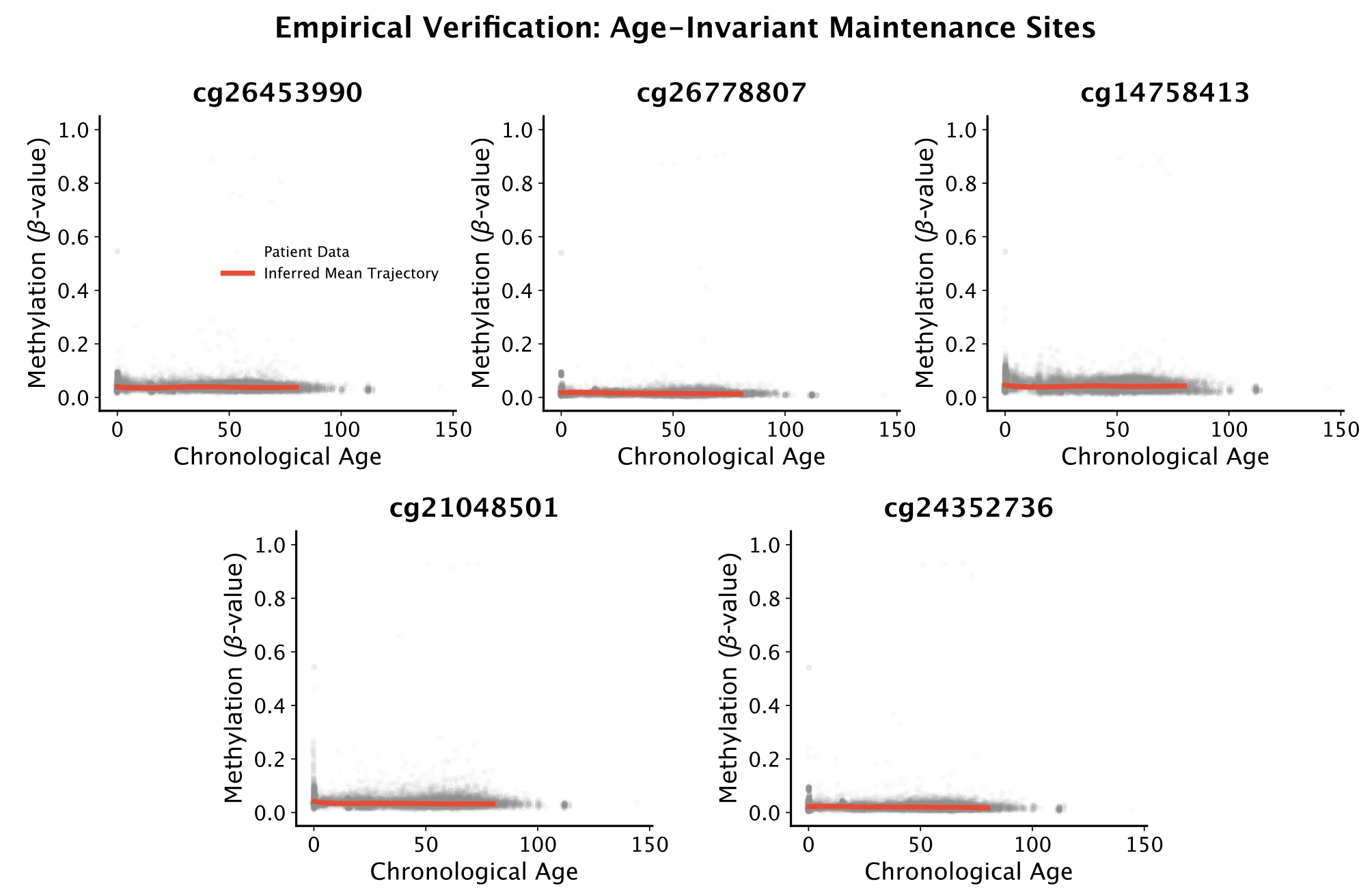
DNA methylation (DNAm) serves as one of the most robust molecular biomarkers of biological aging. While conventional epigenetic clocks accurately predict chronological age from high-dimensional CpG profiles, they treat aging as a static regression task, meaning they can only output a single score rather than simulating how an entire profile continuously changes over time. To reconstruct these continuous dynamics, we frame lifelong human epigenetic aging as a trajectory inference problem across discrete age snapshots derived from widely available cross-sectional data. We introduce a two-stage computational pipeline: first, an age-regularized Variational Autoencoder (VAE) maps high-dimensional CpG profiles onto a chronologically ordered latent manifold while preserving a generative decoder bridge back to the original methylation space. Second, we model the continuous movement across this latent space via Regularized Unbalanced Optimal Transport (RUOT) that unifies deterministic drift, random diffusion, and non-conservative mass changes. By resolving this RUOT formulation using the DeepRUOT framework, our model fluidly accommodates population-level density shifts like survivorship bias and cellular attrition without requiring rigid biological priors. Evaluated on a large-scale, 80-year pan-tissue dataset, our model demonstrates robust distribution interpolation and uncovers a prominent late-life surge in the learned growth field that mathematically captures the variance expansion driven by stochastic epigenetic drift. Finally, by decoding continuous latent paths back to individual CpG sites, we reconstruct and empirically verify distinct biological aging archetypes, offering a rigorous, generative paradigm for simulating human molecular aging.
In newborns, the DNA methylation pattern is almost identical, but by age 80, differences between people become so large that these marks can reliably distinguish one person from another, like fingerprints, but molecular.
In the series 'Altered Carbon,' wealthy people store backup copies of their consciousness on a 'stack' but can't stop the biological shell from aging. The model from this work is a step toward learning not just to measure the shell's wear and tear but to predict and correct its trajectory.