Optimal transport is a mathematical framework that asks a simple question: what is the most efficient way to move a pile of earth (or any mass) from one location to another, given a cost per unit of distance? In more formal terms, it seeks the minimal cost to transform one probability distribution into another, where 'cost' can be defined in many ways—distance, time, energy, or any other metric. This seemingly abstract problem has become a powerful tool across science, because many processes can be framed as moving mass or information from one state to another.
History
The problem was first posed by Gaspard Monge in 1781, and later reformulated by Leonid Kantorovich in 1942, who introduced the probabilisticformulation that made it tractable. Kantorovich's work earned him the Nobel Prize in Economics in 1975. The field saw a renaissance in the 1990s with connections to fluid dynamics and geometry.
How it works
The core idea is to find a 'transport plan' that matches each infinitesimal piece of mass in the source distribution to a piece in the target distribution, minimizing the total cost. This is not a simple one-to-one matching; it's a global optimization problem that can be solved using linear programming or, more elegantly, through the theory of partial differential equations (the Monge-Ampère equation). The solution often reveals a 'geodesic' path between distributions, and the minimal cost itself defines a metric (the Wasserstein distance) that measures how 'far apart' two distributions are.
In practice
It is used in image registration and morphing, economics (matching supply and demand), machine learning (training generative models like GANs), and in physics for modeling granular flows and the evolution of stellar systems.
Fun fact
The Wasserstein distance, derived from optimal transport, is the metric used in the training of Generative Adversarial Networks (GANs), which are responsible for generating realistic deepfakes and AI art.
Two photographers shoot the same mountain. One takes a hundred shots from the summit and only a couple from the base; the other does the opposite. If you try to align their images, the algorithm might decide that the summit in one photo matches the summit in the other simply because there are many similar points there, not because it's the same spot. Sampling density throws it off.
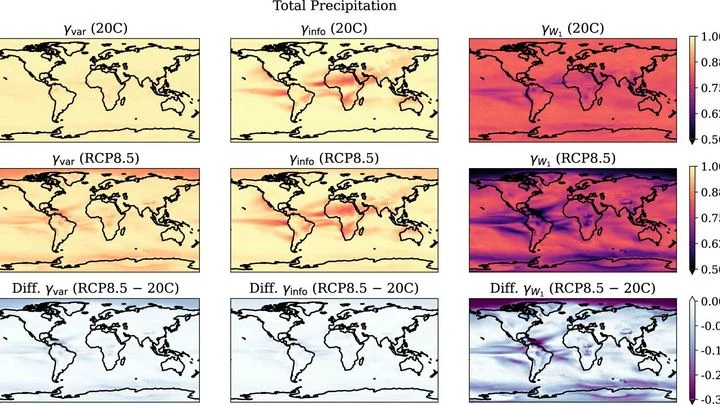
In winter, one part of town gets three times as much snow as the neighborhood next door. One year is a scorcher, the next is a cold snap. That's the whims of weather. But over decades, a different, slow shift emerges: winters, on average, get milder. Telling the two apart is the central challenge for climate scientists.
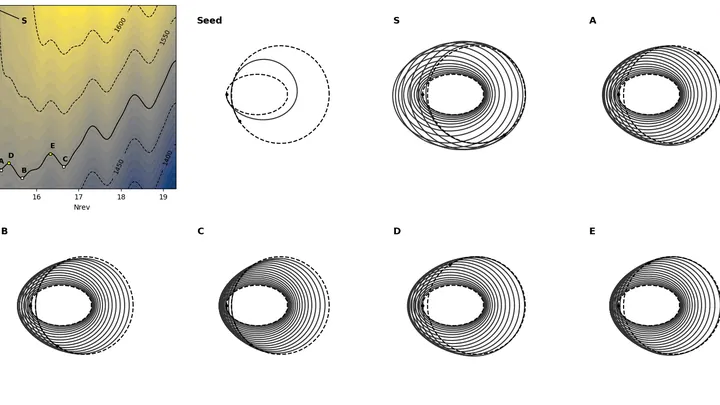
A stellarator fusion reactor resembles an intricately twisted magnetic cocoon. Its job is to confine superheated plasma so that hydrogen nuclei fuse and release energy. But the cocoon's three-dimensional shape creates gaps: some particles escape, especially the fastest ones, which carry most of the heat.
A mountain pass connects two valleys. In one, the protein is folded; in the other, it is unfolded. To get from one to the other, you must cross the saddle — the highest point on the path. In protein science, this point is called the transition state, and the coordinate that shows the distance to it is the committor.
A web where lions eat zebras and hyenas finish the leftovers is not just a list of dinners. It's a survival map for an entire region. When the climate shifts, animals move, and the map tears. To understand where it will tear and where it will hold, you need to find its unchanging 'skeleton'—the connections that repeat across different places.
Inside every cell, logistics is in full swing: tiny protein motors, like couriers, haul cargo along a network of microtubules. One of the main workhorses is kinesin, which steps using the energy of ATP (the cell's main energy currency). For a long time, researchers tried to evaluate it like a car: how much fuel it burns, how fast it gets there.
The power grid is often compared to a water supply: current flows like water under pressure. Electric vehicles here are powerful pumps, capable not only of pumping water (charging) but also pushing back when needed, evening out the pressure. The trouble is, solar panels generate energy in surges, like a pump that gulps and then blasts with double force.
A person in a boat turns by shifting their body weight. An unmanned vessel uses the same trick: a sliding weight inside the hull does the steering. Its movement is controlled by a neural network, anticipating the chaos of waves and gusts of wind. The propeller pushes the boat forward, while the weight shifts balance — like moving from one foot to the other.
Every civilization is born with a gravitational debt. The home planet's mass determines the loan amount, and the Tsiolkovsky equation is the interest rate applied to each kilogram of payload. To send a probe to the stars, you have to pay with fuel, and the debt grows exponentially.
A space tug with an ion engine accelerates slowly, but it sips fuel. To get from one orbit to another, you have to solve a tricky problem: how long to fire the engine and where to point it. Usually, the goal is to find the fastest transfer for a given spacecraft mass.
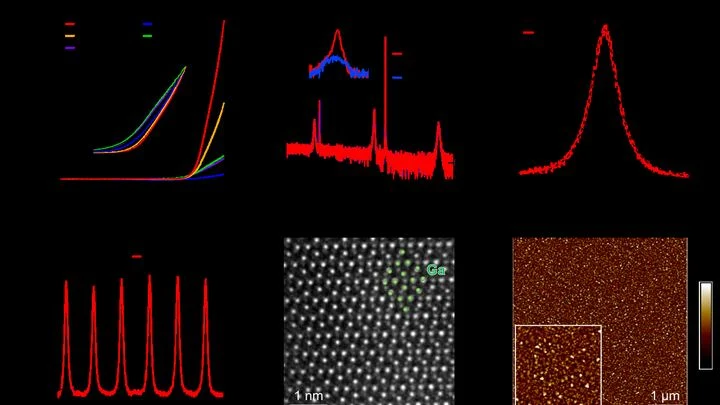
An ionic conductor resembles a crowded bus where passengers (ions) try to squeeze toward the exit. Previously, it was thought that fast exit could be achieved either by a gently swaying bus (soft lattice) or by passengers standing in chaotic order (geometric disorder). The new work shows these are not two different tricks but the same one.
In 1958, Philip Anderson showed that strong disorder can stop a wave. Since then, physicists have discovered that between complete stoppage and free travel there are intermediate regimes. A particle can not only stand still or fly, but also jitter in place, pulse, or combine several types of motion at once.
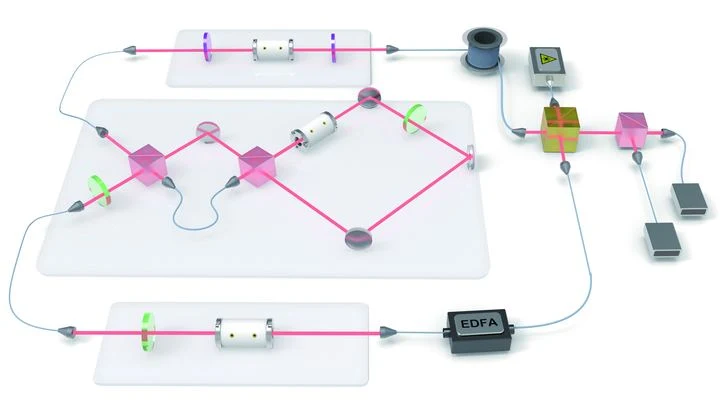
An orchestra plays without a conductor, and you hear the tempo speeding up and slowing down. All you have is a recording of the sound, not the score. Can you tell from that recording which string to pluck to make the whole orchestra play more steadily?
A city is a living system: it consumes resources, produces waste, and its 'circulatory system'—the road network — delivers people and goods to their destinations. But while engineers design transport arteries as rigid geometry of straight lines, nature has spent millions of years perfecting ideal distribution networks.
Imagine a river that doesn't flow in an open channel but through the inside of a sponge, with its currents shifting from place to place. That's a good way to think about the brain's glymphatic system: a network of ultra-fine channels around blood vessels, through which cerebrospinal fluid seeps into the tissue and washes away the waste that has piled up during the day.
A drop of cream falls into a cup of coffee, and within a minute, the entire drink turns beige. This mixing process can be quantified: how much "stirring" is needed to transform one distribution of particles into another? In mathematics, this approach is called optimal transport, and the measure of effort is the Wasserstein distance.
The authors applied this idea to quantum systems.
Gas falls onto a neutron star — the ultra-dense remnant of an exploded star. This gas accumulates at the magnetic poles and forms a mountain. But a mountain on a neutron star is not like one on Earth: it is held not by rock but by magnetic field lines, like iron filings on a magnet.
When there is too much gas, the mountain begins to break apart.
A rock knocked off one planet by an asteroid impact hurtles through space and lands on another. If microbial spores are hiding inside, they might survive the cold, the radiation, and the rough landing. That's panspermia — the idea that life travels between worlds. But imagining such a journey is one thing; calculating every step is quite another.
An optical tweezer is a beam of light that holds and moves tiny objects like bacteria or dust grains. If you need to carry a particle from point A to point B, you could simply pull it straight there. But that would consume more energy than a cleverly chosen detour.
An active particle is a microscopic object that propels itself forward, like a tiny swimmer.
A cell is a city with gates. Each gate is a protein channel in the membrane: through it, ions, sugars, and signaling molecules pass in and out. Some gates are almost always open, while others open and close randomly, like subway doors that let a passenger through one moment and slam shut in their face the next.
A baker who never tastes the dough and only looks at the color of the crust is unlikely to bake perfect bread. Materials science has long been similar: automated setups could churn through hundreds of variants but didn't understand why one recipe was better than another.
A bacterium in a drop of water is looking for food. Around it, there's a chemical gradient: more food molecules on one side, fewer on the other. How should it move to reach the tasty spot fastest? It could steer smoothly, like a cyclist dodging a puddle. Or, like a bacterium, it could periodically stop, tumble, and swim off in a random direction.
A city can be studied in different ways: one person maps the streets, another tracks traffic flows, and a third maps population density. The maps don't match, but they describe the same place. A similar problem arises when biologists look at a cell through different instruments: one shows its shape, another the distribution of proteins inside. We need to understand how these data are related.
Paraglider, hang glider, and glider — three different wings, but in the sky they behave the same. Pilots catch invisible warm air currents, rise on them, then glide to the next. Such flight is like a game of hopscotch: a jump upward, then a glide forward, and again a search for a place to jump.
Scientists analyzed thousands of real routes and found a common law.
A postal money order doesn't arrive instantly but after a set delay, and the amount credited to the recipient's account ends up larger than what the sender deposited in cash. That's roughly how the new protocol, dubbed temporal quantum energy teleportation (TQET), works.
In ordinary quantum energy teleportation, two parties, Alice and Bob, share a common quantum state.
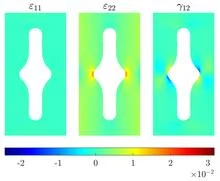
A mechanical testing lab is like a kitchen where a chef tastes a dish to guess the recipe. For an anisotropic material, one that is stiffer along its fibers than across them, a single taste is not enough. You need three or more separate tests, each with its own specimen. Engineers have spent years refining specimen shapes by hand, relying on intuition and experience.
An orchestra without a conductor plays a complex piece. The listener hears the overall music but wants to understand who leads the melody and who merely echoes it in unison.
The puppet master pulls the strings, and the marionette dances. In forecasting the future from time series, the puppet masters are the few variables that truly control the system. The rest merely echo their movements, creating an illusion of complexity. The challenge is to find these puppet masters and watch only their fingers, not the whole stage.