Cancer is a class of diseases characterized by uncontrolled cell growth and division, often driven by mutations in genes that regulate the cell cycle, DNA repair, and programmed cell death. These mutations accumulate over time, turning normal cells into malignant ones that can invade surrounding tissues and spread to distant organs—a process called metastasis. The disease is not a single condition but a family of disorders, each with its own genetic signature and behavior, which is why treatment and prognosis vary widely across cancer types.
History
The term 'cancer' comes from Hippocrates, who used the Greek words 'karkinos' (crab) and 'karkinoma' to describe tumors, around 400 BCE. The modern understanding of cancer as a genetic disease emerged in the 20th century, with the discovery of oncogenes in the 1970s and tumor suppressor genes in the 1980s.
How it works
At the cellular level, cancer begins when mutations activate oncogenes (which promote growth) or disable tumor suppressor genes (which normally restrain growth). This disrupts the delicate balance of signals that tell cells when to divide, differentiate, or die. As cells divide, they acquire further mutations, leading to a heterogeneous tumor population—a kind of evolutionary tree where different branches have different properties. Some mutations enable cells to detach from the primary tumor, travel through the bloodstream or lymphatic system, and colonize new tissues, forming metastases.
In practice
Cancer research drives the development of targeted therapies, immunotherapies, and diagnostic tools such as liquid biopsies, which detect tumor DNA in blood samples. These technologies are used in oncology clinics worldwide to personalize treatment and monitor disease progression.
Fun fact
The word 'cancer' is derived from the Greek word for crab, because Hippocrates thought the swollen veins around a tumor resembled crab legs.
Stated relations:follows from →mutation · part of →gene · part of →cell
The brain is like a city where every cell is a resident, and its fate depends on its neighbors. It used to be thought that the aging of each cell was its own private business: DNA damage accumulated, so the cell wore out on its own. But a new study shows that even a cell's ability to repair its DNA depends on who lives next door.
A tightly stretched membrane, squeezed into a narrow case, decides on its own where to burst. So does a cell: when it is cramped, the point of division shifts from the middle, and the two halves come out unequal. Previously, it was thought that such asymmetry is predetermined by chemical labels, but the new work shows that mechanics alone is enough.
The orchestra starts playing, but each musician has their own tempo. If everyone plays at roughly the same speed, the music flows in a continuous stream. But if one group of instruments plays noticeably slower than the rest, the sound gathers into a dense clump that slowly moves forward.
In an orchestra that has been playing the same symphony for years, the musicians gradually start to drift: each one plays on their own, yet the notes remain the same. That is roughly what happens to cells as they age. Scientists have come up with a way to measure this discord, that is, how faithfully each cell follows the shared program of gene expression.
A forensic examiner arrives at a crime scene and lifts fingerprints. Epigenetic clocks work the same way: from chemical marks on DNA they determine how much a cell has aged. A tumor leaves its own "fingerprints," and almost always they point to decrepitude.
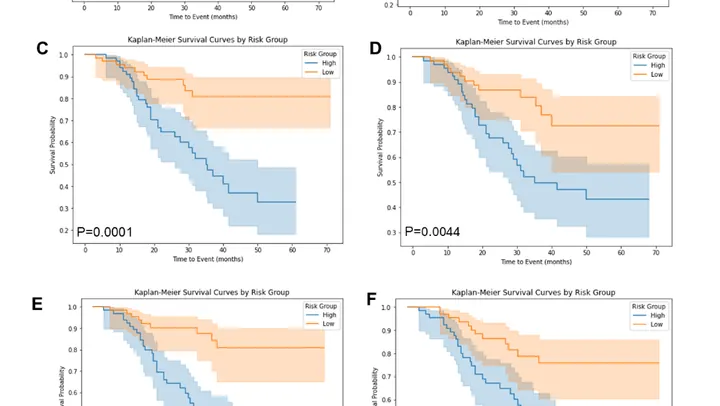
The researchers took 5528 samples from the TCGA database, which holds DNA methylation data for eight cancer types.
Cells have power plants: mitochondria, which generate energy. But when a cell turns cancerous, those plants start working for the tumor, helping it divide without restraint. Researchers took ordinary turmeric, the familiar yellow spice, and attached a chemical "address" that makes it accumulate specifically in mitochondria.
A Greenland shark swims through cold water in its fourth century, and with every passing year its odds of dying do not rise but fall. This is not a miracle, but the result of an evolutionary trade-off that has so far eluded theory. An organism is like a family budget that cannot be spent twice: every unit of energy can go into reproduction, growth, or body repair.
Imagine someone hauling two sacks up a hill. One is stuffed with sugar the body cannot process. The other is filled with the years the body has lived faster than the calendar. While the sacks are light, the climb is manageable. But if both are filled to the brim, the legs give way, and the person collapses not with one disease but with several at once.
Picture a muscle's control panel where buttons are removed with age. First to go are the buttons that handle hormone response, then those that kick off recovery after exercise. Researchers studied cell nuclei from vastus lateralis muscle biopsies from 287 donors aged 20 to 79 and saw exactly how these buttons disappear at the level of DNA packaging.
A mail carrier delivers letters along one-way streets. As long as he only drives forward, the route is simple and predictable. But if U-turns are suddenly allowed, he'll start doubling back, crossing his own tracks, and the delivery pattern gets tangled. That's roughly how an infection behaves when people can get sick more than once.
Every tumor writes its own cosmology. Its cells are galaxies, and mutations are stellar flares marking the branches of a genealogical tree. The key to its history is the rhythm of accumulating genetic typos.
Forget the flat sheet: embryonic tissue is a dynamic landscape of hills and folds. On convexities, cells stretch; in concavities, they compress, as if performing a dance governed by laws eerily similar to spacetime curvature.
DNA methylation consists of tiny chemical marks on our genes. Over the years, they change on a fairly strict schedule. Standard epigenetic clocks look at these marks and output a single number: biological age. But a number can't tell you how the pattern of marks rearranged day by day, year by year. The authors of this work decided to turn a static photograph into a continuous film.
Inside every cell, a complex network of genes determines what it will become — a nerve cell, a muscle cell, or part of the skin. This choice often resembles flipping a toggle switch: two stable positions, and the cell decides which way to tip. But cells have a feature rarely considered in such models: they divide.
A crowd in a city square behaves differently depending on whether people hold hands. If each person only lightly touches a neighbor's elbow, people easily spread out in all directions — the crowd expands as a smooth carpet. But if they interlock fingers, movement slows down and the crowd breaks into clumps: dense clusters form here and there, with empty corridors between them.
A tongue tumor is like a stranger in a crowd. On the surface, they all look much alike, but beneath the surface hide very different personalities. Some tumors behave aggressively, others grow slowly. Doctors need to understand who they're dealing with before surgery.
Usually, this means taking a tissue sample — a biopsy.
The microbial community in the gut is like an orchestra: what matters is not only the musicians but how they play together. When disease strikes, it's not just the lineup of microbes that changes: their interconnections shift too. Researchers built interaction networks of microbial genes in healthy and sick individuals.
PET/CT is like a map where cancer cells light up as bright spots. But what if the map is blank and the disease is still hiding somewhere? In 132 men with recurrent prostate cancer, doctors found no glowing lesions, but they decided to study the texture of the scan itself, like an experienced tracker noticing bent grass where an animal has passed.
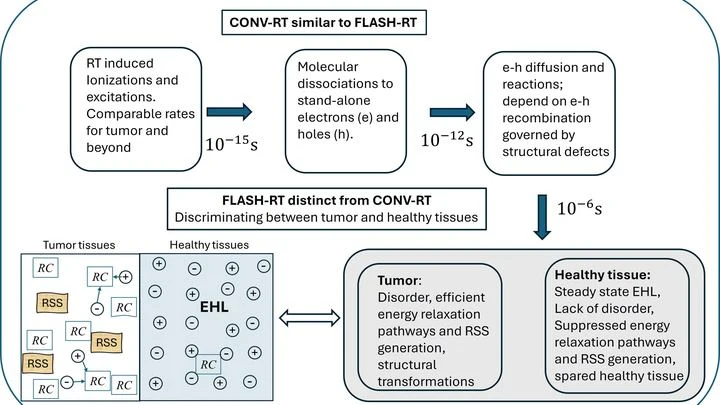
Two cities: one with neat, straight streets, the other with a tangle of alleys. If you send a powerful flood of water through both, in the first the water quickly drains away through channels, while in the second it swamps everything. That's roughly how tissues behave under ultrafast radiation therapy, known as FLASH.
A lightning bolt strikes an anthill. Some ants die instantly, some freeze, and a few days later the survivors start rebuilding the tunnels. That's roughly how a tumor behaves after electroporation — a method where short electric pulses are passed through tissue to poke holes in cancer cell membranes and kill them.
When you cut your finger, skin cells start working in concert: some divide, others crawl toward the wound, and still others pause. But exactly how a cell decides what to do next depends on its internal "schedule"—the cell cycle.
A tumor doesn't stay put. Individual cells or whole groups break off and set off on a journey through the body. Some crawl solo, like scouts; others stick together, like a flock. Scientists built a computer model to understand how these cells pick a direction.
In the model, cells respond to two signals.
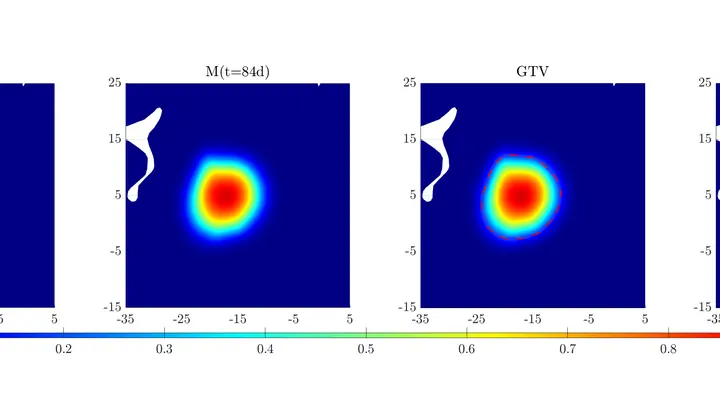
A brain tumor is like a traveler trudging through a dense forest: trees and bushes are the different types of brain tissue, some easier to traverse than others. Glioma cells don't move in a straight line; they constantly loop around, bumping into obstacles and going around them.
Glioblastoma, a brain tumor, is a tricky foe: in some patients, the drug temozolomide works, while in others it barely helps. The difference often lies in a small stretch of DNA — the MGMT gene. If this region is chemically switched off (methylated), the tumor is worse at repairing its cells, and the drug hits harder.
A glass of water and a glass of jelly look the same but behave differently. So it is with prostate tissue: on a standard slide under a microscope, you can see both the tumor glands and the supporting connective tissue around them. Previously, pathologists focused only on the glands, treating the support as mere background.