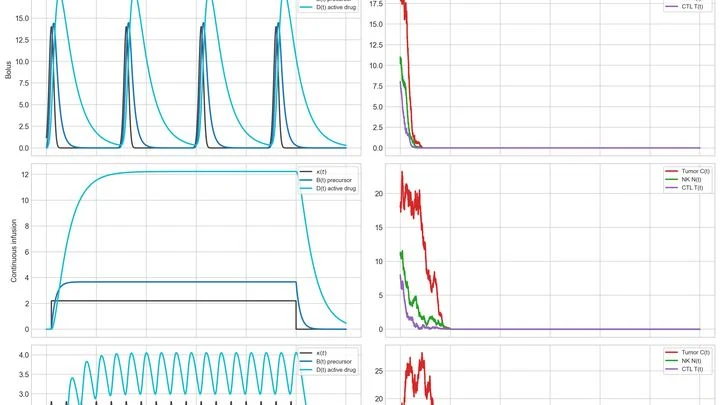
Stochastic processes are systems whose behavior is inherently random, meaning that even with complete knowledge of the current state, the future is not fully determined. Instead of predicting exact outcomes, physicists describe these systems using probability distributions and statisticalaverages. Stochasticity appears everywhere in nature: from the jitter of a dust particle in water (Brownian motion) to the noise in electronic circuits and the fluctuations of stock markets.
History
The mathematical foundation of stochastic processes was laid by Louis Bachelier in his 1900 thesis on the theory of speculation, and independently by Albert Einstein in his 1905 paper on Brownian motion. The term 'stochastic' itself was coined by the mathematician Jerzy Neyman in the 1930s.
How it works
A stochastic system evolves through a sequence of random events. Mathematically, it is often modeled by adding a random 'noise' term to the equations of motion, leading to a Langevin equation or a Fokker-Planck equation for the probability distribution. The key insight is that while individual trajectories are unpredictable, the ensemble behavior — the average over many realizations — follows smooth, deterministic laws. This allows physicists to make robust predictions about the statistical properties of the system, such as its mean, variance, and correlationtimes.
In practice
Stochastic models are used in financial risk assessment, climateprediction, quantum measurement theory, and the design of error-correcting codes for communication systems.
Fun fact
The random noise in a resistor, called Johnson-Nyquist noise, is a stochastic process that sets a fundamental limit on the sensitivity of all electronic amplifiers.
Write down a recipe, then check it an hour later: if the proportions are off by even a gram, the taste is gone. Chemical reactions in open systems behave much the same way: the slightest difference in initial concentrations grows over time into completely different states.
Chemotherapy hits cancer like a powerful spray on a dirty plate: the stream washes away almost everything, but crumbs remain in the cracks. Old models said that if you make the pressure strong enough, the plate becomes perfectly clean. New work shows this isn't so.
A light switch clicks, and the light comes on. But imagine a switch that, with the same press, can either turn on the lamp or leave the room dark. It also remembers what it did last time, and sometimes it seems to flip a coin to decide whether to light up.
This kind of behavior was found in a crystal of black phosphorus — a semiconductor just a few atomic layers thick.
A hundred thousand stars in the dense core of a globular cluster move like steel balls in a giant pinball machine. Each 'bump' — a gravitational encounter between a binary system and a single star — triggers a cascade of unpredictable events.
Two gardeners haggle over water from a magical well. One proposes how many buckets to take, the other can agree or refuse. If the deal goes through, the water decreases; if not, the well gradually refills. This haggling repeats hundreds of times, and the gardeners' habits sometimes change randomly, as if they're trying new tactics.
A stable system behaves like a ball in a bowl: give it a push, and it rolls back to the bottom. The spread of possible trajectories, uncertainty, shrinks over time. But the speed depends on the slope of the bowl's walls. In complex systems, this 'bowl' has sections of varying steepness.
Technological disasters like Chernobyl rarely strike without warning. They gestate for years: organizations ignore warnings, their complexity mirroring the rise of entropy — a measure of relentless chaos that builds up unnoticed until it avalanches.
A crowd at a metro station during rush hour. Some hurry toward the escalator, others slow down at the departure board, still others weave around a column. Each step is not merely a reaction to what's right in front of your nose. A person estimates in advance where a neighbor will be a second from now and adjusts their route accordingly. Physicists call this forward-looking behavior anticipatory.
Every morning you pick up the same mug, but the coffee tastes either bitter or just right. It's not about the coffee, and not about your character. Inside us, an invisible panel with dozens of sliders is constantly shifting: fatigue, hunger, anxiety, hormone levels.
In a football stadium, the crowd's emotions arise from the chatter of individual fans. If mood could be both joyful and sorrowful at once, you'd have a quantum superposition. But the murmur of thousands of voices instantly forces that blend into a single definite state.
A crowd of people suddenly starts moving as one. In physics, this happens with atomic spins — tiny magnetic arrows. When many spins come together and interact through a shared medium, they form one big magnet, or a macrospin. This macrospin doesn't just point in one direction; it can get stuck in several positions, like an ice cube that refuses to melt even when it's warm.
A coin toss seems random, but in reality, physics decides everything: the force of the throw, air resistance, the surface's elasticity. If you knew all the details, you could predict the outcome. True randomness lives deeper — in the quantum world.
A solar panel on a roof produces little current in the morning, a lot at noon, and stays silent at night. Wind doesn't blow randomly either: it's often stronger in the morning and evening than during the day. Energy providers need to know in advance how much energy will be available in an hour or three, so they can switch on backup plants or store electricity in batteries in time.
Water in a glass settles down once you stop stirring it. Oil in an engine dampens vibrations. It seems viscosity is always about damping. But in some flows, it's the opposite: add friction, and waves start to grow as if from nowhere.
Physicists have found a simple explanation.
The speedometer needle in a car shows how fast the wheels are spinning. The climate system also has rotation, but it is invisible: it happens in state space, where each point is a combination of ocean temperature, the depth of the warm layer, and other parameters.
An old aviation instrument sometimes sticks: the needle catches on the scale and doesn't move, even though the plane is already changing altitude. Engineers found a simple solution: add a slight vibration. The shaking doesn't hinder; on the contrary, it helps the needle break free and show the truth.
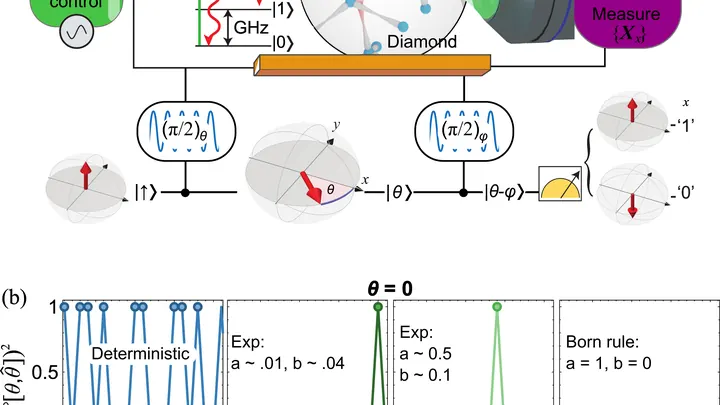
In 1946, Felix Bloch predicted that even without an external magnetic field, a fluctuating magnetic moment exists in an ensemble of spins. It grows as the square root of the number of particles, and in small samples this noise can exceed thermal polarization.