How Particle Knots Rewrite the Rules of Statistics express
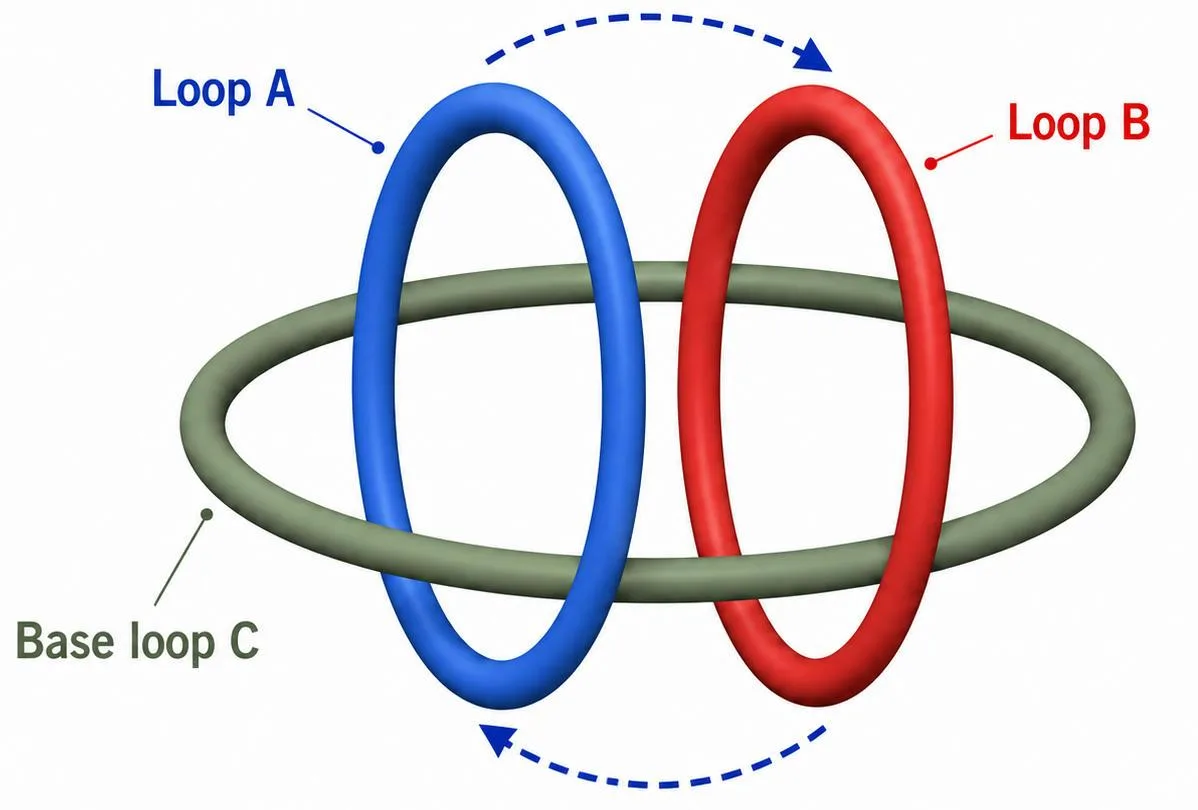
Two threads hang in space. One is looped around the other — physicists call this braiding. For a long time, it was thought that the rules of this dance were rigidly set by the number of dimensions. But the authors of the work found a new maneuver: a special kind of braiding that works in one dimension less than usual.
This maneuver is a repeating operation: wrap one thread around the other, then in the opposite direction, and so on N times. It captures what mathematicians call the "Bockstein response"—something like a hidden signature of space that was previously unnoticed. This process turned out to be a new word in the statistics of topological excitations.
What surprised them was something else: the usual triple braiding of loops in three dimensions doesn't fit into the old classification. To understand it, they had to imagine it as braiding a particle with a loop plus unusual rules for merging loops and point defects. It's as if a knot of ropes, when cut, gave not just two ropes but something with a memory of past entanglements.
Braiding threads in different dimensions is like a dance: in three dimensions you can go around an obstacle, but in two you can only jump over it, and that changes the whole pattern of interactions.
The idea of a warp drive from Star Trek relies on twisting spacetime — similar mathematical knots might one day turn science fiction into blueprints.